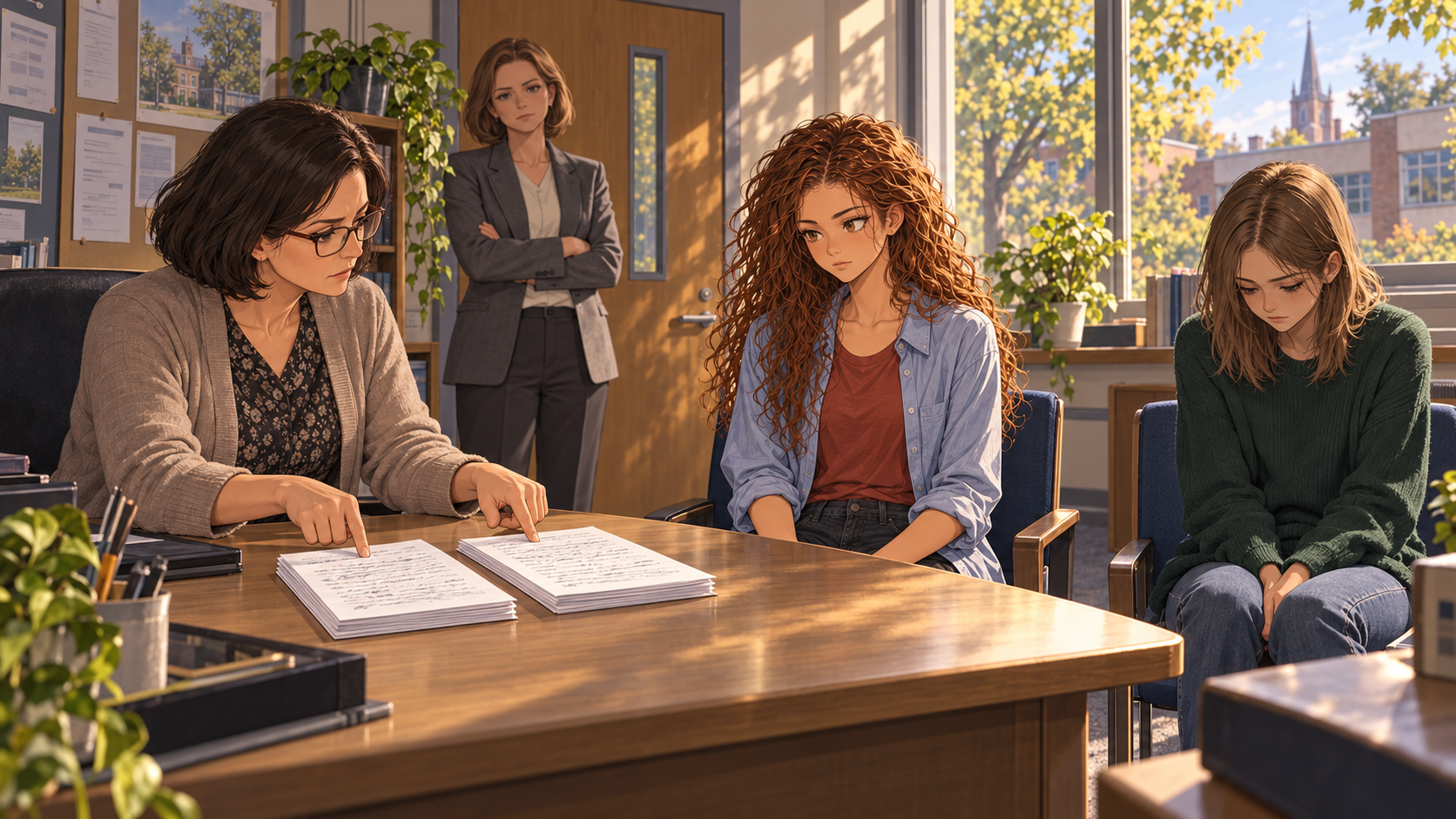
The strongest evidence of the crime was on page three, and it was a single word: happinness.
Mrs Hoffman placed a finger on the word, moved to the stack beside it, found the same page, found the same line, and placed her other finger there. Both hands stayed where they were, one on each sheet.
“Same place,” she said. “Same mistake. Same letter.”
There were too many people in the meeting room: Mrs Hoffman behind the desk, the deputy head standing by the door, and a girl in the chair by the window, looking at her knees. V had seen the girl somewhere. A corridor, the canteen, perhaps the bus queue. One of the B classes. She glanced at the name on the right-hand paper: Martha Weber.
“I don’t understand,” V said.
She hadn’t meant it as a defence. She genuinely didn’t understand, and saying so was a reflex with her; the kind that occasionally got her into trouble, because people generally heard “I don’t understand” as “I don’t believe you.”
“Neither do I,” said Mrs Hoffman. “I’ve been doing this for twenty years. I’ve seen copied essays, summaries, things downloaded from the internet; sentences rearranged, words swapped for synonyms, paragraphs shuffled. All of it. I have never seen this. Six pages. Word for word.”
V looked at the two stacks on the desk. The thing inside her head started working without being asked.
Twenty-six people had been given the assignment. Coming up with the same idea was possible. The same example: unlikely, but possible. Writing the same sentences for six pages and making the same spelling mistake in the same place was something else.
So something had been copied. So one of them had taken the other’s work.
Inside her head, she gave a careless shrug.
I didn’t take it. I don’t know this girl. So she took mine.
V didn’t like the conclusion. Looking at Martha’s face, she couldn’t quite make it fit. Martha wasn’t sitting the way a guilty person ought to sit. She just looked tired.
“I didn’t copy,” V said. Her voice came out calm, and nobody was more surprised by that than she was.
“Neither did I.” Martha had lifted her head. Her voice was thin but steady; she wasn’t reciting something rehearsed, just speaking with the weariness of someone who had already explained the same thing three times. “I wrote my essay last Tuesday. I tidied it up and printed it on Thursday morning.”
“Thursday morning?” said the deputy head.
“Yes. I’d got up early. I had a really bad headache anyway.” Martha rubbed her temple with two fingers, as though the pain were still there. “Something like a migraine. It started at about half past seven and didn’t go away until I got to school. That was when I tidied it up.”
Something very small shifted inside V.
Half past seven.
At seven thirty-four on Thursday morning, Elenie had asked her about the philosophy assignment over the phone. She remembered the time precisely because, on remembering she’d forgotten, she had checked how long she had left. V remembered ending the call. She remembered sitting down at her desk, opening her laptop, the blank page on the screen, her fingers waiting over the keys.
She didn’t remember what came next.
What came next was her mother calling from the stairs. It was eight oh one, and there were six pages on the screen.
“What do you have to say, Vivienne?” asked Mrs Hoffman.
V didn’t answer.
Not answering went against the habit of her entire life. Which was why everyone in the room noticed. The deputy head uncrossed their arms. Mrs Hoffman leaned forward.
“Vivienne?”
“I wrote it.” V raised her head and looked her straight in the eyes. “On Thursday morning. Between half past seven and eight.”
Mrs Hoffman was about to say something, then didn’t. She looked at V for a little too long, then glanced away and began straightening the papers on her desk. Nothing needed straightening. The papers were already straight.
V knew the habit. People would get caught on something in her eyes, then suddenly find something to do with their hands. When she was little, she’d thought it meant she had the upper hand. Now she just disliked not knowing what they saw there.
“I’m putting a note on both your records,” Mrs Hoffman said at last. “I won’t mark these essays. You’ll both receive a zero. I’ll give you a new topic, and you’ll write that assignment here at school, where I can see you.” She stood. “And if one of you ever tells me how this happened, I will be a very happy woman.”
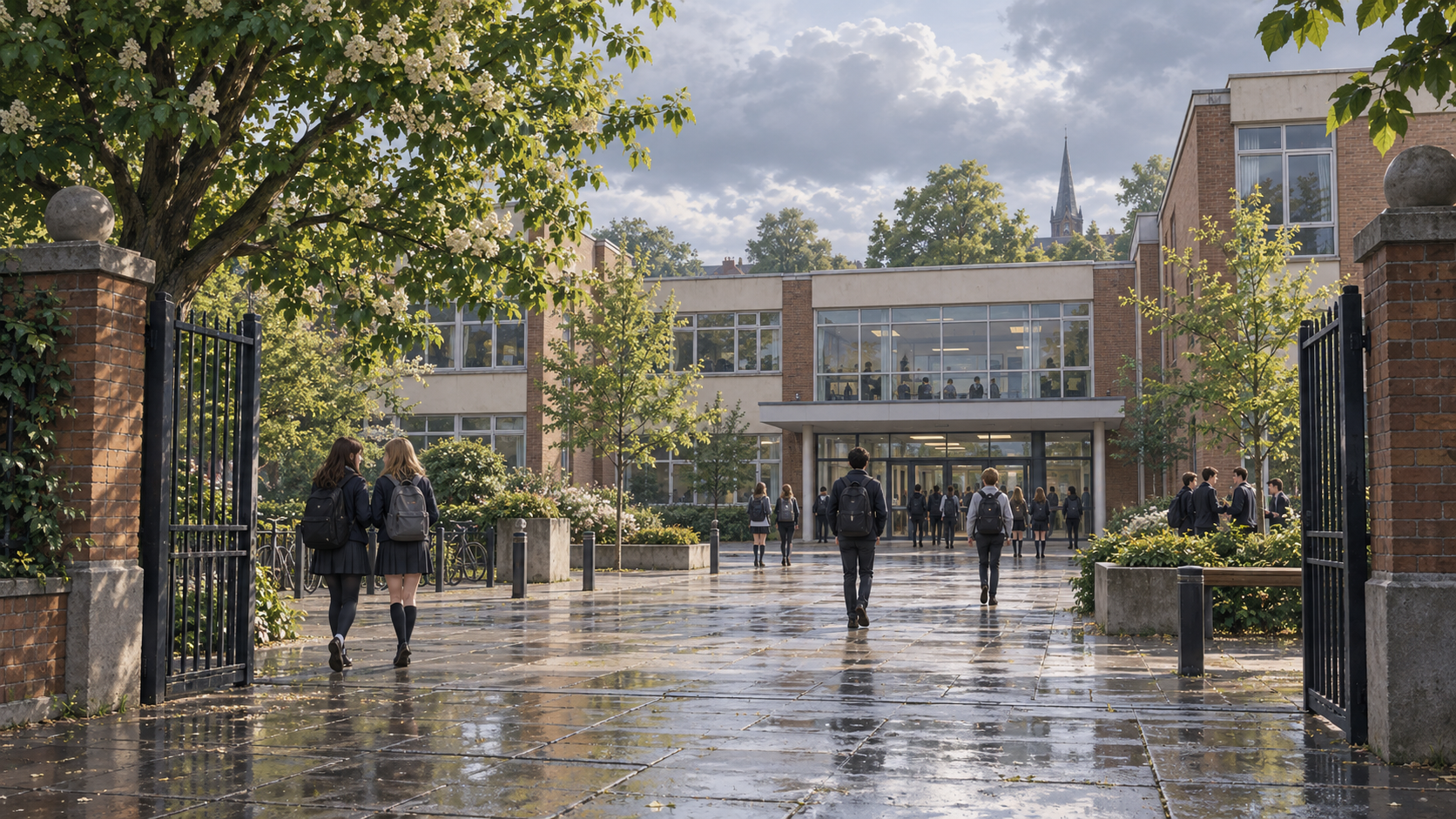
Out in the corridor, once the door had closed behind them, Martha hung back a step.
“Look,” V began, “I really didn’t…”
Martha turned to her. And there, for less than a second, the guarded look fell from her face; her pupils widened a little, and her gaze caught inside V’s eyes, as though she’d found something worth reading there.
Then she came back to herself and took a step away.
“I know,” she said. It wasn’t the steady voice from a moment ago. It was quieter, more surprised. “I know you didn’t copy. I don’t know how I know, but I do.” She grimaced, as though she’d heard how that sounded. “Never mind. See you.”
She adjusted her bag strap and left.
V stood there for a while.
She knew what to do first. She’d been doing it for years. Take the strange thing that had happened, stick a label on it, put it on a shelf. Stress. Coincidence. Lack of sleep. Reflexes. Her mind playing tricks. Luck. She had an extensive collection to hand, and every odd thing she could remember was sitting on the shelf inside her head, neatly labelled.
Then she realised the second thing, and it was worse than the first.
This was the third strange thing to happen to her this month. And they seemed to be coming closer together.
The first had been two weeks earlier.
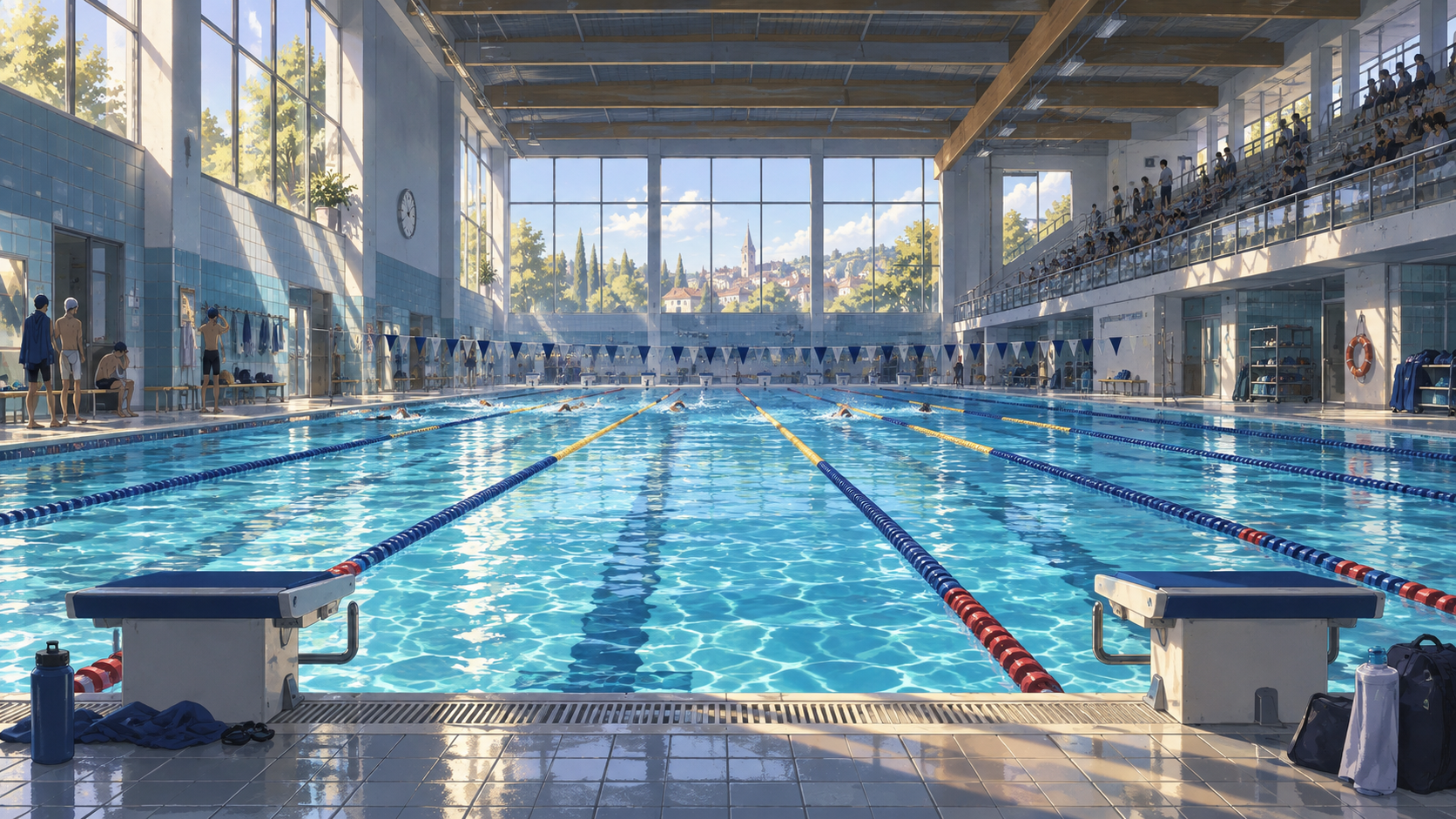
By the final turn, it was over.
She had been swimming for years, and if those years had taught her anything, it was that how you finished a race was decided long before the finish. She fed the strength she’d been saving into her arms. Stroke, stroke, breathe. As she turned for air, she glanced sideways and saw no one, because everyone there was to see was behind her.
All right. This is done.
Then her hand hit something.
First her hand, then her arm, then her shoulder struck something rigid and cold. Momentum flung her legs sideways, cut her stroke in half, filled her mouth with chlorinated water. When she righted herself, she was in the middle of the pool, with nothing in front of her.
She reached out again to find what she’d hit.
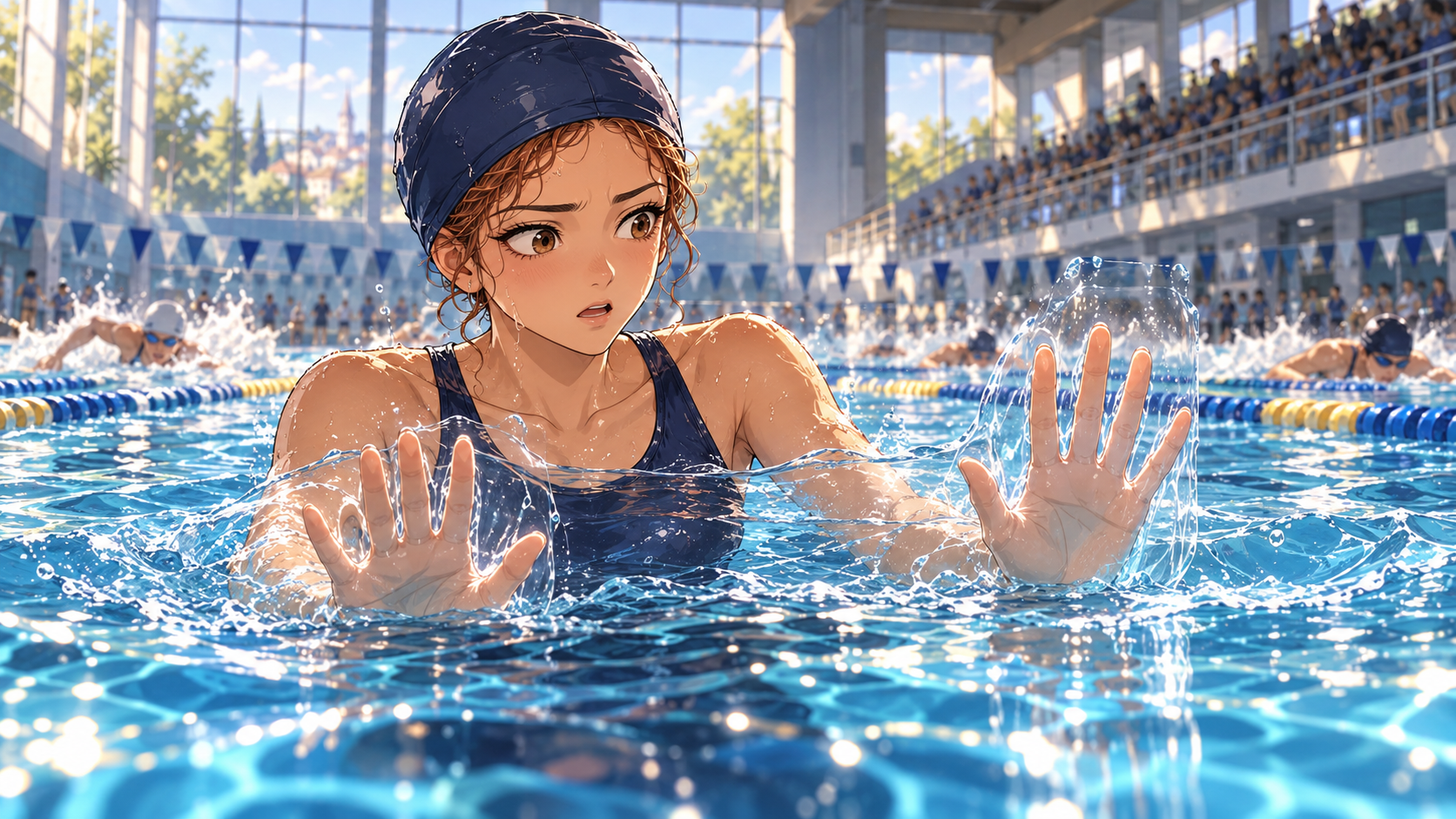
Her fingers met something that looked like water but wasn't. It felt smooth, unyielding, like glass... She kept feeling it, pushed against it, searched for its edges. You couldn’t lean on water. Water didn’t make walls. But the wall was there. She spread both palms and pressed; from outside, it probably looked like she was doing a mime act in the pool.
Somewhere, someone was shouting. Perhaps more than one person. The voices came through a layer of glass.
She searched for an edge. Her heart was beating in her ears instead of her chest. One sentence went round and round in her head: what is this?
She flinched when someone caught her arm.
Her coach had jumped in and was shouting in her face. It was as though someone had suddenly turned up the world's volume. V looked at him, then back at the invisible wall, and laughed.
“Is this a joke?”
She put her hand against it again.
This time, there was nothing but water. She pushed her hand forward. The water gave way, as water was supposed to.
“But…” Her voice sounded weak even to her. “But it was here.”
Only then did she realise the race was over, everyone was watching, and the murmur in the stands had thinned to whispers.
She climbed out, her expression unchanged, and met no one’s eyes. She was known for never losing her temper and never coming off worse, and that was how it would stay.
After her shower, she sat in front of her locker with her bag in her lap and pretended to scroll through her phone. Her finger went up and down the screen, but her eyes read nothing. A little further down, a few girls had gathered around the day’s winner and were laughing. They probably weren’t talking about her; she knew that. But every laugh felt like a small stone thrown at her back.
“Freya, that last fifty metres! What did you do, fit an engine?”
Freya. A swimmer V raced against every year and had never noticed until today. Today, she had taken first place on the podium, while V had performed a mime act in the water. Whoever benefited from an event was clearly responsible for it. V narrowed her eyes at the girl and reached the only logical conclusion the available evidence allowed: this girl had put a spell on her. Ridiculous. But her anger needed somewhere to go, and this was a much better address than “I lost.” The only problem was that every time the girls laughed, the anger grew instead of going anywhere. We’ll meet again, Morgan le Fay.
At that exact moment, something shattered inside the bag on her lap.
A few girls turned. V slowly unzipped her sports bag, as though something might leap out of it. The bottle her mother had bought because “glass is healthier than plastic”, the one she drank from at practice and competitions, was in pieces. Its water had soaked everything: towel, spare cap, spare clothes, maths notebook. All of it was dripping.
The bag hadn’t hit anything. The bottle hadn’t fallen. It had been sitting in her lap. It had burst between her own hands.
Among the shards lay one large piece that looked like glass. It was transparent, but it wasn’t glass; its edges glistened wetly, and its shape didn’t belong to any part of the bottle.
She had just closed her hand around it when a voice overhead brought every one of her demons to attention.
“Nothing’s going your way today, is it?”
Morgan le Fay. The day’s winner, medal still round her neck, craning to look inside the bag, with a softly giggling apprentice witch beside her.
Was that a trace of mockery? She doesn’t know me, V thought. Zipping her bag and getting to her feet, she put on her cruellest smile. Slowly, she brought her face closer to the face of the girl called Freya. She loved using her eyes in situations like this. She locked them on the girl’s and held the look until Freya stumbled backwards into the locker behind her. The metal gave a dull boom. V savoured the look for a second or two. Then she stepped closer and, without losing her mocking expression, gave a small, sudden jerk of her head. “Boo.” Her smile widened. “Shall we introduce ourselves? I’m Vivienne.” Without waiting for an answer, she slung her sodden bag over her shoulder and walked out.
In the corridor, once she was somewhere no one could see, the expression went out of her face. The wet bag was leaving a cold patch through her T-shirt, against her shoulder. She stopped, swung it round and opened it again.
The shards were there. The wet notebook was there. But the large, ice-like piece was gone. She had filled the bottle herself at home. On the eighth of April, water freezing inside it and bursting the glass wasn’t a particularly likely explanation.
For the first time, her label collection had to open two files for a single day.
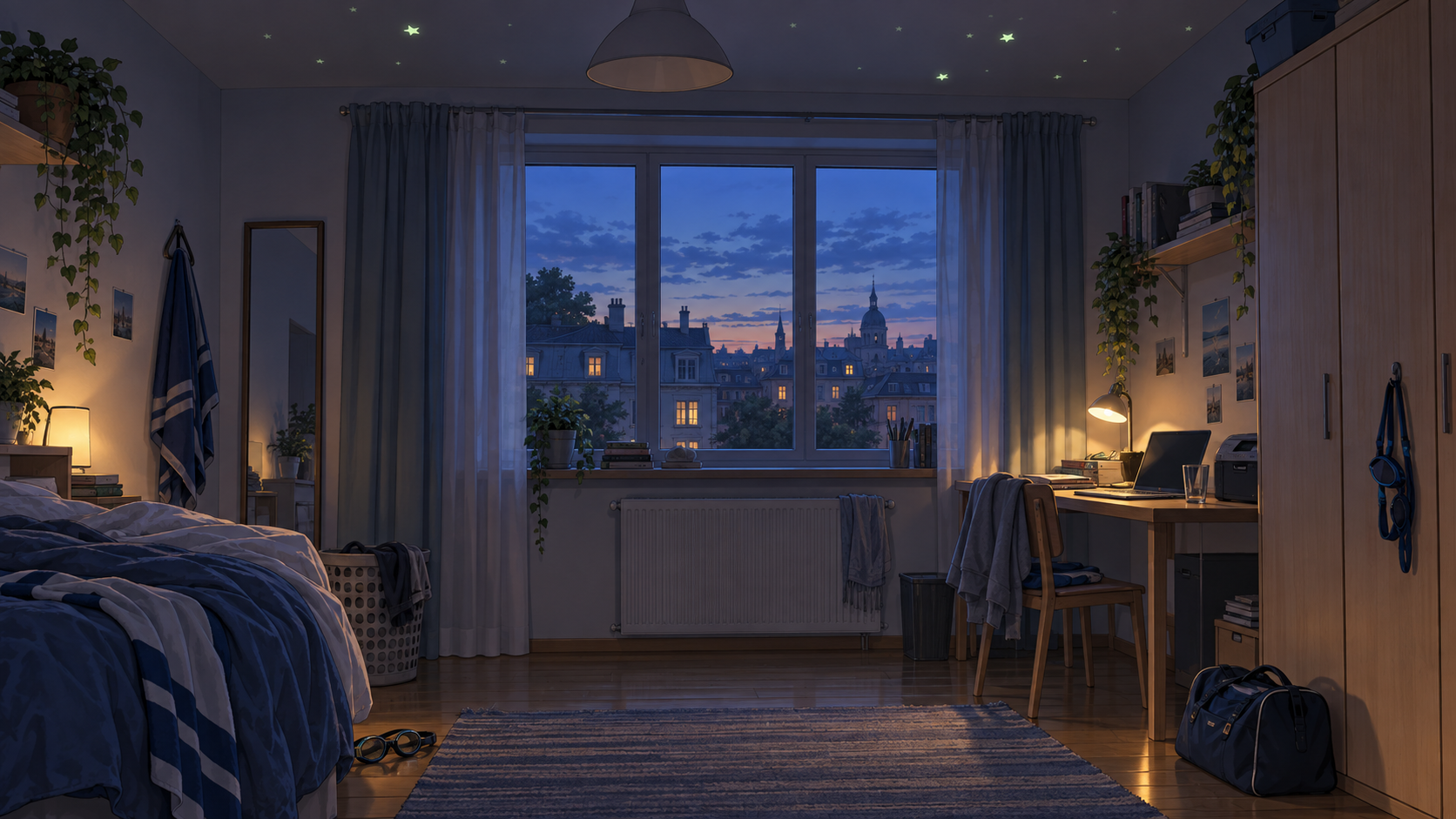
That evening, when Elenie arrived, V was sitting cross-legged on her bed, watching the race footage on her phone for the fourth time. Someone from the team had filmed it from the stands, and V still hadn’t decided whether asking for it had been a good idea or a bad one.
Elenie stretched out on the bed and propped her feet against the wall. “Go on, then. The whole school’s talking, by the way.”
“What are they saying?”
“Some say cramp, some say panic attack. There’s also a theory that you saw a ghost in the water. I started that one. You’re welcome.”
“Elenie.”
“Kidding. It started on its own. I just gave it my support.”
Instead of answering, V held out the phone. “Look. Here.” She paused the video and tapped the screen. “Right there. It looks like I’ve hit a wall instead of water.”
Elenie sat up, took the phone and watched the clip. Then watched it again. She frowned, bringing the screen closer. V waited, hoping for something on her friend’s face: a spark, a moment of oh, hang on.
“What wall?” Elenie said at last, handing it back. She was smiling a little. “You just lost your rhythm. It happens.”
“Elenie. I’ve been swimming for years. I know what losing your rhythm feels like, and I know what happens. You slow down. You don’t stop. You definitely don’t get thrown backwards. Look properly. I hit something.”
“Maybe that’s what you want to see because you lost.” Elenie shrugged. Her voice was gentle; the words weren’t. “Your mind’s playing tricks on you. I don’t see a wall. Anyway, let it go. You can’t win every race. It’s not the first one you’ve lost, and it won’t be the last.”
V said nothing more. She took the phone and watched the video once again, this time alone, in silence. Her fingers moved back and forth along the edge of the screen, as though trying to touch the wall in the water, but found nothing. On the screen was only a girl who had suddenly stopped in the middle of a pool and was pushing at the water with her hands. Everyone had a theory about why she’d stopped. No one believed hers.
She didn’t really want to believe it herself. Not believing was much more comfortable.
Elenie stayed and talked about what they were going to do for V’s birthday the following month, in May, then stayed for dinner at the insistence of V’s mother, Laura. At the door, she turned back. “Don’t let it get to you. In two weeks, nobody’ll remember.” It was a well-meant and entirely wrong thing to say. V smiled, closed the door and murmured, “I will.”
After Elenie left, she helped her mother clear the table. She pretended to enjoy listening as her mother laughed about the little monsters she’d been teaching that day. Then she went upstairs and sat at her computer. She was looking at the screen, but taking old incidents off the shelf and turning them over. A few years ago, she had caught a jug with her arm and knocked it off the kitchen counter. She could still see exactly what she’d seen when she turned to look: the jug wasn’t falling. It was hanging there, half a metre above the floor, tipped a little to one side. As though someone had paused the film and she was the only one still watching. Even the water hadn’t spilled. When she reached out and took it, its weight dropped into her palm, as though it wanted to carry on from where it had stopped. Perhaps she’d seen it wrong. That was what she’d told herself for years: it had simply been a wonderful reflex. She’d caught the falling jug at the last instant. There were other files on the shelf. The night she’d argued with Elenie over the phone, when she’d had enough of thinking about it and said “I wish I could just sleep and be done with it”, and the lamp had gone out by itself. They’d had to replace it the next day. The day of the chemistry exam, when she’d missed the school bus and was running after it, and one of its tyres had burst. Though she’d still been late for the exam. The universe had a peculiar sense of humour.
She turned off the light and lay on her back. Half the stars on her ceiling no longer glowed. She looked at the ones that were as stubborn as she was, still insisting on shining, and reported the day to them. It was a habit she’d started at eight, on the day she learned her father wasn’t coming back; a habit she had told no one about and had never quite admitted to herself.
Star report, 8 April 2026: I lost a race today. There was a wall in the water. I’m calling it a wall because I touched it. Twice. Then it vanished. Then my water bottle exploded. My best friend didn’t believe me. Mum said she’d buy me another glass bottle and that this time I should be more careful.
The days after the wall incident at the race, or the mime incident, according to the other students, seemed determined to be the most normal days of V’s life. School, practice, home. Twice in the school corridor she heard someone call her “the mime”, and both times she made a mental note of who was laughing. But the water didn’t become a wall again. Time didn’t freeze. The world followed the rules.
Sundays were for Ginny’s father’s horse farm. For years, the three of them had spent two hours of every week there. V no longer had to feel around with her foot for the stirrup, Elenie kept talking even on horseback, and Ginny could never decide which horse to ride. She ended up on the same horse every week, but the other possibilities had to be considered first. V suspected the horse knew this too; it would come to the gate before Ginny announced her decision.
About a week later, after school, the sky was an undecided shade of grey that had finally settled on a light drizzle. That irritating amount of rain: put up an umbrella and you looked ridiculous; don’t, and your hair was ruined. The smell of wet tarmac was everywhere. V was waiting for Elenie under the awning by the bus stops.
She was late. V looked at her watch, then at the sky. My hair, she groaned inwardly. Her hair was in the top two most important things in her life. The other was her mother, and sometimes the hair won. Humidity had already begun organising in its outer suburbs; her hair was curly to begin with, and damp turned it into an independent life form on her head. Five more minutes, she calculated. Five more minutes and this hair is no longer mine.
Just then, she spotted Brian on the opposite pavement.
You know the sort every school has, the idiot who thinks having a rich father means he can do whatever he likes. That was Brian. Textbook example. The slimiest boy in the class. He was waving at her and grinning. Brian’s grin was the sort that set off before its owner. Once he finished waving, he would probably come over. Once he came over, he would say something. And that something, with statistical certainty, would be an irritating invitation to spend the evening together.
Oh, lovely, V thought. The one thing missing from my magnificent day.
She looked away, down at the raindrops on the toes of her shoes. And she muttered. Not even aloud, just between her lips, to herself: “Don’t come over, don’t come over, please, I cannot deal with you right now.”
The sound came first. A muffled cry that echoed strangely off the wet concrete.
V looked up.
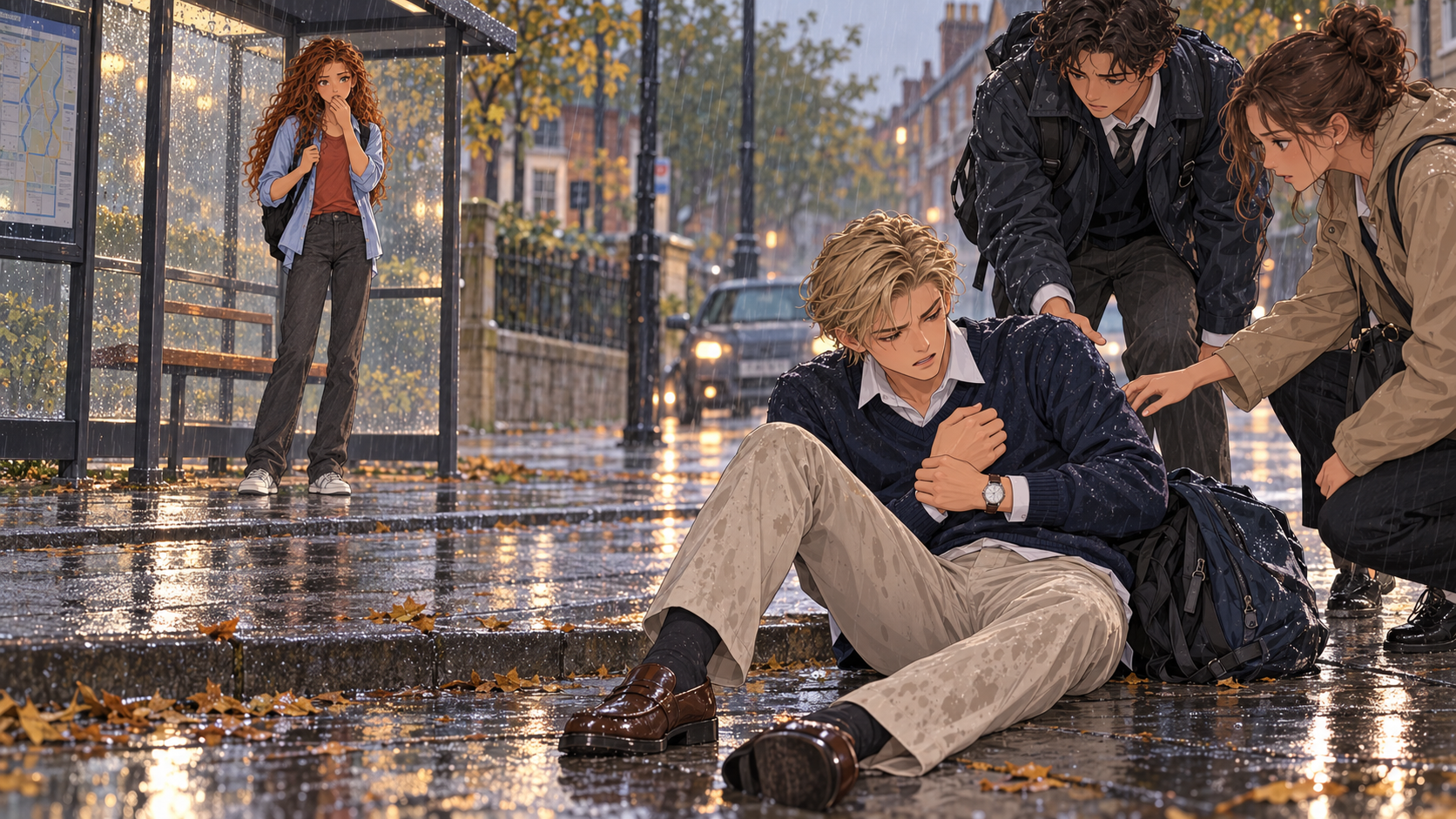
Brian had stepped off the kerb and was on the ground. From the way he lay and the strange position of his foot, he seemed to have turned his ankle and lost his balance. He had put a hand out to break his fall; his wrist was bent at an odd angle, and Brian was no longer grinning. A few people ran over. Someone shouted, “It could be broken, don’t move it!” Someone took out a phone.
V stood frozen. Her bag strap was digging into her palm. She hadn’t even noticed taking hold of it.
And inside her, in the middle of all that rushing about, something happened that no one could see: for an instant, she felt relieved. Something taut loosened. The relief lasted two seconds, then gave way to shame. Why am I pleased? she asked herself. The boy’s broken his wrist and I’m… relieved? Whoa. No. Come on. I can’t have done that as well.
Ridiculous, of course. People didn’t turn their ankles because someone muttered. The pavement was wet, Brian was clumsy, it was raining. Her collection offered three labels for the occasion, and V stuck them on top of one another. To make sure they held.
By the time Elenie finally arrived, the ambulance was turning the corner. “What happened? Who is it?”
“Brian.” V put her bag on her shoulder. “He fell.”
As the word left her mouth, one corner of her lips curled upwards. V smoothed it away before Elenie could see. Or thought she did.
“Why are you smiling?”
“I’m not.” She bit her lip. “Rain. My face is wet.”
Elenie looked at her for two seconds, then shrugged, and the conversation moved on to why she was late, which was a story involving a teacher, a photocopier and an injustice. V listened, laughed, got on the bus.
Brian received one line in that evening’s star report: Brian fell today and broke his wrist. I laughed. Then I felt bad for laughing. No. I wanted to feel bad.
And then the Thursday morning when the main event happened. It must have been a few days after Brian broke his wrist. That morning, she had just come out of the shower and was standing in front of her wardrobe, a towel in her hair and earphones in her ears. Elenie was on the phone, and the subject was the same as every morning: what to wear today, what everyone else would wear, which of yesterday’s outfits had been mistakes. Life, in other words, was as ordinary as it could be.
“Oh, by the way,” Elenie said, in that easy voice of hers that hopped from subject to subject, “what’s your philosophy essay about?”
A scream.
Call ended. Time: 7.34.
The essay was due today. The essay was due first lesson. And the essay was a blank page inside a laptop she hadn’t opened.
Cursing her memory a thousand different ways, V sat down and opened the laptop. The topic was on the screen, in a tab left over from the previous week: Is happiness a choice or a consequence? Her fingers waited over the keys. Her mind was empty. Happiness, at present, was something experienced by people who didn’t have an essay due, and she couldn’t put that in the essay. Panic, worry and fear had come round together for a visit and weren’t helping her write a single line.
Then her body began to tingle. It started in her fingertips and spread up her arms, a sensation more like a hum than a tingle. Something like the silence in the water just before she touched the wall. But V didn’t have time to think about that. V didn’t have time to write six pages. V didn’t have anything.
Then her mother’s voice came from the doorway. “V! It’s eight o’clock! You’ll miss the bus!”
V looked up. It was 8.01.
“But I only just…” The blank space on the screen was full. There were six pages of writing.
Six. Pages. Six pages with proper margins, well-formed paragraphs, an introduction, a main body and a conclusion. The cursor blinked at the end of the last sentence. V still had the towel on her head, the fingers of her right hand felt numb over the keyboard, and there was nothing in her memory of the past twenty-seven minutes. She remembered sitting down. She remembered the tingling. After that: her mother’s voice.
She dragged the scrollbar to the top and began to read. It was… good. Too good. The sentences sounded like hers, but flowed in a way she couldn’t have managed, as though someone had taken her voice and put it into a better instrument. She stopped at one sentence. Her lips moved. Did I write this?
Labelling was fast-tracked: Stress. Adrenaline. Incredible what people could do under pressure. Laptop closed, essay snatched from the printer, towel flung on the bed. By the time V went out the door, she even felt triumphant. Six pages in twenty-seven minutes. That had to be some kind of record.
That evening, before bed, curiosity won, and she tried an experiment: typing the same essay again while looking at the text on the screen. In thirty minutes, she managed three pages. With the words in front of her. And aching fingers.
Under the duvet, giving that night’s report to the stars, she lined up the figures. With the text: 0.1 pages per minute. Without looking, without remembering: 0.22 pages per minute. Conclusion: I am a person who works twice as fast under stress.
The stars said nothing. They didn’t need to. V wasn’t putting the sentence she didn’t want to hear into words either.
The next day, halfway through the second lesson, there had been a knock at the classroom door, and V had been called to Mrs Hoffman’s room.
After the final bell, Elenie was waiting outside the school gates, leaning against the railing. Before V even reached her, she could tell from her face: she’d heard.
“Tell me.”
“What?”
“V.”
“All right, fine.” V adjusted her bag. “My philosophy essay turned out to be the same as another girl’s.”
“The same how?”
“The same as in the same. Six pages. Word for word.”
Elenie stopped. Actually, stopped walking. Someone coming up behind bumped into her and kept going.
“How?”
“I don’t know.”
“Who is she?”
“Martha Weber. One of the B classes.”
“Do you know her?”
“No.”
“Does she know you?”
“No.”
Ginny appeared from an unspecified somewhere, holding something half-eaten, and joined the middle of the conversation without asking a thing. “Is this the copying thing? I heard.”
“What did you hear?”
“That you copied someone’s essay.”
“Ginny,” said Elenie.
“I’m not saying you did! I’m saying people are saying it.”
V said nothing. She kept walking towards the bus stop, and her friends followed.
“What kind of person copies six pages word for word and thinks they won’t get caught?” Elenie said. “You’d change a sentence or two, at least. I mean, I would. And since our V is at least as clever as I am…”
Ginny giggled. “At least as clever as you.”
“It’s an example. So where did this girl get your essay?”
“She couldn’t have. It’s mine. On my computer.”
“You must have sent it to someone.”
“I didn’t.”
“Left it in the printer.”
“I printed it at home.”
“Hackers?”
V rolled her eyes.
Elenie walked in silence for a few steps. V could almost hear the possibilities opening and closing inside her friend’s head. Eventually, Elenie arrived where V had arrived the day before.
“Then this girl must be lying.”
“She isn’t.”
“How do you know?”
V couldn’t answer. She had an answer: the girl’s face, her weariness, what she’d said in the corridor. But none of it would fit into a sentence, and saying things that didn’t fit wasn’t V’s way.
“I don’t know,” she said.
“Look, I’ll talk to her. I’ll find her on Monday, have a word, sort it out. If that doesn’t work, I’ll pull her hair out.”
“Elenie.”
“What? They’re calling you a cheat.”
“Nobody’s calling me anything.”
“Ginny just did.”
“I did not!” said Ginny. “I said what other people said!”
Vivienne laughed, and laughing felt much better than she’d expected.
By the time they reached the bus stop, Elenie was still talking: justice, teachers, the system, another injustice that had happened to someone else last year. Then she suddenly stopped, swung her bag in front of her, took out her notebook and spoke in an entirely different voice.
“Anyway. You’re coming to mine tomorrow.”
“I’ve got practice tomorrow.”
“That’s in the morning. Come in the afternoon. You too, Ginny.”
“What’s tomorrow?” Ginny asked.
“Birthday planning.” Elenie opened the notebook and showed them both a blank page, as though there were something on it to see. “We’ve got a month, and we have nothing. No venue, no list. Nothing.”
Through the discussion, in which Ginny greeted every suggestion first with why and then with maybe, V said nothing. As she stepped onto the bus, she turned back. “What time?”
“Two.”
“Okay.”
Looking out of the window, she understood what Elenie was doing and thought a thank-you without saying it. Elenie wouldn’t have wanted it said, anyway.
At eight on Saturday morning, there were only two people at the pool doors: V and the attendant unlocking them.
“You again.”
“Me again.”
Being first into the water was one of V’s private privileges. There wasn’t a wrinkle on the surface. No one had disturbed it, no one had warmed it, all of yesterday’s people and their yesterday tiredness had settled to the bottom overnight, and now there was something there, colourless and flat within the blue stone walls, waiting only for her. No cap, no goggles, no thought: V slipped in from the edge.
The first three seconds were always the same. Sound went away. School, essays, the bus, home, corridors, the boy who called her “the mime”, six pages on a screen, the girl saying I didn’t copy, the teacher looking away: all of them stayed outside the door, because no one else could come through the water’s door.
Forty-five minutes later, Chris called from the stands. “How many laps have you done?”
“Don’t know.”
“I do. The warm-up was supposed to be twenty.”
“I’m warm.”
“You’ve done forty-two laps, Vivienne.”
Deren was still tying back her hair, sitting with her feet dangling in the water. She looked at V. “Saturday morning. One human being. Forty-two laps.”
“Someone counted them, though.”
“Yes, I count,” Chris said. “I count because one day your shoulder will go, and then you’ll say nobody warned you.”
V rolled onto her back in the water and looked at the ceiling. “You warned me. I made a note. Mentally.”
Deren laughed and jumped in. A wave hit V in the face.
Halfway through practice, Chris checked his stopwatch for the fourth time, then put it in his pocket.
“Free time,” he said. “Twenty minutes. Then we work on starts.”
Before he’d finished, Deren had slipped under the lane rope. “Get them.”
Nobody asked what she meant. On the bottom of the pool were eight small coloured rings they used to mark turning points during drills. Chris had banned them from using the rings after last year’s game ended with pool equipment scattered everywhere. The team had adopted the ban as one of the game’s official rules.
“Three against three,” Deren said. “Yellows are worth two.”
“Why?”
“Because I don’t like yellow.”
“That’s not a rule.”
“You made it last week.”
“Last week I was winning.”
“Exactly.”
V pulled down her goggles. Deren looked at her.
“No.”
“I haven’t done anything yet.”
“I know that face.”
“My face is perfectly normal.”
Deren’s gaze caught briefly on V’s eyes, then dropped straight to the bottom of the pool. “We’re using ‘normal’ very loosely today.”
V went under without answering. The game’s only real rule was that you could bring up just one ring per dive. That rule existed because of V, too.
In the first round, everyone went for the nearest ring. V didn’t. She swam just above the bottom, passed two yellows, turned by the red and headed for the blue ring in the deepest part.
Deren’s voice came from above, muffled and meaningless. V looked up. Deren was shouting something from the surface and pointing upwards with both hands. V put a hand to her ear: I can’t understand you.
Deren gave her the finger.
That, she understood.
She took the blue ring and surfaced.
“What is wrong with you?” Deren said.
“Two points.”
“Blue is one point.”
“Now it’s two.”
“You can’t change the rules in the middle of the game.”
“You made yellow worth two.”
“I said that before we started.”
“I didn’t hear you.”
“You’d jumped in!”
V put the ring on the side. “Communication issue, then.”
In the second round, someone stole V’s yellow ring. In the third, Deren caught her by the foot as she surfaced, and they both swallowed water. In the fourth, the other team began piling their rings in a corner of the pool, which led to a three-minute argument over the fact that the rules didn’t say they couldn’t.
Chris blew his whistle from the other end. Nobody looked at him. He blew it again.
This time Deren lifted her head out of the water. “You said free time!”
Chris held up his stopwatch. “Twelve minutes.”
“Time is relative.”
“Think like that when we’re practising starts, and you can walk to the regionals instead of taking the bus.”
The team laughed. They agreed on one last round, and everyone went under together.
V didn’t go for the first ring. Or the second. The deepest yellow lay in the shadow of the lane rope. Deren had seen it too; V could tell from the legs beside her as she descended.
They reached the bottom together. Deren reached for the ring. V touched it first. When Deren grabbed her wrist, V took the ring with her other hand. Deren didn’t let go.
For a few seconds they looked at each other on the bottom of the pool, utterly serious. Then Deren opened her mouth, said something, and bubbles came out.
V read her lips.
Cheat.
She shook her head and answered just as seriously.
Loser.
Deren’s face crumpled. She tried not to laugh, lasted two seconds, then released a cloud of bubbles and shot upwards.
V held the ring.
She didn’t go up.
Deren’s legs passed across the top of her field of vision. A few seconds later, the others surfaced, and the noise above the pool began again. Someone was arguing about the result. Someone was saying Deren had cheated. Deren was probably blaming V.
None of the voices quite reached this far. Above her, the light refracted, stretching the ceiling lamps into white patches on the surface, long then short. People’s legs passed, disturbing the water, and then the water settled again.
V let go of the ring. The yellow plastic drifted down and landed beside her. V sat cross-legged.
There was no reason to stay. Her chest hadn’t even begun to tighten.
Down here, no one wanted anything from her. Even Deren’s voice was only a distant hum. No stopwatch. No times. No next turn.
Just water.
Ten seconds passed. Then another ten. She thought she ought to go up, but there was still no real tightness in her chest. She waited a little longer.
She just liked it.
Eventually she rose from the bottom and surfaced. Deren was waiting at the edge, out of breath.
“You are not normal.”
V pushed her goggles onto her forehead.
“I’m taking that as a compliment.”
“Don’t. I stay down there long enough to say one thing. You’ve rented a place.”
V caught the edge of the pool. “Good rates.”
Deren looked at her for a second, then put both hands on V’s head and pushed her underwater.
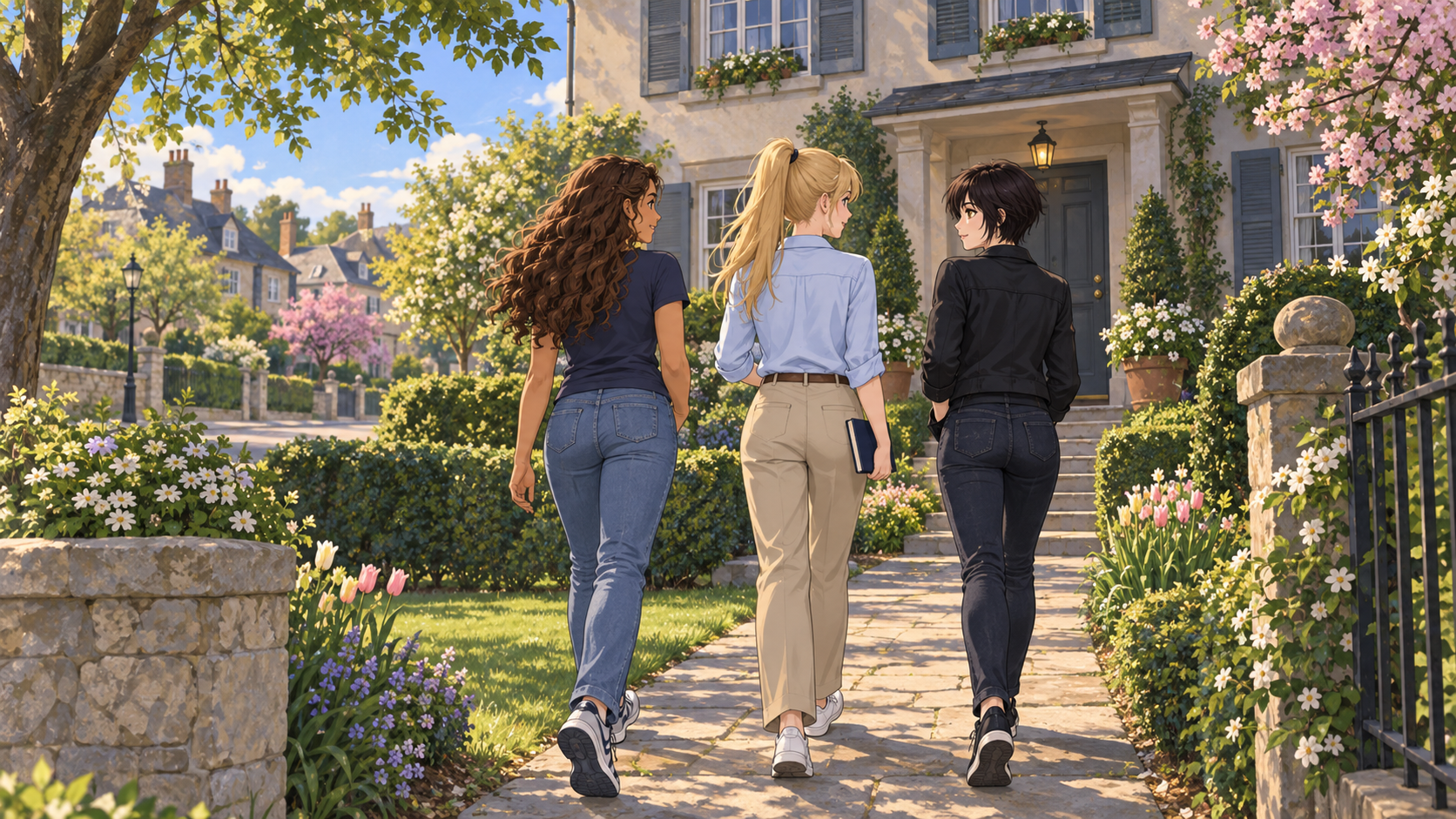
At two that afternoon, they were at Elenie’s house. Elenie’s mother was one of those old-fashioned women who counted her daughter’s friends as guests. She put out savoury pastries, made tea, said, “You girls talk, I won’t interfere,” and passed through the kitchen three times.
Once tea and pastries were dealt with, they moved to Elenie’s room, where Elenie sat on the floor with her notebook open. The birthday was a little over a month away, which, to Elenie, meant there was no time left.
“Venue,” she said. “Venue first. Nothing happens without a venue.”
“My house,” V said.
“Not your house.”
“Why not?”
“Because your cousins are coming, and there’s nowhere in your house to hide from your cousins.”
Ginny was lying the wrong way round on the bed, playing with her phone. “The lake,” she said. “That place by the lake. Someone had a birthday there last year. There was grass and stuff.”
Elenie put down her pen. “Ginny.”
“What?”
“You just had an idea. Without thinking about it.”
“I did, didn’t I?” Ginny sat up, considered the weight of what she’d said for a few seconds, then her face fell. “I mean. Maybe the park, though.”
“No, no. You can’t take it back.” Elenie wrote in her notebook and underlined it twice. “The lake. Ginny’s suggestion. I’m dating this.”
V leaned against the bed, took a sip of tea and said nothing. The lake wasn’t a bad idea. By mid-May, the water would be warm enough to swim in, and there was a jetty. V said none of this aloud, because if she did, “V wants to swim” would become an item in Elenie’s notebook, and that item would never leave.
“Clothes,” Elenie said.
“We’ve got a month,” V said.
“We haven’t got a month. We’ve got Ginny.”
“What’s that supposed to mean?” Ginny complained.
“It means if you start looking a month in advance, you’ll decide just in time. Statistics.”
Ginny threw a pillow at Elenie and missed, threw another because she’d missed, and missed again. Elenie picked up the pillow, straightened it, put it back and returned to the notebook: guests, music, who had a car, what happened if the aunts came.
Then, by some untraceable route, the conversation moved to a message one boy in their class had written to someone and sent to someone else, and stayed there for forty minutes. Ginny found the screenshot. All three read it. It was funnier the second time. At one point Elenie said, “That’s so mean,” and carried on laughing.
When it began to get dark, V realised she needed to go, and also realised she didn’t want to. She stretched the distance between those two things into three minutes of tying her shoes by the door.
On Sunday evening, her mother was frying something in the kitchen, and V was forbidden to enter.
“Mum, what are you making?”
“A surprise.”
“I can smell it.”
“Then it’s a treat.”
V edged up to the counter. Her mother nudged her away with a shoulder. V took one and retreated in triumph, burning her mouth. “If you take another, you won’t eat your dinner,” her mother called after her. She took another. She ate her dinner too.
After dinner, V washed her hair and, as she did every Sunday evening when she washed her hair, sat in the living room at her mother’s feet, her back towards her. Without turning down the television or looking, her mother reached for the brush.
It had worked this way for years. V considered her curly hair her one true enemy in the world; her mother seemed to brush by listening to it. The brush never caught. V never said “ow”. When she asked how she did it, her mother always gave the same answer: “I know your hair better than you do.”
There was a quiz show on the television, and they were both annoyed with the contestant.
“Tell him that’s not the answer.”
“He can’t hear you, V.”
“Well, he should. Watch. He’s going to get it wrong.”
He got it wrong. Mother and daughter shouted at the same time, then laughed at themselves for shouting.
After a while, her mother put the brush down, ran her fingers through V’s hair and said, “You got your hair from your dad. His was just the same. You should have seen it wet.”
V said nothing. Sentences like these came five or six times a year, always while something was being done, never when they were sitting face to face. V had learned not to answer them. If she answered, her mother would stop. If she kept quiet, there was a chance her mother might go on.
She didn’t go on. Instead, she divided the hair in two, braided it, tied off the ends and said, “Off you go. School tomorrow.”
On her way up, V stopped on the stairs. “Mum.”
“Yes?”
“Is there any of that stuff left for tomorrow?”
“No.”
“You’re lying.”
“I am.”
She went into her room, turned out the light, lay down and gave her report to the stubborn stars on the ceiling.
Nothing happened this weekend. Chris counted forty-two laps. Ginny didn’t take back an idea, possibly for the first time in her life, and that lasted half an hour. My birthday’s going to be at the lake. Mum fried things and lied. My hair looks good.
The stars had nothing to say about this report.
Tuesday, lunchtime. The room beside the library was the kind of place where sounds came in from outside but words didn’t. Someone was running in the corridor, someone was shouting. It all stayed on the other side of the door.
When V entered, Martha was sitting at the desk by the window and didn’t look up. They left a desk empty between them.
Mrs Hoffman handed out two sheets of paper. “The topic is at the top. You have two hours. Phones on the desk, face down.” She sat at her own desk, took a red pen and a stack of reading from her bag, then put on her glasses. “I’ll be here.”
V turned the paper over.
Thinking, Does it count as doing something if you can’t remember doing it?, she managed three pages in two hours.
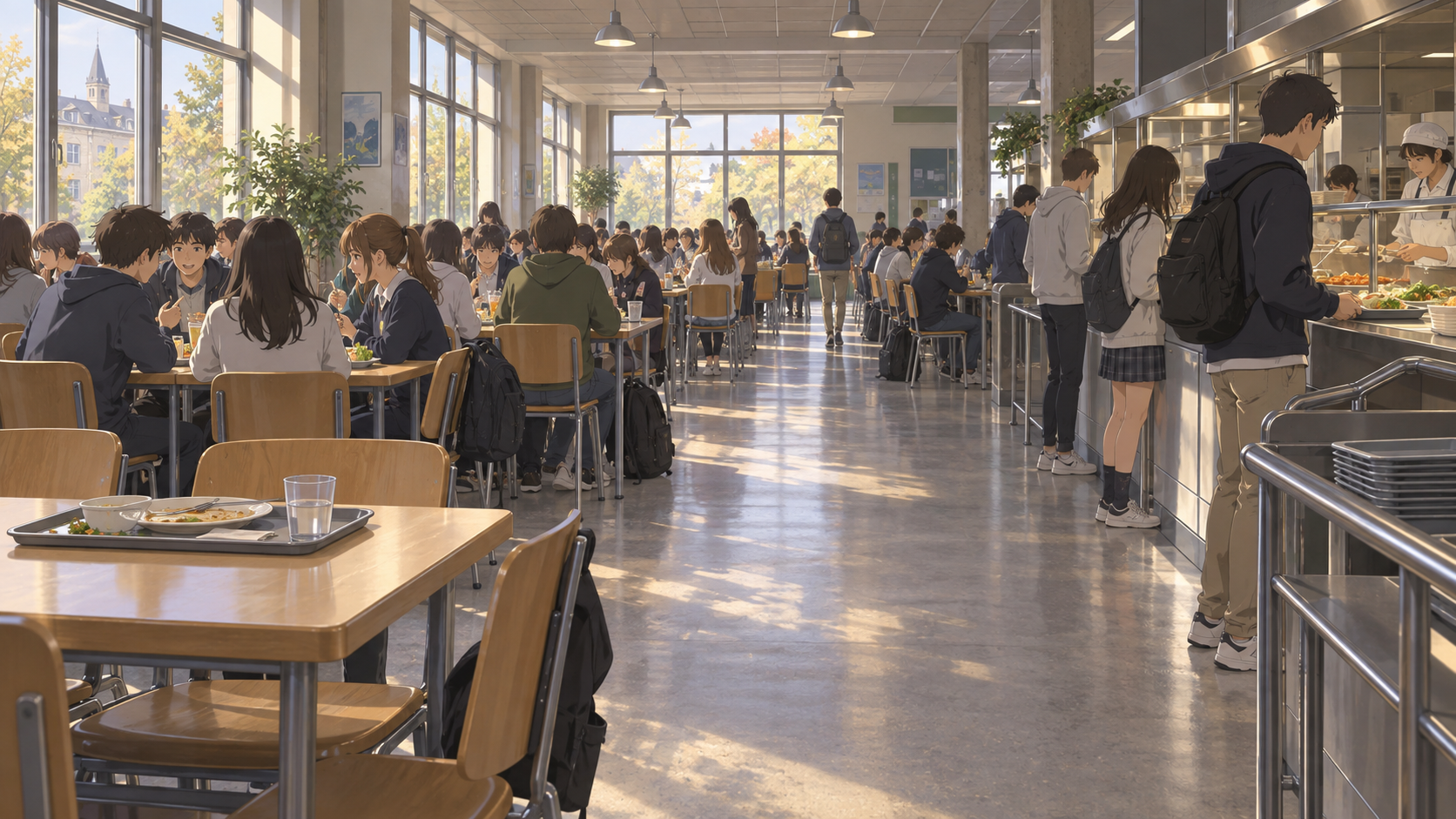
At lunchtime on Wednesday, the canteen was the usual canteen: clattering trays, a hundred conversations merging into a single drone, the smell of something fried.
V sat alone at the corner table. Elenie was in the library trying to rescue an assignment, Ginny was nowhere to be seen, and normally V would have enjoyed this. Twenty minutes once a day without having to answer anyone seemed a reasonable entitlement.
Today, she wasn’t enjoying it.
Yesterday afternoon, she had come out of the room beside the library, and there was no one she could tell about what had happened in there.
She had told Elenie. But what she had told her wasn’t what had happened. An accusation of copying, a zero, an odd girl, an odd teacher. All of it true. All of it incomplete. The twenty-seven minutes weren’t in that story, and V had known it as she got on the bus on Friday evening. She’d realised not that she hadn’t told her, but that she couldn’t.
Before you could tell someone about a thing, it needed a name. The thing V had didn’t have one.
She knew how to be alone in a crowd. She had learned young, and learned well.
When she was eight, her class teacher had called her mother into school. Waiting outside the door, V had heard half the conversation; not all the words, but the shape of them. Doesn’t join in. Doesn’t ask questions. Just sits there at break. Then her mother had come out, taken her hand and said nothing all the way home, which, for V’s mother, was close to impossible.
That summer, she was enrolled in swimming lessons.
Her mother’s intention was clear, and V understood it on the very first day: let the child make some friends. Twenty children, one pool, one instructor, plenty of shouting. V sat at the side, watched the others and made no friends.
But she got in the water.
And in the water, she found something: no one wanted anything from her there. No one asked, “Are you all right?” No one thought it odd that she wasn’t talking, because nobody talked underwater anyway.
To eight-year-old V, it was the fairest place in the world.
At the end of that summer, the instructor told her mother, “She should keep going.” Her mother was pleased, but not for the reason V thought. Later, much later, V understood that her mother had counted the friends, and the number was zero. But her daughter was getting up in the morning because there was somewhere she wanted to go, and back then, that was enough.
There was something else she remembered from that year, and that was the part she chose not to remember.
It had been today, in the April of that year. Her mother was sitting in the kitchen, talking to someone on the phone, and V was behind the door. When the call ended, her mother sat her down opposite her and said, “Your dad isn’t coming back, sweetheart.”
V didn’t ask why. She wouldn’t like the answer. She wouldn’t be able to say maybe one day he would.
At the end of that summer, she kept going to the lessons. The next summer, too. And the next.
Someone dropped a tray loudly onto the canteen conveyor, and V flinched.
She looked at her table. Just her meal on the tray in front of her, a cup of water beside it, a fork and a spoon. No one else. In all this crowd, today she didn’t want to be alone.
She reached for the cup.
Before her fingers reached it, the feeling appeared in her hand. That thing spreading from wrist to elbow, more hum than tingle, the silence of the water on dry land. The sounds dulled, and V held her hand in mid-air.
Without anyone touching it, the metal cup toppled sharply, as though an invisible hand had struck the table. It rolled to the edge, fell and rolled across the floor.
V looked around.
Someone at the table behind was telling a story loudly, and the listeners were laughing. The queue had moved forward. Two tables away, a boy was looking at his phone. No one had turned. No one had seen.
She put her hands under the table, as though they were to blame. Then she did what a reasonable person would do.
At the other end of the table stood a second cup, half-full, ownerless; no telling who had left it there. V slowed her breathing and moved her hand across the tabletop towards it, centimetre by centimetre. Experimental conditions, said a voice inside her, as though writing a lab report. Variable: distance. Hypothesis: the table was unsteady before.
When her fingers were thirty centimetres from the cup, the hum came.
The cup tipped. Rolled. Fell.
Conclusion, said the voice inside her, and stopped. The conclusion section was blank, because the only sentence available was one a reasonable person couldn’t put in a report.
V didn’t move for a long time. The canteen kept turning, trays rattled, someone walking behind her knocked her chair and said “sorry”, and V said “it’s fine”, and her voice sounded normal.
What was inside her was fear, but not the kind of fear she’d expected.
No one was looking. Which meant she didn’t know if it had really happened. The world didn’t care. In one way, the world not caring was good, and in another, V thought for the first time, it was terrible. Because if no one saw, if no one was going to say, “Yes, I saw it too, the cup fell over by itself,” then these were things that happened only inside V’s head.
The label collection opened, was searched, and closed empty. There were no labels left that would stick to this.
She began to feel dizzy. The nausea was climbing towards its limit. She hurried out of the canteen and into the toilets. She tried to be sick, but managed only a few dry heaves. At the sink, she turned on the tap, washed her hands and splashed her face. She looked in the mirror. The girl there was the usual girl: wet forehead, light brown eyes, an arrogant face wearing its ‘everything is under control’ expression. V looked that face in the eye.
Get a grip.
Then the hum came back.
This time it wasn’t in her hand. It was everywhere, a wave travelling from the nape of her neck down her spine to her heels. The taps beside the mirror shuddered at the same instant. A muffled rumble rose through the pipes, from deep inside the building. As though something were coming. A great deal of something, very fast.
The first water appeared beneath the cubicles. Silent and quick, it spread across the tiles towards V’s shoes.
V and her scream left the toilets at the same time.
The school cancelled the rest of the day’s lessons and sent everyone home, citing a plumbing fault in the toilets. The corridors turned festive. Someone actually gave a speech thanking the school’s pipes. For everyone else, it was a lovely, unexpected holiday.
For V, it was a journey home spent thinking and staring at the wet toe of her shoe.
The wetness was real. Her shoe really was wet. Oddly, that was the only good news V could hold on to that day: if the shoe was wet, the water was real; if the water was real, the pipe was real; if the pipe was real, the fault was real. And faults happened. The label needed three somersaults before it would stick, but it stuck.
There weren’t even any somersaults for the cups, though.
There was nothing for the cups.
That night, V shut her bedroom door, then pushed it again to make sure it was properly closed.
She drew the curtain. Not to keep the streetlight out, but to keep anyone from looking in. She knew it was physically impossible to see into her room from the street four floors below. She drew the curtain anyway.
She cleared her desk. Books on the floor, notebook on the floor, pen pot on the floor. One thing remained in the middle: the empty glass she’d brought from the kitchen.
She sat down.
In the canteen, she’d been reaching out when the cup fell. She reached out. Stopped thirty centimetres away, as she had in the canteen. Waited.
Nothing happened.
Perhaps it was the distance. She drew back to forty centimetres. Moved in to twenty. Brought her fingertip almost against the glass, then pulled it away, because touching it would defeat the point.
Nothing happened.
Perhaps it was the way she was sitting. Perhaps it was the light. Perhaps it had to be daytime. V stood up, went round the desk and tried from the other side. Opened her palm, then opened both palms, then wondered what having both palms open could possibly have to do with anything. The thought went nowhere.
Fall over.
She said it in her head. Then with her lips. Then, in a voice so quiet she was ashamed of herself, she actually said it.
“Fall over.” “Break.” “Fly.”
The glass stood on the desk. Glass, as glass was supposed to, did nothing.
She closed her eyes, opened them. Held her breath, let it out. Tried to remember the canteen: the cold table, the clatter of trays, her hand held in the air. She tried to remember what she’d been feeling and couldn’t. Because she hadn’t been feeling anything. She’d just reached out.
At last, she pulled back and slumped into the chair.
And something she hadn’t expected happened inside her: relief.
It wasn’t working. She’d tried. Really tried. Which meant V wasn’t doing anything. Which meant the cup in the canteen had fallen over by itself, just as the bottle had burst by itself, just as Brian had fallen all by himself. Sometimes things happened on their own, and V had nothing to do with them.
It was the most comforting sentence she’d put together in a long time. As she put it together, she noticed her hand was still trembling slightly, and chose not to dwell on it.
She picked up the books and arranged them on the desk. Thought about taking the glass down to the kitchen, decided she couldn’t be bothered, pushed it to the edge instead.
She reached for the light switch and pressed it.
Behind her, on the desk, the drop at the bottom of the empty glass stirred and began to climb its inner wall.
Three weeks passed, and nothing happened.
V counted them silently, day by day. Cups didn’t fall over, pipes didn’t burst, no one fell, no mornings went missing. School was normal, practice was normal, May arrived and the weather grew warm. By the end of the third week, thinking about that Wednesday no longer made her stomach clench. The incident had grown smaller, further away. It had gone onto the shelf.
It still didn’t have a label. But even an unlabelled file stopped being urgent after three weeks of dust.
When V came down to the kitchen on the morning of her birthday, her mother had that look on her face. Come on, be happy, you have to be happy today. Beside her was a tray piled with pancakes.
“Happy birthday, Vivienne!”
When Laura hugged her, V’s feet briefly left the floor. Her mother was a small woman, but her hugs could have strangled a bear. Struggling for breath, V groaned, “Mum… have… to go… to school…” She was not released. Her cheeks were kissed, her hair was smelled, she was squeezed once more, and only then deposited in her chair.
“Sixteen,” her mother said, sitting opposite with her chin in her palm. Her eyes were shining; that dangerous kind of shine, two sentences away from tears. “I came into your room last night while you were asleep, you know. Just looked at your face. You slept the same way as a baby. Mouth open.”
“Mum.”
“You snore now, though. You didn’t do that as a baby.”
“Muuum.”
“All right, all right.” Her mother laughed, then took a small, dark box from her apron pocket and set it beside the plate of pancakes. The velvet was worn at the corners. An old box, once clearly navy blue, now a tired shade somewhere between grey and blue.
“This is yours.”
“I hope there are more pancakes in there,” V said, reaching for it. But the end of the sentence didn’t sound like a joke, because her mother’s expression had changed. It wasn’t an expression that could hold a joke. It was something older. Heavier.
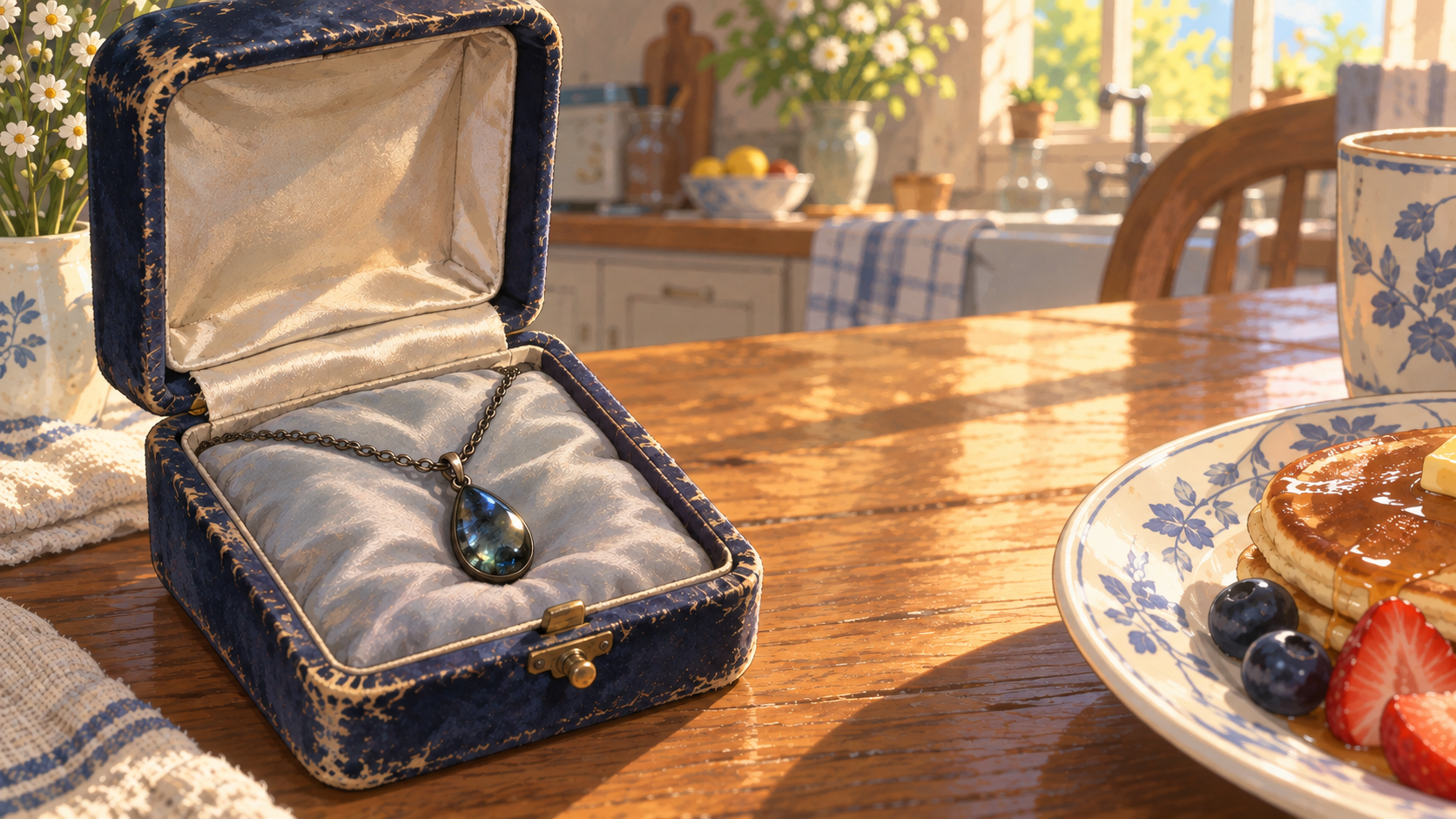
The hinge gave a faint creak. On a bed of faded satin lay a necklace: a fine, dark chain, with a teardrop-shaped stone the size of a fingernail.
She couldn’t decide what colour the stone was. Dark blue at first, then the light changed and it was grey, then almost black. As though the stone couldn’t decide on its colour either.
“Your father’s,” her mother said. Just those words, for a while.
V didn’t look up. The stone was easier to look at.
“His family’s, I mean,” her mother went on. “They’d had it for a long time. When your dad gave it to me, he said that if we ever had a daughter, I was to give it to her on her sixteenth birthday.”
“Why sixteen?” V asked. The analytical part was already at work, lining up questions. “I mean, not eighteen. Not graduation. Not a wedding. Sixteen. Who says sixteen?”
Her mother shrugged. “I don’t know. His father left it to him. As far as I know, there hadn’t been a girl in the family for a long time.”
“And naturally, the first girl turns up and gets every weird family tradition dumped on her.”
Her mother gave a small laugh. “More or less.”
She looked at the stone for a while. “Your dad used to take the box out now and then. More often after you were born. ‘So it really is going to happen,’ he’d say.” Her smile slowly disappeared. “Towards the end, he was going through old family records too. The day before he died…”
She didn’t go on. The word they didn’t use in their family had slipped out. She fell silent.
V said nothing.
Dad left my present before he went.
It took three seconds to swallow whatever had formed in her throat. Then she pulled herself together. “Old families are strange. I bet there’s a stone in the family graveyard with my name on it too. You can give me that for graduation.”
“Vivienne!”
“Kidding. I’m kidding.”
She lifted the necklace from the box. The chain was heavier than she’d expected. Or perhaps it wasn’t heavy, and her hand only thought so. When the stone touched her palm, it felt cool for a moment. A little too cool for a warm kitchen on a May morning. As though it had just come out of the fridge.
“Try it on,” her mother said.
V brought the chain round her neck, fought with the clasp for a while, and finally fastened it. The stone settled over her breastbone, just below the neckline of her T-shirt. She opened the mirrored cupboard door in the hall and looked. Now the stone was greenish.
Make up your mind.
“Your dad was so good at telling those stories,” her mother said behind her, trying to steady her voice. “He loved the family stories. It was all he was doing towards the end, really. Old records, papers…”
The sentence trailed off into a dishcloth without arriving anywhere. She had already started wiping the counter.
“Finish your pancake. You’ll be late.”
V almost asked something, then decided against it. Let not making her mother cry on her birthday morning be her first responsibility at sixteen.
She finished the pancakes standing up, putting her bag over her shoulder. As she went out, her mother called, “Buy yourself something nice when you go shopping tonight! Just don’t melt the card!”
“You can’t have both, Mum!”
The door closed. The May morning was mild, and V noticed that the stone beneath her collar was still cool.
At school, being the person whose birthday it was felt like being briefly famous. In the first lesson, the people beside her wished her a happy birthday. At the second break, girls she half-knew shouted “Happy birthdaaay!” in the corridor. In the third lesson, the teacher paused during the register, said, “Is it your day today?” and threatened to make the class applaud.
V was tired of saying thank you, but she wasn’t going to lie: it wasn’t bad. People smiling at her. The day behaving as though it owed her a small privilege. She could get used to it.
At lunch, Elenie had settled at a desk by the window with the shopping centre’s floor plan open on her phone. She explained that evening’s trip like a military operation.
“Top floor first. Everyone starts at the bottom, so the fitting rooms are full. We work our way down. Upstream strategy. Deren’s meeting us there, straight from practice.”
“Did you make this plan last night?”
“There’s a spreadsheet too, but I don’t want to frighten you.”
V was laughing when she spotted Ginny coming through the door. “Ginny! Over here.”
Ginny came over with a half-eaten sesame bread ring in her hand and her usual expression: about to make a decision, no idea which one. “You’re coming today, right? Shopping. After school,” V asked.
“I’m coming.” Ginny took a bite. “Probably. Eighty per cent coming.”
“Ginny.”
“Ninety per cent. I’ll talk to Mum, but I’m coming. I am. Consider me there.”
Without looking up from her phone, Elenie said, “I’ve already added a line to the floor plan: Ginny indecision allowance, forty minutes.”
Just then, that voice came from the desk behind them. You could tell from the slouch, from the grin that had got into his voice, from the breath he took before he began: Brian mode was on.
“What’s this? Birthday girl getting herself an outfit for the weekend party?” He leaned forward over the desk. “Can I come? Promise I won’t say a word. I’ll just watch you getting dressed and undressed.”
Someone at the next desk laughed a “whoa”. Someone else turned with a “Brian, seriously”. Elenie’s eyebrows were already up, and her mouth was about to open. But V got there first. She didn’t even turn round. She had her front-facing camera open and was fixing a strand of hair. Without changing her tone or looking away from the screen, she spoke.
“Brian, last month you only waved at me, and you broke your wrist.” She tucked the strand behind her ear and closed the camera. “Try watching, if you like.”
A second’s silence. Then the boy at the next desk burst out laughing. Someone behind gave a low “oooh” and flapped a hand as though it were broken. Ginny pointed her bread at Brian and mumbled something through a full mouth.
Brian’s ears went pink, then scarlet. He was still trying to grin, but the grin hung on his face, abandoned by its owner. He drew his right wrist, only just out of its cast, under the desk where it couldn’t be seen.
“I… the pavement was wet,” he managed.
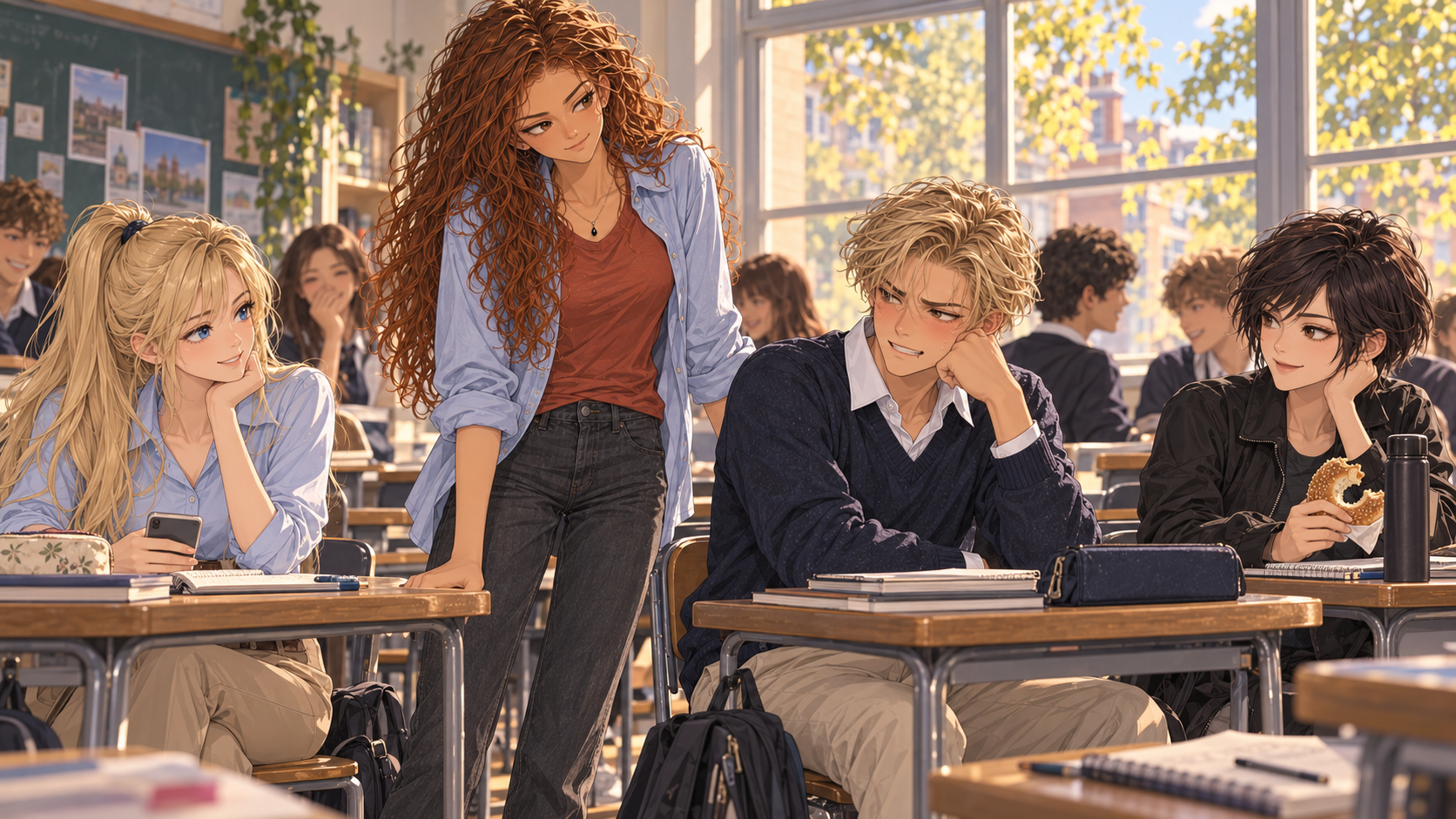
“Fitting rooms can be wet too,” V said, taking her water bottle from her bag and having a sip. “Don’t risk it.” Then she stood, leaned towards Brian at the desk behind her and put on her vengeful smile. “Shall we introduce ourselves? I’m Vivienne.”
The subject was closed. Brian said nothing else that break, and V sat with a small, bright feeling of victory that wasn’t shameful at all.
The stone under her collar was cool, and V no longer even noticed.

The moment they entered the shopping centre, Elenie raised an arm and pointed at the escalators. “What’s the plan?”
“Top floor,” V and Ginny said together, with the monotony of a school song learned by heart.
“Upstream strategy,” Elenie added proudly.
Deren was waiting at the top of the escalator, her hair still damp from practice, a sports bag on her shoulder and a half-finished carton of protein milk in her hand. She raised it when she saw V. “Birthday girl!” Then, as she hugged her, she said in her ear, “Chris asked about you today. Are you really not coming on Saturday? He said, ‘If it’s her birthday, she can come in the afternoon.’ Completely serious.”
“Saturday is my party, and Chris is not included.”
“That’s what I said. A bit more politely.”
For the first half-hour, the top-floor plan worked perfectly. The fitting rooms were empty. In fifteen minutes, Elenie and Deren had chosen, tried on and bought.
V tried on two things she’d picked out for the party. In the dark green one, she stopped for a second in front of the mirror. The dress made the colour of her eyes shine in a strange, lovely way. She bought it.
The system’s point of failure was, as always, Ginny.
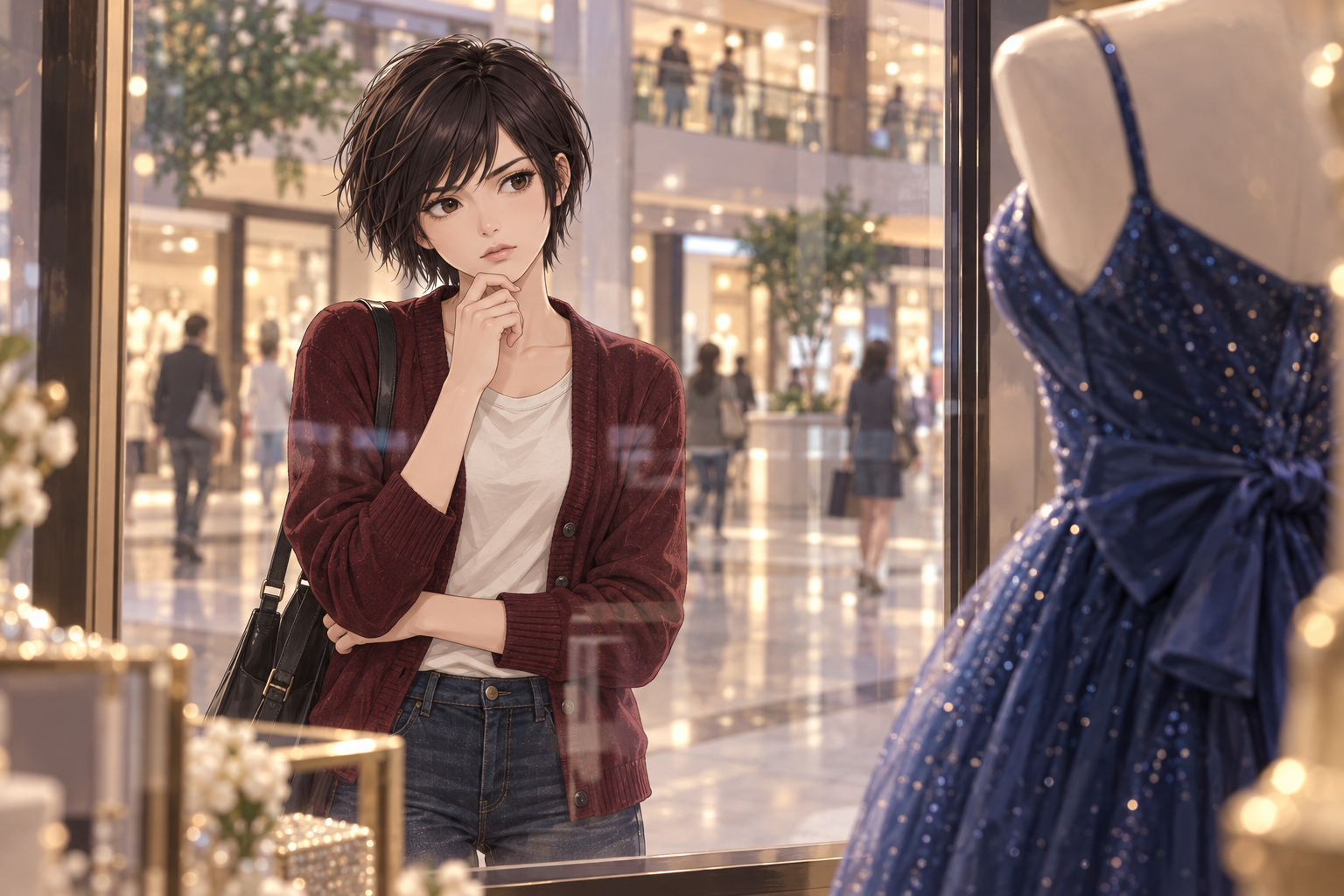
There were two dresses: one blue, one dusty rose. Ginny had found the blue one in the first shop, said “this is it”, then become unsure. Twenty minutes later, she was still flicking between photographs of the two.
“Eighty per cent blue,” she said.
“An hour ago, it was eighty per cent dusty rose,” Deren said.
“Because the dusty rose was newer then.”
“I’m hungry,” V said. “Let’s go upstairs. Ginny can decide on the way.”
“She won’t,” Elenie said.
“I will!” Ginny said.
She didn’t.
By the time they reached the broad marble corridor leading to the food court, Ginny was still switching between the two photos, and her indecision had outgrown its place in the group and become a fifth person walking among them.
In the middle of the corridor was an ornamental pool: round, shallow, its bottom covered in coins, with three jets rising and falling at regular intervals in the centre. A woman sat on the edge, beside a boy of three or four who was testing the limits of his promise not to put his hand in the water.
And on the other side of the pool, looking into the bookshop window, was Martha Weber.
V noticed her with the blank clarity of noticing something she wasn’t interested in: oh, that girl. Then she looked away. Martha hadn’t even turned her head.
The instant Ginny saw the pool, she stopped. “Wait. Wait, wait, wait. V. Throw a coin.”
“What?”
“It’s a wishing pool. It’s your birthday. Birthday wishes don’t go to waste. Statistically proven.” Ginny was already rummaging in her bag.
“Statistically,” V repeated, letting the word crush her beneath its weight.
“Just throw it,” Deren said. “Free wish.”
Ginny had already pressed a coin into her palm. The cost of arguing had exceeded the cost of throwing it. “Fine,” V said. “But I choose my own wish.”
Before flicking the coin with her thumb, she paused for a second, fixed her eyes on the pool and formulated the wish in her head, word for word, clearly enough to have it notarised.
My wish: for Ginny, once in her life, to make up her mind on the first attempt.
A fierce cold struck where the necklace touched her skin, with a pain like an icy burn. She winced and reached for it.
At that same instant, the coin slipped from her finger, spun through the air, dropped towards the water, and just before it touched the surface, the fountains fell silent.
Not just silent. The water in the air stayed where it was. The droplets from the three jets hung there with the light off the marble, hundreds of little glass beads suspended from the ceiling on invisible threads. Sound went too. That constant trickling, unnoticed and therefore nonexistent, stopped, and for a moment the corridor was deafeningly quiet.
V’s coin passed through the middle of the frozen picture, entered the water and landed with a click on the coins below.
And in that precise gap, V looked up.
The girls had walked ahead. Elenie was telling a story, Ginny was looking at her, Deren was on her phone. The child at the edge of the pool was looking at the water. The woman was searching her bag. The people coming down the escalator kept coming down.
Martha Weber wasn’t looking in the window.
She was looking at V.
Then the drops came down. Not at normal speed, but like dripping honey: slow, heavy, lazy, one by one. Where they touched the surface, rings spread in stutters, as though a film were skipping frames. One second. Perhaps one and a half. The fountains made a coughing noise and picked up where they’d left off. The trickling returned. The world turned its volume up.
“The water stopped,” the child said.
“No, it didn’t, darling,” his mother said, taking a tissue from her bag.
“But it did.”
V walked. “Pump,” she said, to no one in particular.
On the other side, Martha had turned back to the window.
There was no way to know how much she’d seen. Perhaps she hadn’t looked at the fountains at all. Perhaps she’d only watched V throw in a coin; people watched other people make wishes. Nothing strange about that. Perhaps she’d spotted V much earlier and couldn’t decide how to say hello.
Perhaps.
On the stairs to the food court, V looked back once more. The space in front of the bookshop was empty.
In the queue, Ginny didn’t look at the two pictures again. She looked at the menu, thought for three seconds and said, “I’m having that.” Then, about the dress, she said, “Blue.” Then she moved on from both before anyone had asked her a thing.
Elenie froze, holding her tray. “What happened to you?”
“What happened?”
“You decided.”
“I did.”
“In one day?”
V laughed, said nothing and put a bottle of water on her tray.
They talked about the party throughout the meal: who was coming, which cousins were bearable, whether the lake would be warm enough to swim in during May. Deren said, “You live in water, you don’t get a vote.” Elenie said, “Nobody is swimming. It’s a party, not a documentary.”
At one point, V slipped a hand beneath her collar.
On a May evening, the stone was ice-cold.
V pulled the necklace out over her T-shirt, held it in her palm for a while as though trying to warm it, then let it go.
On Thursday night, when V lay down in bed, she gave her usual report to the dead stars on the ceiling.
I turned sixteen today. Ate pancakes. Inherited a necklace from Dad’s family that can’t decide what colour it is. Buried Brian in front of everyone, and I’m not sorry. Ginny made a decision on the first attempt. Let the record show. Also, the shopping centre fountain broke.
Her hand went to the stone on her chest. She had thought about taking it off so it wouldn’t dig into her while she slept. Then she hadn’t. Dad. Just thinking the word brought a tear from the corner of her eye. This time, she let it.
The stone was cool beneath her palm.
My party’s in two days, she thought as she drifted off. All I want is for no one to throw me in the lake. I’ll have just had my hair done.
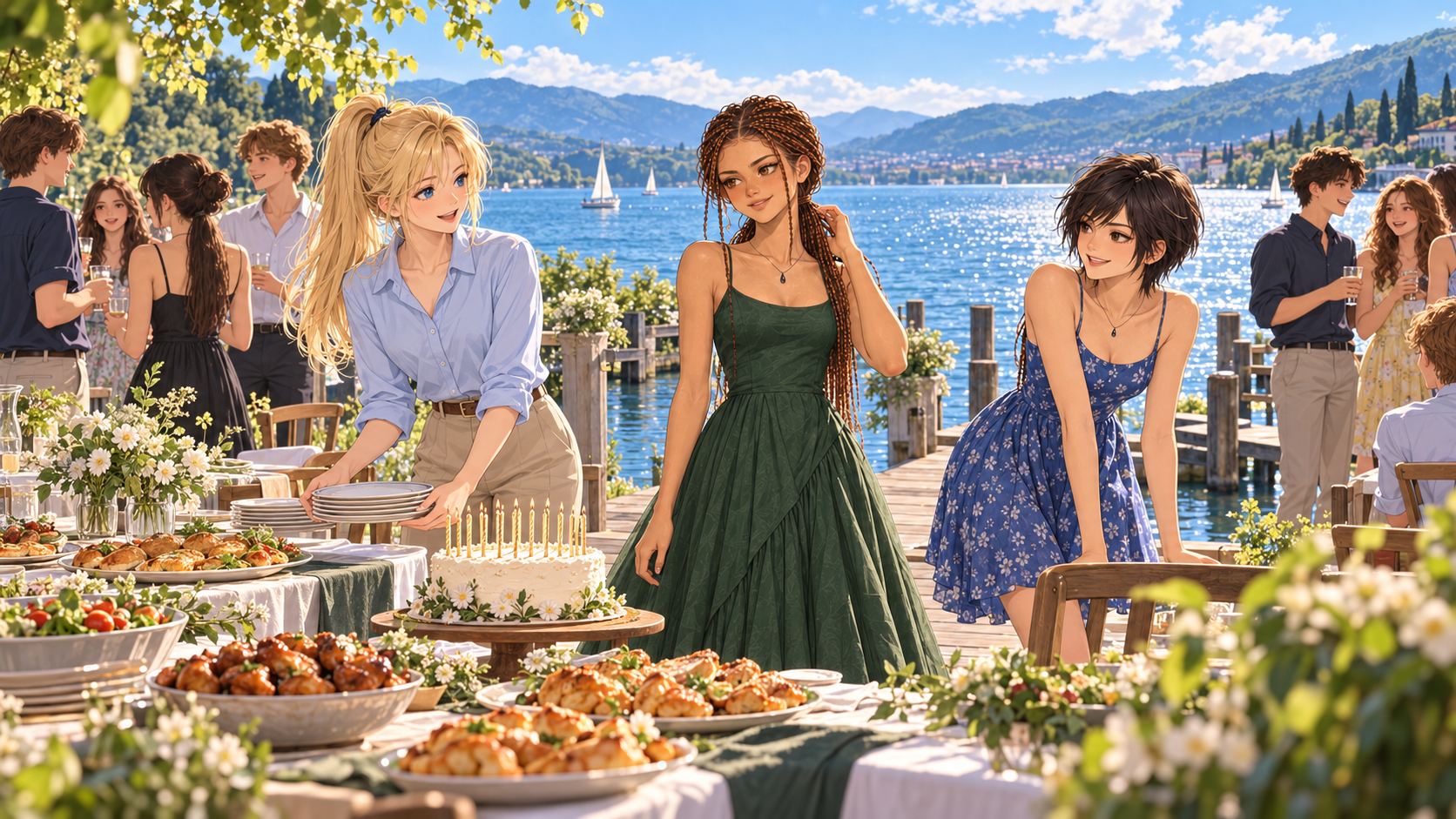
Saturday was a day that did May justice: postcard-blue sky, sun that warmed without burning, a layer of light like scales across the lake. Tables had been set out on the grass at the lakeside venue, and spread across them was an entire fleet that her mother swore was “not overdoing it”: three kinds of savoury pastry, two trays of chicken wings, enough meatballs to feed an army, and, at the centre of it all, waiting for its moment to emerge from the fridge, the cake that would carry sixteen candles.
“You haven’t overdone it at all,” V said, surveying the tables.
“Your cousins are coming. They don’t eat food. They destroy it.”
Elenie had arrived at nine that morning and worked until one in V’s room, comb in hand, back aching. Left alone, curly hair became an independent life form. Asked to submit, it negotiated. After four hours, V had hundreds of fine braids, individually woven, individually tied, gathered at the nape of her neck.
“Never again,” Elenie had said, opening and closing her fingers.
“Liar.”
“True. But the price is going up.”
V had looked at herself in the mirror and liked what she saw. She didn’t tell anyone, but looked twice more that day, and liked it both times.
The green dress was darker in the May sun than it had been in the shop mirror. V had a body that had spent years in water, and she knew it: shoulders, back, arms. Not a model’s body. A body doing its job. Nobody in a crowd would turn to watch her walk away. But everyone looked at the poolside, because beauty was measured differently there.
By three, the place was full: half the swimming team, Deren leading the way with a joke present of a swimming cap that read COLLISION HAZARD; a dozen people from school; three cousins on her mother’s side, with two aunts trailing after them.
One aunt threw up both hands as soon as she saw V. “My goodness, you’re old enough to be a bride!” Then she came closer, took V by the chin, turned her face towards the light and called to the other aunt, “Look. Look at the colour of those eyes. Who has eyes like that?”
“Her father did,” said the other.
“Oh, no, his were dark.”
They debated this for a while. V escaped by taking a plate from her aunt’s hand on the pretext of carrying it to the table. As she went, she heard, “There she goes again.”
The eye issue was V’s oldest issue. Light brown, tending towards yellow, almost honey when she turned into the sun. V didn’t even find them interesting in her own face; she saw them in the mirror every day. The problem wasn’t in the mirror. It was in the people facing her. At some point while they were talking, they got caught, and then found their hands something to do to get themselves free. When she was little, she’d thought it meant she had the upper hand.
The youngest cousin, a ten-year-old girl, followed her two steps behind until evening. At one point, she reached out and touched a braid, then apologised for touching it.
“How did you do that?”
“In four hours.”
“Can I have it done too?”
“Go and ask your mum.”
The child ran, asked, didn’t return.
Music came from someone’s portable speaker and wasn’t too loud. Yet. Elenie, the self-appointed head of the operation, moved between the tables. Ginny had her picture taken repeatedly in the blue dress, which everyone said suited her beautifully, and each time she replied, “I knew as soon as I saw it.”
The lake glittered in little waves against the shore. V turned to look at it several times. But today there was no swimsuit. Today, there were four hours of work on her head.
After the cake, things loosened up. The aunts found shade and tea, the cousins finished the meatballs, the music went up a little. V stood at the end of the jetty with Deren and two girls from the team, laughing at Deren’s story about practice.
Afterwards, nobody admitted starting it. Elenie said, “Definitely Deren.” Deren said, “It was Ginny’s idea.” Ginny defended herself with, “All I said was, ‘Poor thing, she’s had her hair done.’” History did not record the culprit.
What it did record was this: four hands suddenly seized V’s arms and legs, the world tipped sideways, the sky spun, someone shouted “one, twooo”, V screamed “don’t you dare… DON’T… my hair”, and on “three”, she was launched off the jetty into the lake to the accompaniment of laughter, music and gulls.
For half a second in the air, everything was perfectly clear: the turning blue sky, laughing faces on the jetty, sunlight scattered like scales on the water.
The cold began before she touched the water. She would always remember that afterwards: the cold had come before the water reached her. As V went under, the last syllable of her scream became bubbles.
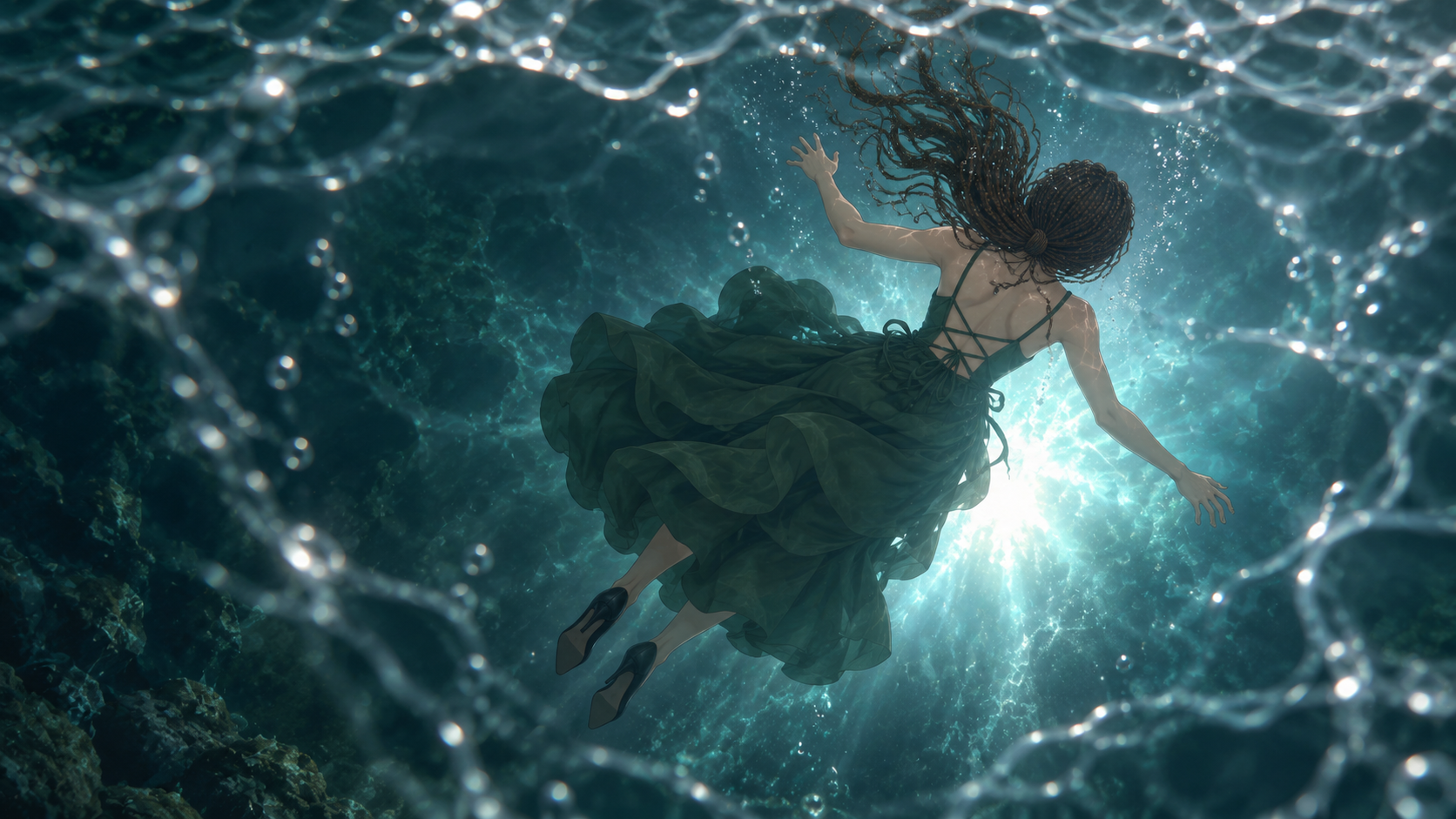
The water closed over her. Sound closed too. Music, laughter, gulls: all cut off at once, as though someone had pulled a door shut. And the water filled with light.
It wasn’t sunlight filtering down. She’d seen enough lakes, enough pools to know that. The light came from below, from the depths, from everywhere and nowhere. White at first, then something as undecided as the colour of the stone: blue, grey, green, growing brighter. V wanted to close her eyes and couldn’t; the light was filling the space behind her eyelids too.
And V’s last thought was so perfectly V that even she would later find it hard to believe:
My hair.
Then the light took everything.