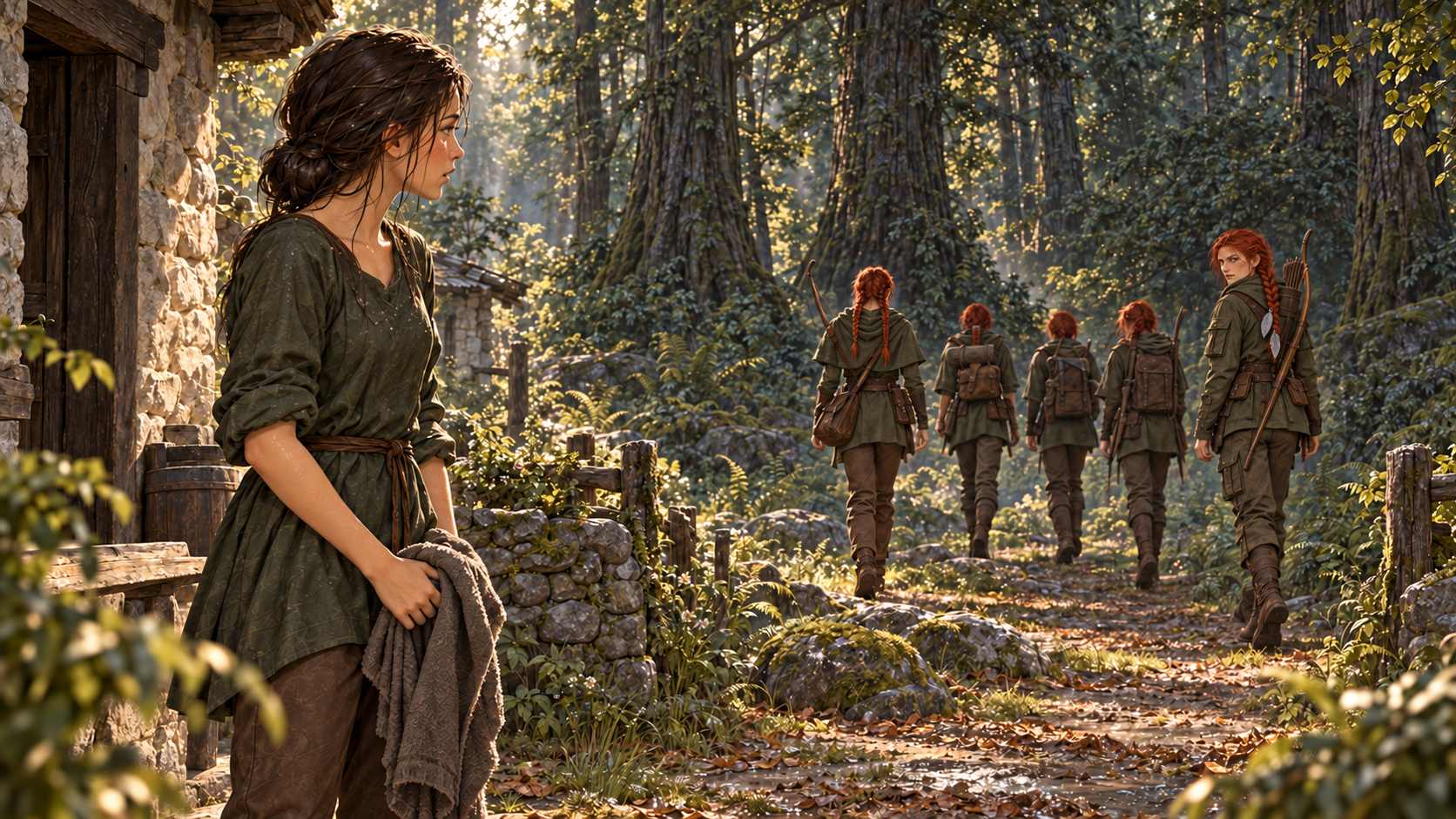
No one told V that Sirel was leaving; she saw it for herself, and by the time she saw, she had missed her.
She was coming back from her morning session by the stream, hair wet, palm still tingling, with only breakfast on her mind. She rounded the clearing in front of the stone house and stopped: at the northern exit of the village, just below the tree line, stood five people. Packs, bows, short spears on their backs. And at the front, that familiar leather bag over her shoulder, Sirel.
V opened her mouth, not knowing what she meant to say, only wanting to make a sound, but the five figures turned at that very moment and the forest, as always, swallowed its own in three steps. All that remained was a half-second glance from the woman at the back of the group: a look that measured, recorded and kept its verdict to itself. A tall woman with a bow slung diagonally across her back and two grey feathers tucked into her braid.
At breakfast, V put the question in front of Pirig. “Where did Sirel go?”
“Towards Sidra.” Pirig went on ladling soup into the bowl. “To look.”
“Look at what?”
“What you left behind.”
V’s spoon stopped halfway. The town. Under the bridge. The thin trickle of water across the dry stones. Images she had spent days carefully burying were back in the daylight after a single sentence. “Isn’t that dangerous? They saw me there. They might have seen her with me.”
“No one finds a Serndal in their own forest.” Pirig pushed the bowl towards V. “Those five won’t be found.” A pause; something softened in her voice. “Certainly not my daughter.”
Enna supplied the rest. If there was a piece of information floating through the village, Enna caught it like a butterfly and brought it to V. Ilva was with the group, “better at tracking than my sister, but don’t tell my sister,” and three others. No one had said how long they would be gone.
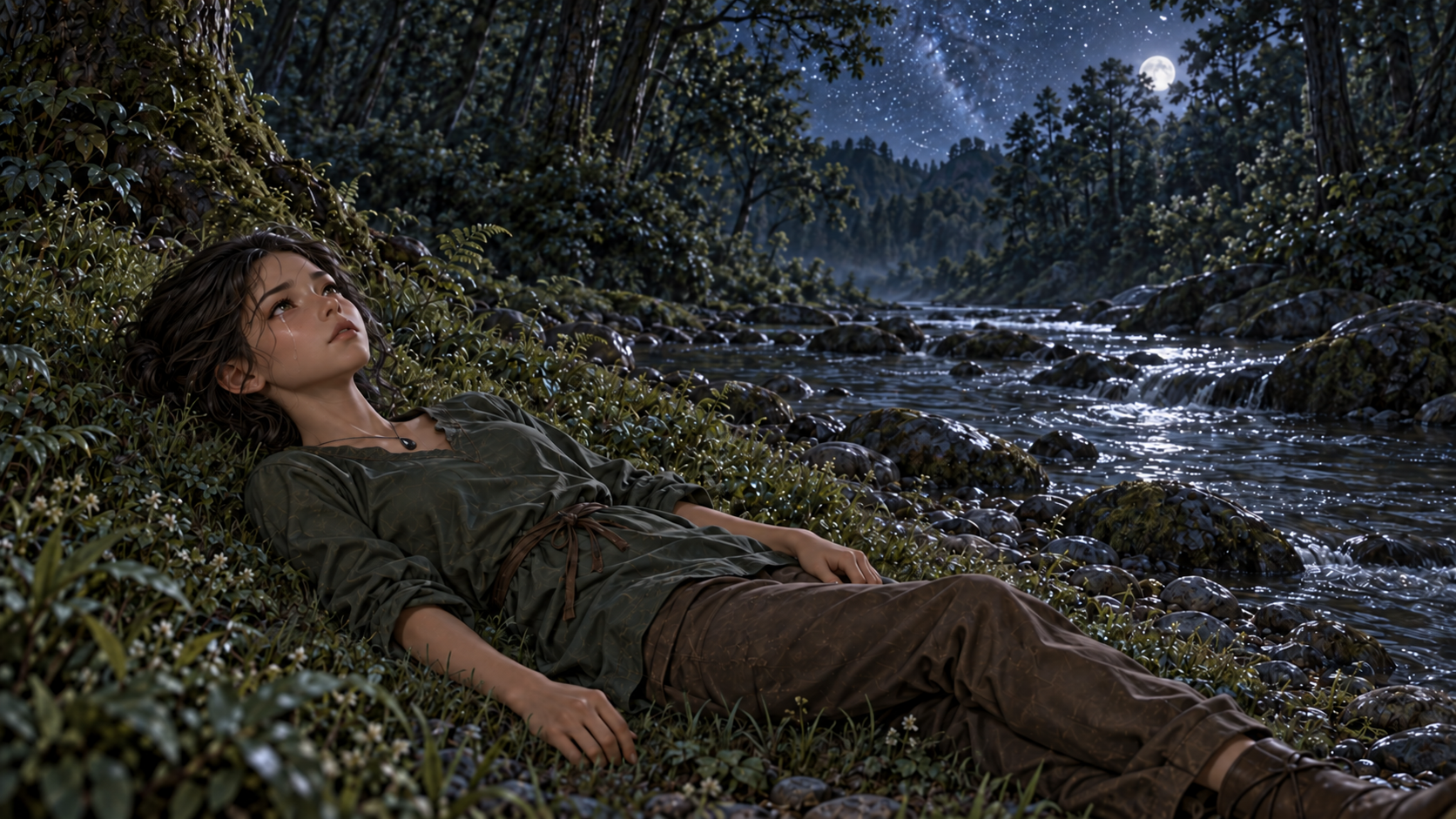
That night, V realised she had not given the stars a report in days. Before going inside to bed, she went down to the stream and lay on the bank. She still couldn’t find the Great Bear, but let it go. “This one might take a while,” she began.
“Good morning. No, good night. I don’t even know any more. Which is it? Even the sun here rises and sets without consulting me. A few things need to go on record. First, I should say: I miss you. So much.” Before she had even finished the sentence, drops formed at the corners of her eyes and quietly obeyed gravity. She went on without bothering about them. “I owe Mum an apology. All those times I got angry with her, complained at her, she was always the one who acted as if nothing had happened afterwards. And because I knew she would, I think I was just being a spoilt idiot. I’m revising every note I’ve made about her here.” She wiped both eyes with her hands as the drops came faster. “I knew that if I fell, I had a mum who would come running to pick me up. That was why I stood so straight. Why I never bowed to anyone. There are two kinds of people: those who know I’m right and those who take longer to learn. I always knew they’d give in eventually. Because even if I stumbled, I had Mum. And I don’t know if I’ll ever get to tell her any of this.”
“What a stupid dream. I can’t wake up. They’re telling me I’m a witch. It’s a joke. I killed someone.” She stopped, swallowed, took a breath and waited a few seconds. “If I see Elenie, if I see her… I’m going to splash her.” She laughed aloud at that, and discovered what it was like to laugh while crying.
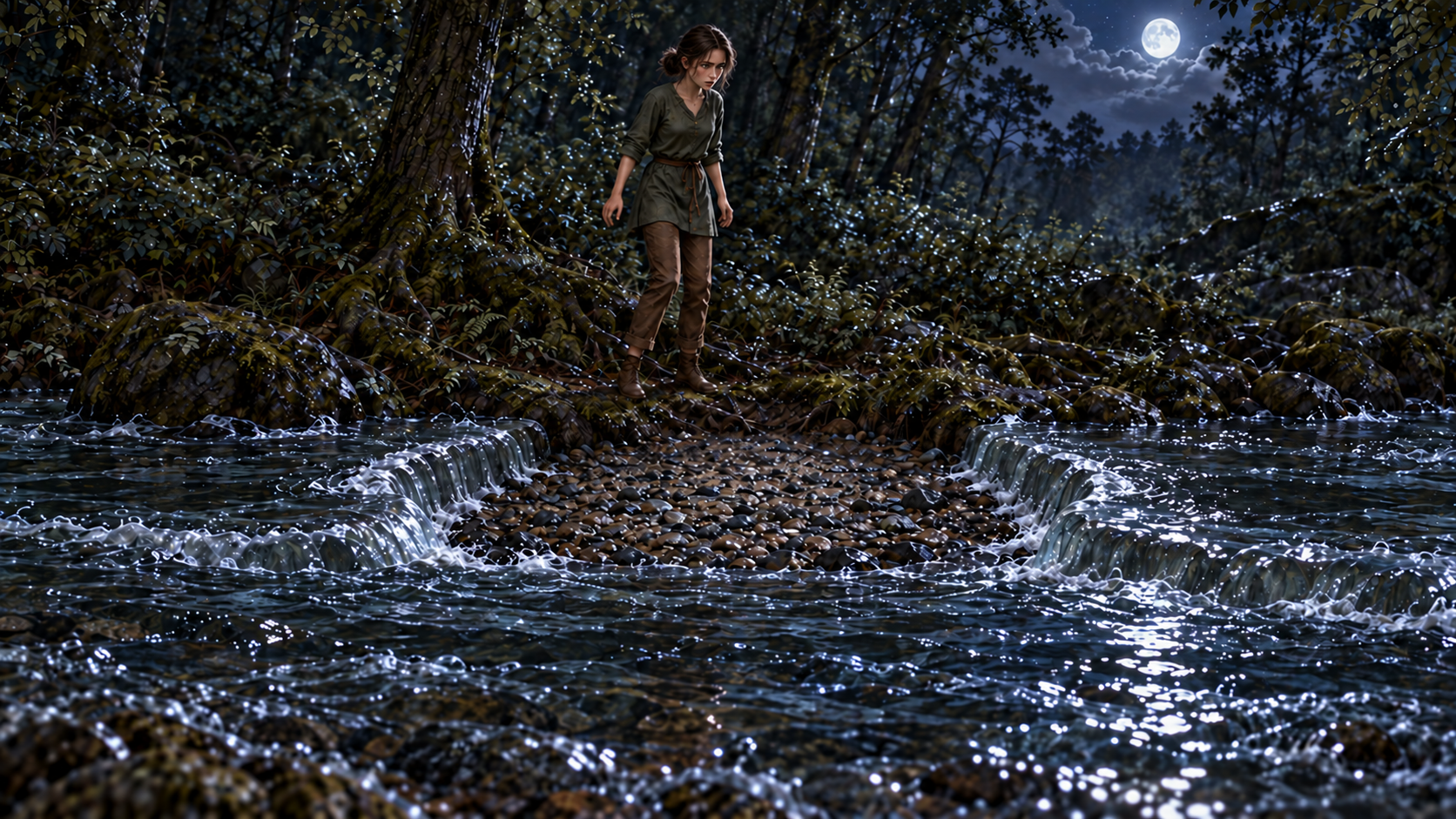
She sat up. “I know Mum’s out there somewhere, waiting for me, and I know she loves me. That alone is a reason to get up. Right. I’m going to make this stream stand up. Nobody else should have to clean up my mess. I’m Vivienne.” She rose with determination and walked towards the stream. As she approached, the water parted as though welcoming her. She stopped at the sight. The moonlight on her face showed the fear clearly. “Well. I’ll come back tomorrow.” She spun round and ran for bed.
In Pirig’s hands, the days settled into a routine, and only once V was inside it did she realise how much she had missed having one. It was like training. Like the pool. Working with water would not be enough, at least for now. Like anyone who wanted to stay alive in Tishar, she needed to learn to use a bow and manage the basics of survival, such as lighting a fire. So it would be the stream before noon, target practice with the bow in the afternoon, and life lessons from Roval in whatever time remained. Life had been divided into countable pieces, and among countable things, V could breathe.
In the morning, the stream was waiting. When V reached the bank, she stood facing the water for a while, ashamed of having run away the night before. At midnight, in the moonlight, the water had parted for her and V had run; now there was sunshine, there were children’s voices, and the stream was flowing as though nothing had happened. We will not be discussing last night, V told the water silently. We were both there. We will both forget it. She stepped in; the still eye formed around her in a breath, as always. But that morning V noticed it was a finger’s width wider, and she told no one. Apparently the stream had not forgotten their midnight conversation.
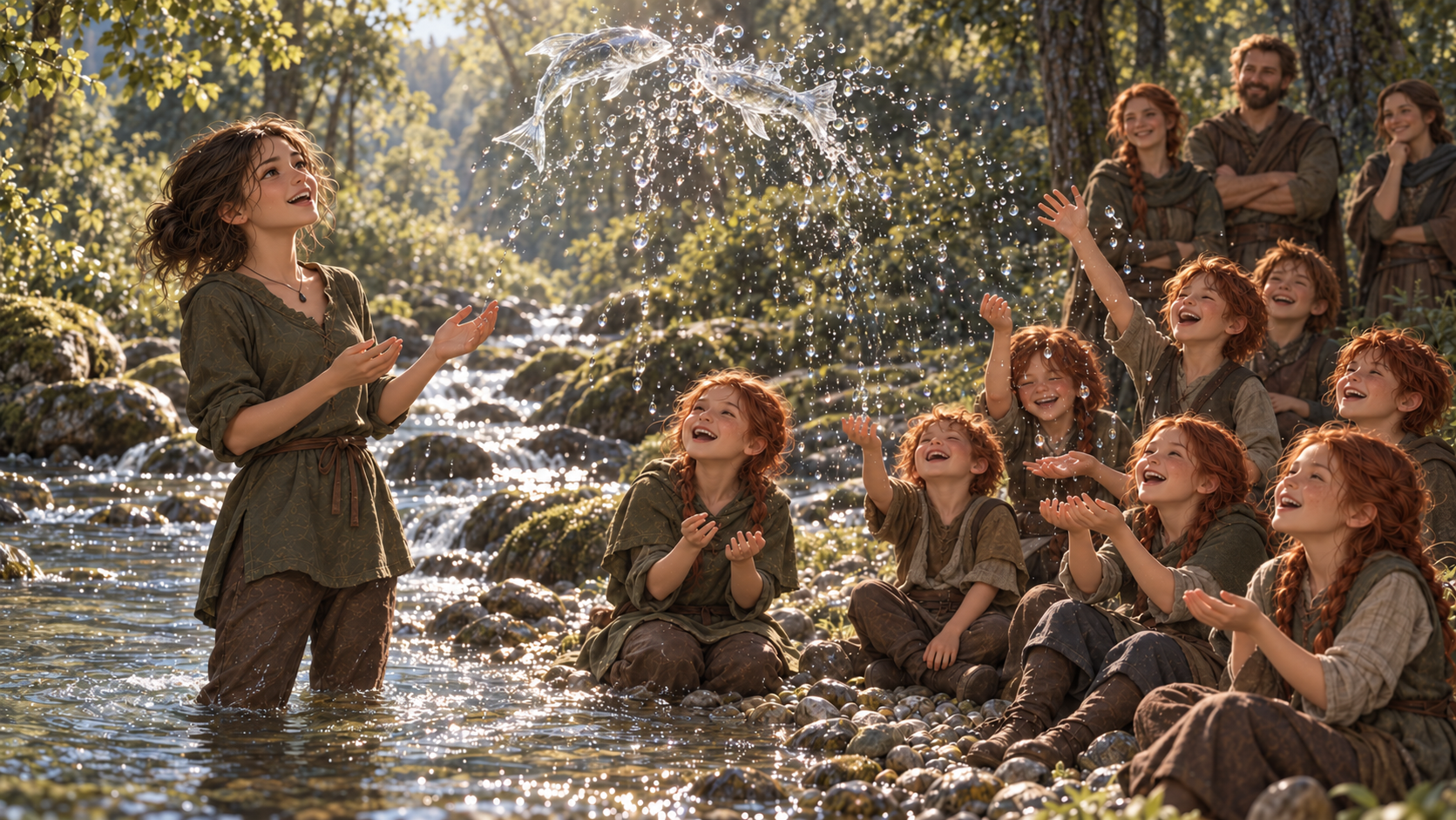
The audience arrived with the sun. Enna’s arrangement had become an institution: children sitting cross-legged on the pebbles in the front row, a few adults standing at the back, looking as though they were about to leave and never leaving. V’s fish shape was old news. Children were an ungrateful audience, and yesterday’s miracle was today’s “we’ve seen that one.” Which meant V owed them a small novelty every morning. The fish leapt. The fish chased each other. One morning, two fish collided in mid-air and turned to rain, and the rain fell over the children in a fine, sunlit curtain; the shrieks of the soaked crowd split the village in two, and V, feeling the tingling in her palms grow with the laughter, kept the rain going three times longer than she had planned. That evening’s file note was short: The power likes an audience. So do I. At least we have one thing in common.
The water bullet, on the other hand, was a project without an audience, because failure was the one thing V preferred to experience alone.
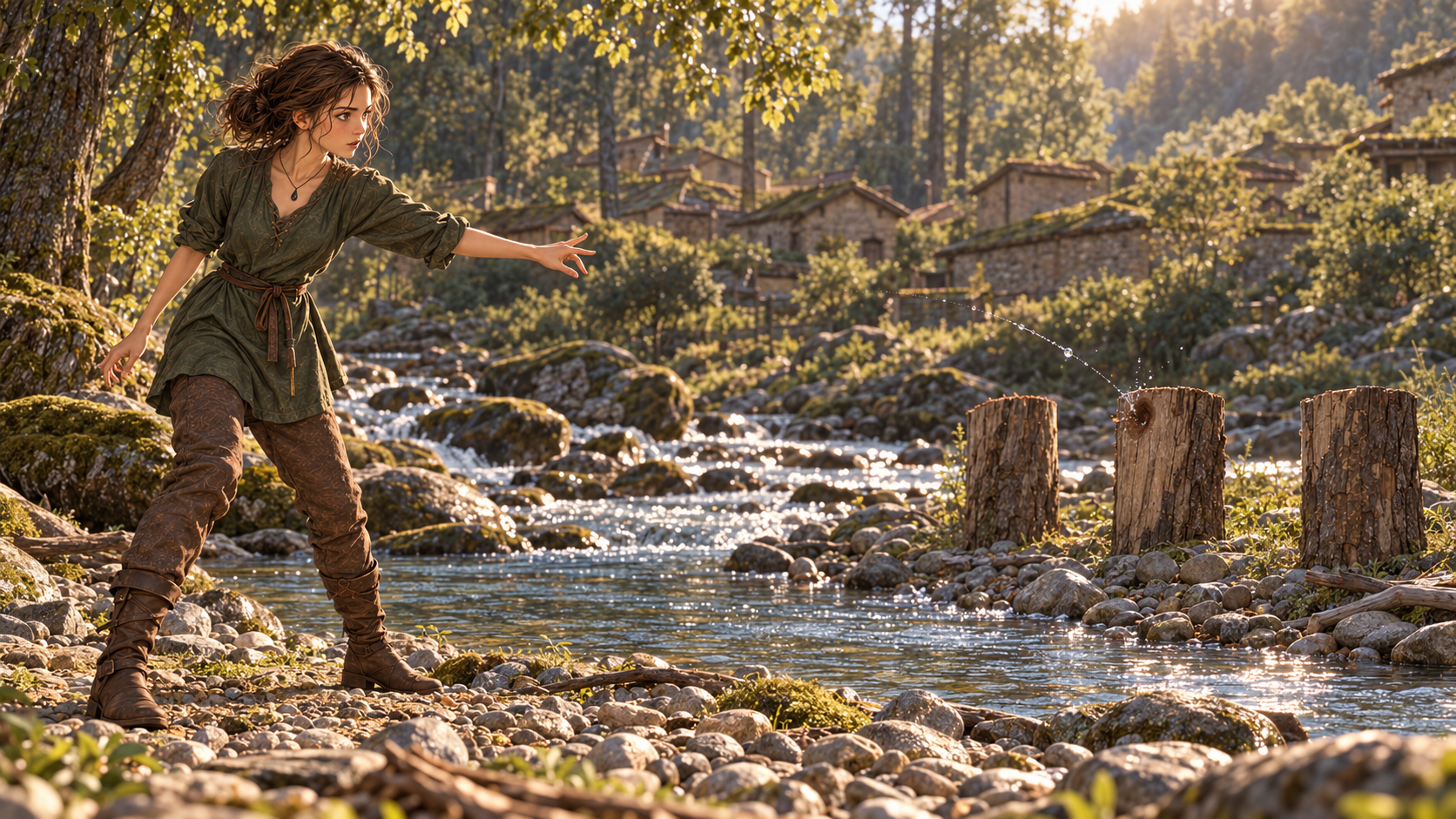
The idea had come from target practice: if she could give water a shape, perhaps she could give it speed too, make it hard enough. She set up three dry logs by the stream, at the lower bend where no one went, and spent hours throwing spray at them. She kept it up for two days without considering giving up, making bouquets out of water whenever she got bored. The moment it left her palm, the water lost its nerve and scattered in the air; what reached the target was not a bullet but a sneeze. Shape wasn’t the problem. She could hold a shape now. The problem was compressing the water. Compressed water grew hard, hard water grew heavy, and V knew this, but knowing wasn’t enough to do it; wanting, as always, waited outside the door.
The solution came through the usual door.
On the evening of the third day, standing in front of the log and breathing hard through her nose with frustration, V thought of Sirel. She had gone all the way to Sidra. Walked for days to investigate the mess V had left behind, put herself in danger for someone she barely knew. Then V thought of the rest: the times she had stayed silent, the times she had waited, all those small moments when she had stood beside V.
What would I do for you?
The answer came so fast that V laughed. It wasn’t a nice answer. It held whatever she felt for Sirel, but nothing very nice for anyone who tried to touch that.
And at that exact moment, she let the water in her palm go.
The drop, no bigger than a hazelnut, struck the centre of the log ten paces away with a sharp crack. It left a neat, wet hollow in the bark. Like a bullet wound.
V stared without moving for a while. Then she cut a notch in the log and stepped back.
Twelve paces.
Fifteen.
Twenty.
As the distance grew, the drop shrank and the mark deepened. On the third, fifth, perhaps tenth shot, V understood what she was doing differently. She wasn’t pushing the water. Wasn’t driving the power through her arm and throwing it at the target. She was only holding it until the right moment, then letting go.
Release.
She knew the word. Had known it for years. At the end of a stroke, in a turn, at the start; that tiny moment when you gained speed not by trying harder, but by letting go at the right time.
V looked at the new hole in the log. Her swimming career was turning into a weapon in another dimension. She couldn’t decide whether that was ridiculous or magnificent.
She added two notes to the file: You don’t force the water. You release it.
And beneath them, after a little thought: Sirel helps. We are not filing the reason for that just yet.
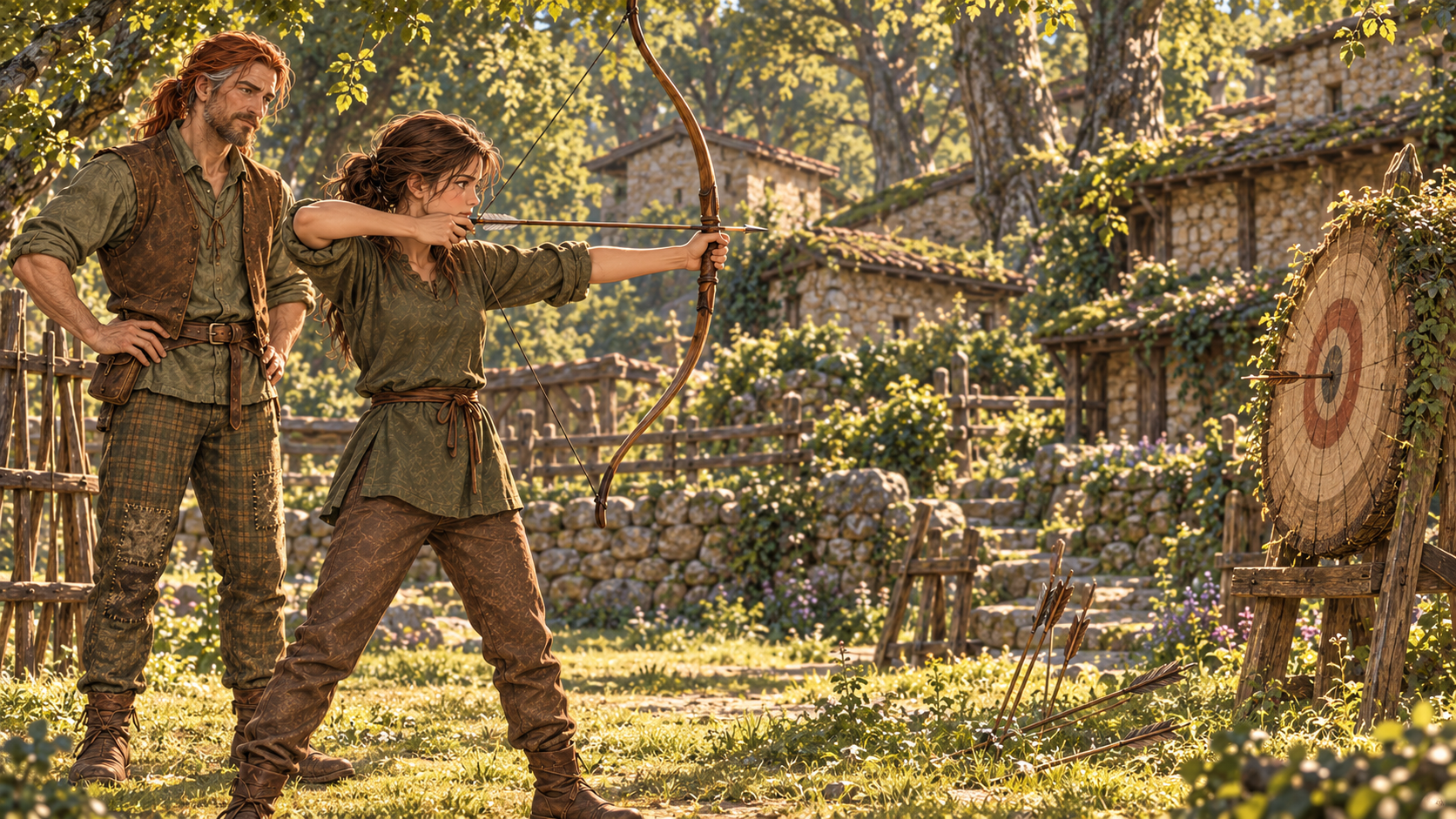
The bow took revenge for all of it.
The range was at the southern edge of the village, and it belonged to Tarn: a man in his forties, grey at the temples, his fingertips callused hard as horn by bowstrings. Every bow in Keral had come from his hands, and Tarn knew them like his own children. Which string loosened in the damp, which stiffened in the cold, which cried in a beginner’s hands. The bow he gave V was the most patient bow on the range; Tarn himself was the most patient thing on the range, and that was not a compliment. His was the patience of stone: nothing wore it down, nothing tired it, and with geological indifference he translated every mistake V made into the same three words.
“Elbow. Breathe. Again.”
Strength wasn’t the problem. V’s back had handled the draw from the first day, and Tarn’s eyebrows had risen a millimetre when he noticed, which by Tarn’s standards was a standing ovation. The problem was the system. A bow was a sentence: angle of the feet, line of the shoulders, alignment of the string, seeing the target, not seeing the arrow, anchor point, breath, release… The parts had to come in order, and if a single one moved out of place, the sentence lost its meaning. V’s body refused to make sentences. For years, V’s body had lived in a language of one word. Release. And that language was at war with the grammar of the bow. The arrows went left of the target. Right of it. Over it. One, apparently intent on personally insulting the laws of physics, did something backwards, and as Tarn retrieved it from the grass and examined it, he used more than three words for the first time:
“Don’t,” he said, “do that again.”
“If I knew how I’d done it, I’d promise.”
“Elbow. Breathe. Again.”
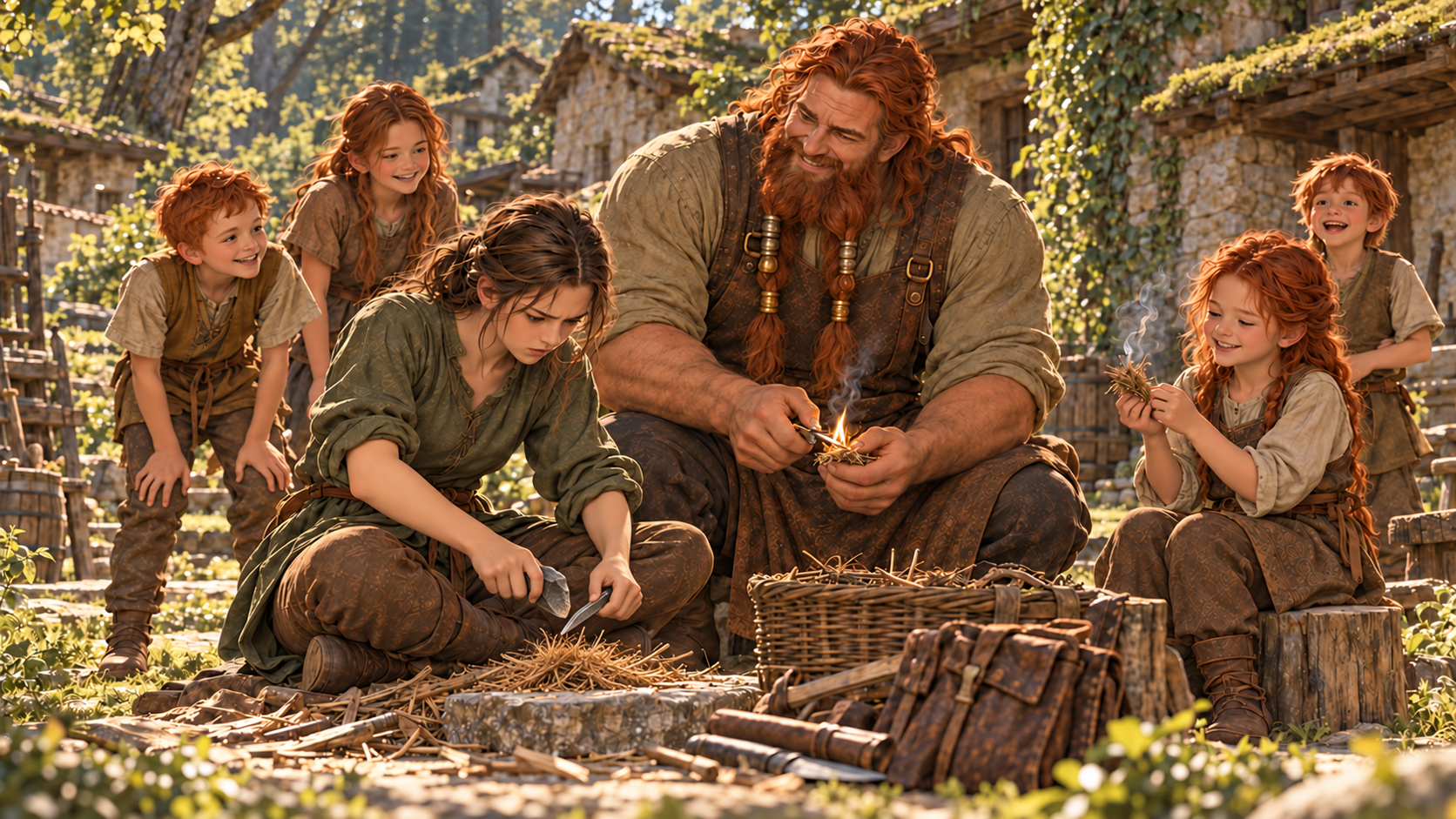
Roval’s lessons fell at the end of the afternoon, in the softest stretch of daylight, and V arrived at the first lesson already prejudiced against him: life lessons from a man whose arms were thicker than her legs, whose beard was divided in two and tied with beads, and whose face could be translated as “keep away” had not been on her list. The prejudice collapsed within ten minutes. Because when she reached his teaching ground, eight children sat around him, looking at that frightening face as though it were a sweet jar.
Roval’s school was simple: the forest doesn’t want to kill you, but if you’re an idiot, it won’t help you either. Every lesson was a footnote to that sentence. Which mushrooms fed you, which put you to sleep, which never let you wake again. Where to drink water, where never to. How to dress a wound, how to walk on a bleeding leg. Why you built a shelter on the slope rather than the hilltop. And fire. How to light a fire.
The fire lesson became the darkest page of V’s career in Keral.
Flint and tinder were a three-second job in Roval’s hands. In the children’s, a proud struggle of a minute or two. In V’s hands… In V’s hands, flint became a lump of mineral that refused to spark on principle. A six-year-old girl, Verral’s little sister, whom V was now certain had been sent specifically to torment her, produced smoke on her third attempt and gave V that look: the polite, lethal look of someone about to offer help. Roval watched it all from behind his beard without a word, and at the end of the lesson he crouched beside V, took the stone and tinder from her hands, lit the fire himself and, looking at the flame, delivered what passed among Serndals for a consoling speech:
“You’re water. Put it out.” A pause; the beaded beard shifted with the weight of a smile. “We’ll light it.”
That evening, V reluctantly entered a fact in the file: she was beginning to like this man. Label: looks like a bear, loves children, sense of humour from the Stone Age, but has one. Keep the file open.
At the fifth lesson, something came out of that file by accident.
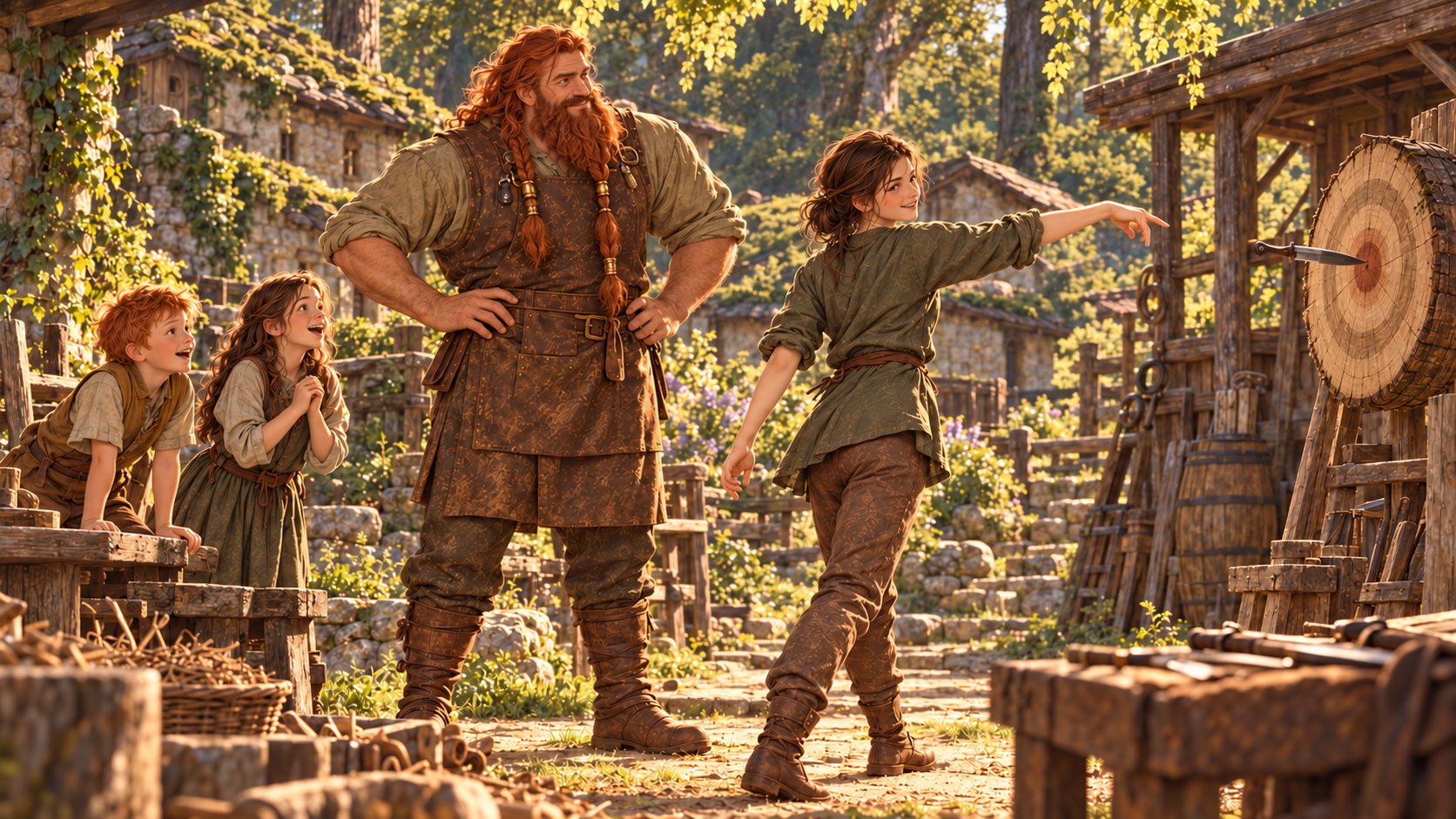
The lesson that day was looking after tools. Roval was teaching the children to sharpen knives and had laid his own side by side on the log at the edge of the ground, like a row of slender fish. As the lesson broke up, V helped clear away and picked up one of the knives. And with a small, quiet click, the world fell into place.
She didn’t know how to describe it; she tried later, in her report to the stars, and the closest she could get was this: a bow was a sentence, a knife was a word. No line of sight, no sequence, no grammar; there was a hand, there was weight, there was release. V looked at the target log at the far end of the ground and did not ask, did not think, did not decide. Her shoulder turned of its own accord, and the knife made one and a half turns in the sinking sunlight and buried itself in the log with a thud.
Silence. Two children gathering their things had frozen where they stood. V looked at her own hand. The hand offered no explanation.
Roval put down his whetstone. Walked to the log. Pulled the knife out, examined the angle at which it had entered, checked the depth with his thumb and turned to V, speaking slowly, deliberately, with the solemnity of a ceremony:
“Again.”
The second throw grazed the edge of the log. The third struck handle first and fell, and a voice inside V whispered, It was a fluke, then, but the fourth stuck. The sixth stuck. The seventh buried itself two fingers’ width from the first, and as Roval pulled two knives from the log and held them out to V, he announced his decision:
“Day after tomorrow. No children.” He placed the knives in V’s palm, handles first. “Just you.”
That night, V went to the bank to give her report and informed the bright pair: “Make a note: today I was good at something on the first try. In this dimension. For the first time. Turns out it’s knives. Nobody act surprised. I liked swimming on the first day too.” A pause; then, more quietly, the real item in the file: “Water bullet, stone, knife. It’s all the same thing, really. Shoulder, wrist, release. One line. The bow speaks a different language. Not mine. In my language, there’s only that moment.” The stars, as always, made no comment. V took that as approval.
She had known she was being watched since the second day.
The feeling was familiar. A prickle at the back of her neck, no one there when she turned. But this time it didn’t frighten her. She was in Keral, and V knew by now that nothing here wanted to hurt her.
She filed it anyway.
A patch of red among the rocks on the opposite slope during a morning at the stream. Gone when she turned to look again.
At Tarn’s range, a shoulder jutting out of the shade beneath the storeroom eaves.
On the way to Roval’s courtyard, a figure crouching by the fence beyond the vegetable beds. He had no business with the fence. Besides, he was so big that the attempt to hide was funny in itself.
By the third day, V was certain. Someone was watching her.
She came across him at close quarters for the first time in the village square, and realised she needed to rewrite his file.
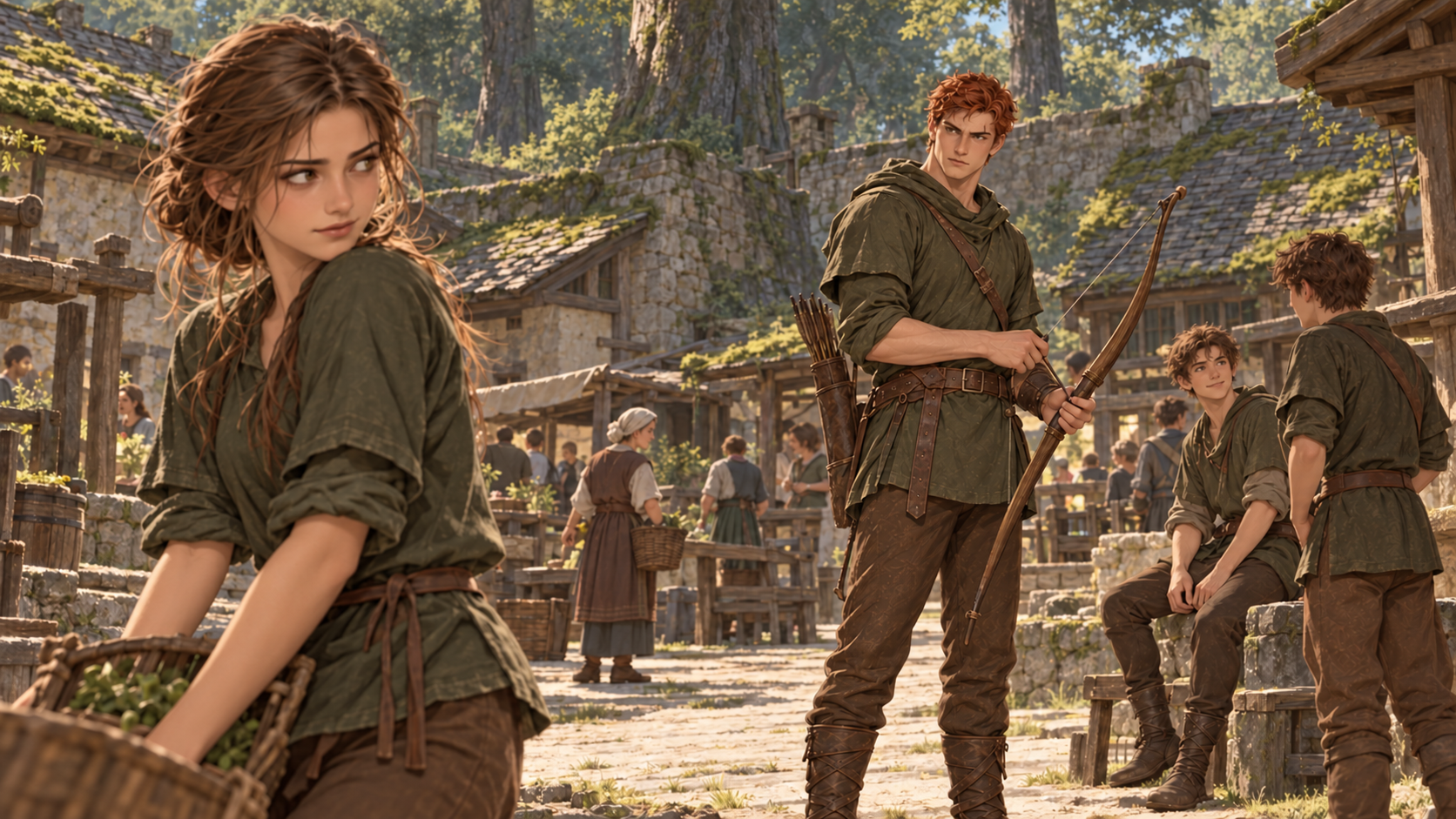
The strangest thing about him wasn’t his size.
Though he was big.
Tall; when V saw the difference in height between him and a child passing in front of him, she couldn’t help looking again. He had broad shoulders, red hair cut shorter than most of the other men’s in the village, and a thin, old scar above his left eyebrow. But none of that was what held V’s attention.
The man didn’t know how to be still.
He was standing still, of course, at the edge of the square with a few younger people, checking bowstrings. But his body wasn’t resting. He listened to a child speaking and watched the entrance to the square at the same time. When he picked up a bow, his fingers tested the string while his eyes caught movement somewhere else. When someone passed behind him, he didn’t turn, but seemed to know they had gone by.
V looked a little too long without realising it.
The man raised his head. Dark green eyes found her directly.
V immediately pretended to be interested in the nothing in front of her.
So you’re the male Sirel, ice man. What exactly do you want from me?
When she looked again a minute later, he was no longer looking at her.
For some reason, that was more annoying. She did not file it.
Enna told her who he was. V hadn’t even had to ask; all she had said was “Who’s the one with the short hair?” and a secret far too large for a ten-year-old to carry had appeared on Enna’s face.
“Harek.”
Enna glanced around and lowered her voice to a child’s whisper. In other words, a volume half the square could hear. “My sister gave him a job. When she left. I heard, but I wasn’t supposed to hear, so I’m telling you, but you mustn’t tell anyone because I don’t know.”
V did not attempt to untangle that logic.
“What job?”
Enna pointed at V with her whole body, with both hands.
“You.”
“Me what?”
“He’s going to protect you. All the time. But you won’t see him.” Enna said the last part in her Sirel voice. “That’s what my sister said: she won’t see him.”
V looked across the square.
Harek was still working on one of the bows.
“That’s not going very well.”
“You’ve seen him?”
“For three days.”
Enna’s face fell. “Don’t tell. There’ll be trouble.”
“From who?”
“Both.”
That made more sense.
Enna moved a little closer.
“Harek wanted to go with my sister. He was really angry. Harek never raises his voice, but he did that day. He said he should be the one protecting Sirel. Because Harek’s the best at fighting. And my sister said, ‘Harek stays here and acts as a shield.’”
Enna paused for dramatic effect.
“Then what?”
“He slammed the door.”
V looked at Harek again.
He had just taken a bow from one of the younger people. Pulled the string with two fingers, said something, handed it back. The boy nodded. There was no triumph on Harek’s face, no teacher’s air. As though he had done something he was supposed to do. That was all.
The file opened by itself.
Harek. Assignment: babysitting. Job satisfaction: hostile towards doors.
Another line followed.
When Sirel left, she left the best fighter in the village behind for me.
V stopped there.
She did not investigate why the last line made her feel a little warmer inside.
Doing the same things every day was boring enough already. Now that she was beginning to get the hang of a few things, she had shortened her training sessions too, and V noticed a dangerous symptom in herself. She was bored.
Boredom was a hazardous substance in V, and V knew it; a bored V invented games, and the games generally annoyed someone. This time the game had found her.
If the man was watching her, and if he wasn’t supposed to be seen, then the name of the game was Catch Harek.
V collected data without letting anything show. She filed Harek’s positions. Stream: rocks on the opposite slope or the stand of willows; range: storeroom roof or southern fence; Roval’s courtyard: fence by the vegetable beds. She worked out the rotation: the man never used the same spot twice in a row, cycled through a pattern of three, and the pattern was locked to V’s own schedule.
On the morning of the fifth day, V did not go to the stream.
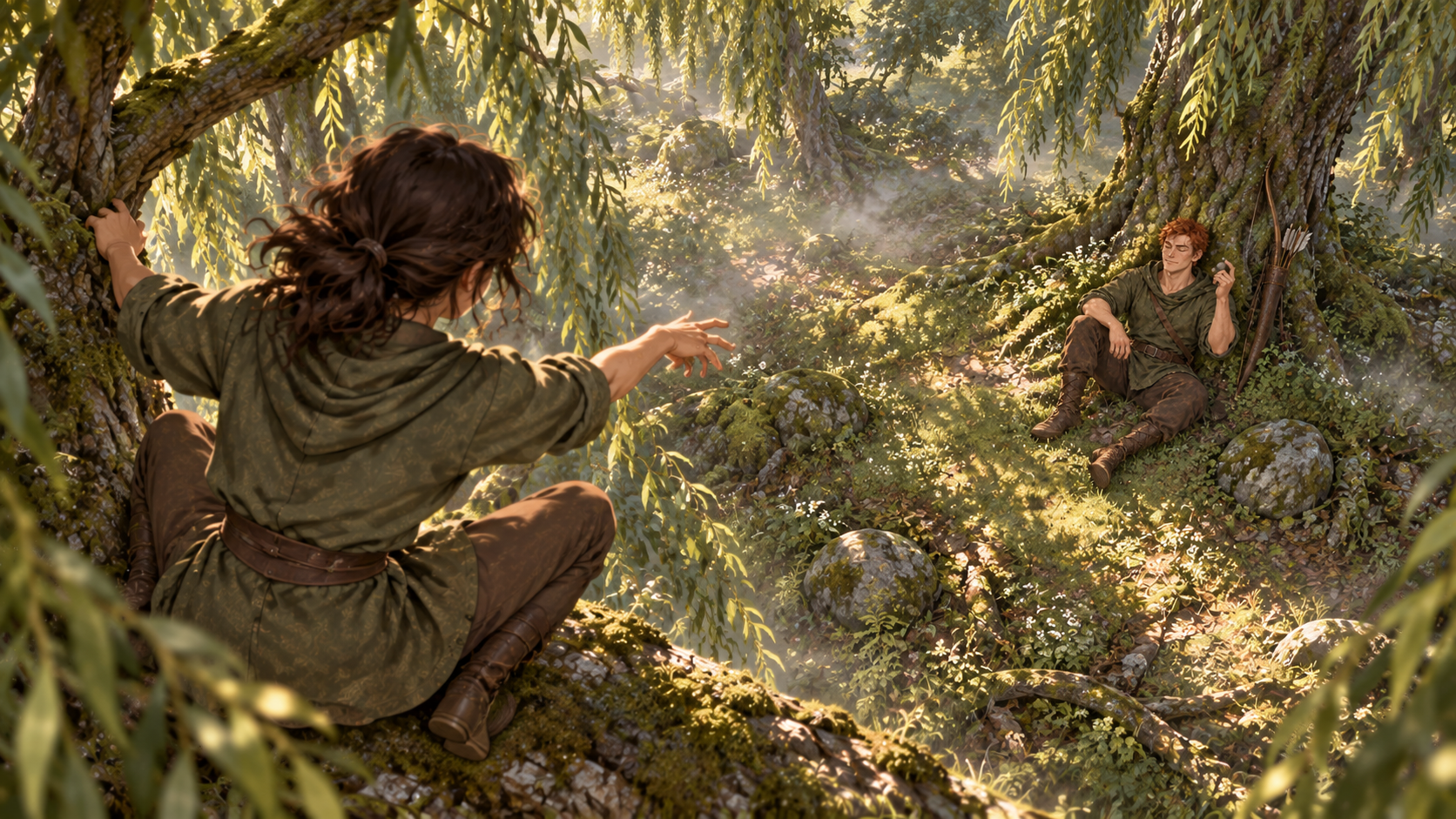
She left the path to the stream, went between two houses and round behind the vegetable beds, and settled into the upper branches of the tree behind the willows before sunrise. She waited. The morning mist thinned, the village woke, and a shadow slipped among the willows with a silence that had no right to belong to a body that size. He took the bow off his back, set it beside him, then leaned against a tree and entered dozing mode.
V watched him from her branch.
Is this a joke?
She waited a little longer.
Harek didn’t move.
He’s asleep.
The man assigned to protect me is sleeping on the job.
This was no longer a game. It was a public service.
V weighed the stone in her palm. The plan was simple: drop it politely at the man’s feet, like a business card. But up on the branch, looking at that dozing rock, the polite version of the plan died. And with the final, gentle turn of the wrist Enna had taught her, V sent the stone straight at his head.
Afterwards, V rewound it in her mind over and over, always getting stuck at the same point: the hand. Harek’s eyes had been closed. V could have sworn to it. A handspan from his head, the stone stopped in mid-air with a dry slap. When had his arm gone up? It hadn’t. While the stone was moving, there had been no arm, and when the stone stopped, there was an arm; there was nothing in between.
Harek did not open his eyes. He felt the stone once in his palm. Its weight, its kind, as though reading whose stone it was, and spoke; without rising, his voice carried through the morning mist to V’s branch:
“Fourth day. Your footprints on the stream path were deep.”
V’s mouth opened.
Harek went on with his eyes closed:
“You weren’t carrying anything.”
He set the stone on the root beside him.
“You were planning something.”
V still said nothing.
“Today you didn’t go to the stream.”
A pause.
“Good tree.”
Then:
“Bad branch for getting down.”
V stayed on her branch, mouth half open. He’s been watching me watch him. While I was setting up my game, he was filing the fact that I was setting up a game. And he had come anyway, sat down at his next spot, taken off his bow and dozed. This hadn’t been carelessness. He had accepted the game.
“But you were asleep,” V said, trying to recover from the defeat in her voice. “Your eyes were closed. Were you pretending that too?”
“I was asleep.” At last, Harek opened his eyes, and the shaded green of the forest found V on her branch. “Ears don’t sleep.”
V climbed down. Harek was right about the branch; it really was a bad one for getting down, and the final part of her descent was less graceful than planned. She planted herself in front of him. Up close, the difference in height was ridiculous; V’s head came to his chest, and she lifted her chin anyway:
“All right. A draw.”
“No.”
“Why?”
“I caught the stone.”
“You caught it in your sleep. That doesn’t count. That’s a reflex. You didn’t do it, your body did.”
Harek looked at her.
V heard her own sentence.
“Fine. It counts.”
Harek picked up his bow.
“But I’ve been seeing you for five days,” V said. “I worked out your rotation. Three spots. It changes with my schedule.”
Harek paused as he slung the bow across his back.
For the first time, V saw something on that face.
It wasn’t a smile.
But it might have been a very distant relation.
“Two days.”
“What?”
“First three days, your gaze was clean.”
V frowned.
“Then it wasn’t.”
For a second, V didn’t understand. When she did, she was annoyed.
“You knew I was watching you…”
“Yes.”
“For two days?”
“Yes.”
“And you didn’t say?”
Harek shrugged.
That was all.
Looking at him, V laughed despite herself.
Harek started walking. After a few steps, he stopped and spoke without turning:
“Good throw.”
V stopped laughing.
“Enna taught you well.”
Another step.
“Next time, aim at my feet.”
“Why?”
Harek half turned his head.
“Aim at my head, you get an arrow back.”
Then he left.
V was alone beneath the willows.
After a while, she opened the file.
Correction: ice man can make jokes.
She thought about that for a while.
Worse.
That morning, an agreement was signed without words in V’s head: Harek would keep watching, V would stop pretending not to know, and neither of them would say a word to Sirel. And V made full use of the right this agreement gave her: if the man was her shadow, she could talk to the shadow.
The questions began during breaks. Between training sessions, V sat somewhere near Harek’s post and let her questions out into the air, making no secret of the fact that she expected answers. Small questions, short answers.
“When will Sirel be back?”
“Don’t know.”
“Where does this stream go?”
“East.”
“Then?”
“The sea.”
“Why can’t I get the bow right?”
“You think too much.”
V opened her mouth to object, remembered everything Tarn had been saying for days, and closed it.
One afternoon:
“Why are you always such an iceberg?”
Silence followed.
V had stopped waiting for an answer.
Then Harek smiled. No laughter. Just one corner of his mouth moving first, then the hardness that always stood ready on his face falling away for a few seconds.
V had her next question ready. She forgot it.
Harek’s smile faded. V was still looking.
“What?” Harek said.
“Nothing.”
V looked away.
No new line was added to the file that day.
In answer to “Is Yavzin big?”, a handful of words fell from among the willows. “Ten times Sidra.” And V caught something different in that answer.
The answers were always short, but V was an expert at reading short answers now; Sirel had trained her in the language. And Harek’s held something Sirel’s did not: detail. The man who knew Yavzin was ten times the size of Sidra had never seen Yavzin.
“How do you know?”
“Been told.”
“But how do you know all of this?”
“I know.”
“That’s not an answer.”
“Pirig told me. Visitors told me. There are maps.”
V asked more questions.
Harek knew which slopes held snow. Which road turned to mud in spring. Which city lay behind the mountain, which river flowed where, in which direction the sea began.
All the places he had never been were inside his head.
Someone who had never seen beyond the walls had memorised every stone on the other side. As V filed the contradiction, a strange ache caught in her chest, because she knew its name. The plastic stars on her bedroom ceiling had done the same thing for years: learning by heart the places you couldn’t go.
One evening, on the way back from the stream, she asked without thinking.
“Have you ever left Tishar?”
Harek didn’t answer. V walked a few steps. His voice came from behind her.
“Twice.”
V stopped. Harek did not catch up. He kept the same distance.
“How far?”
“The border.”
“Then?”
For a while there were only footsteps.
“The trees end at the border.”
Harek’s voice was slower than usual this time.
“Open beyond.”
A breath.
“The sky comes all the way down to the ground.”
V turned to look at him. Harek was looking at the path.
“Is it beautiful?”
“Yes.”
“What did you do then?”
“Came back.”
“Why?”
This time the answer came at once.
“Duty’s here.”
V walked on. But a few steps later, she turned to look again. Harek was the same Harek. Short red hair. The bow over his shoulder. The expression that gave nothing away. And yet, for the first time, he looked different. For the first time, less like the village’s best fighter than a young man who had stood at the border, looked at the place where the sky came down to the ground, and not crossed.
V let that look last a little too long.
If Harek noticed, he didn’t say.
That night, in her report, V informed the bright pair: “New file: iceberg. Correction. Not an iceberg. Icebergs float. They go places. This is something chained.” She drew her knees up. “Turns out being the best in the village isn’t such a good thing. If you’re the best shield, everyone puts you somewhere and you stand there. The man knows half the world and hasn’t seen any of it. Twice he went as far as the border. Saw the sky come down to the ground.”
V fell silent. She didn’t want to say the next sentence. She said it.
“And came back.”
The stars listened.
“Sirel told him, ‘Be a shield.’ He got angry. Slammed the door. Then stayed.”
She looked at the water for a while.
“Would I have stayed?”
She didn’t look for an answer.
“File note: do not reopen this question.”
But the file did not close. And V kept asking. Only now, she chose her questions. She asked about the mountains. The sea. The Nyvras.
“Never seen one.”
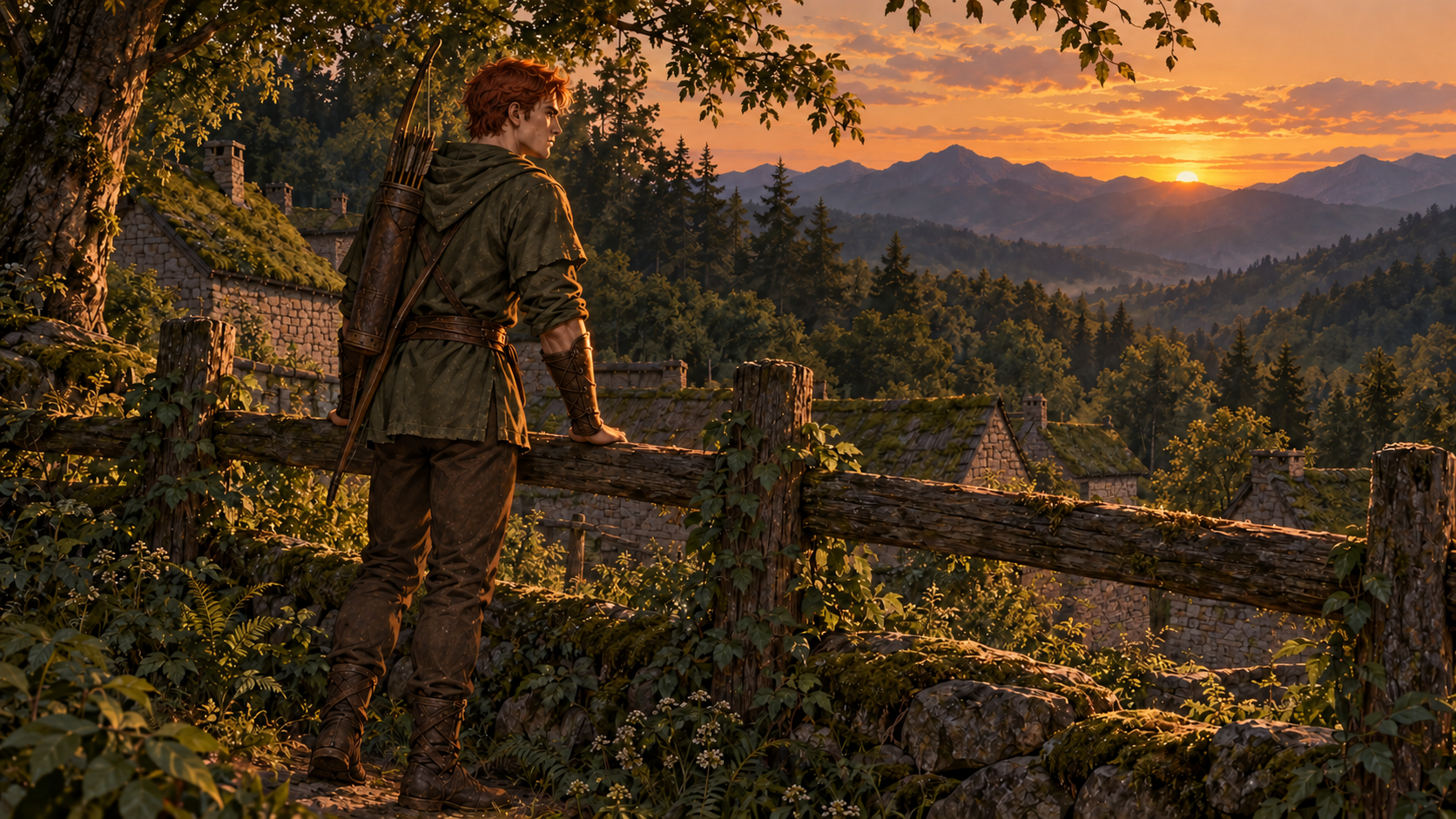
V heard the other word underneath those words: yet. And once, only once, she asked, “If you could leave here, where would you go?” Harek didn’t answer; but that evening, at the changing of the watch, V saw him again by the western fence. Facing the mountains, his short red hair copper in the sunset, so still he might have been stone.
That evening, V put the last label on the file: Harek. A drawn bow. But he’s the one holding the string.
One day, V was sitting near Harek’s post, turning a pebble between her fingers, when she thought of something she hadn’t asked all these days. “Are you Keral’s commander?”
Harek looked at her. “No.”
“But everyone listens to you.”
“When?”
V needed a second to realise that was an actual question. “I don’t know. When you’re walking around, people are always bringing you their weapons and asking things. And I’ve seen you talking to groups of people a few times.”
“No.”
“What do you mean, no? I saw it.”
That faint trace of patience appeared on his face. “I tell them what I know. They listen. When others know more, they tell us. We listen. There’s a leader already.”
V sat up. “There is?”
This time Harek really looked at her. “Of course.”
“Why haven’t I seen them?”
“You have.”
“Who?”
Harek pointed with his chin at one of the houses across the square. V looked. A woman whose hair was almost entirely grey stood outside the door, talking to two men. V had seen her dozens of times. Had never once thought of her as a leader. “Her?”
“Her. Bisur.”
“So what do you do?”
“What I do.”
V closed her eyes. “One day I’m going to deserve an award for managing to communicate with these people.”
The corner of Harek’s mouth moved.
“All right. Say the people of Sidra attack.”
“They won’t. Too scared.”
“Hypothetically. I mean hypothetically. Say they attack. That woman says, ‘Go right,’ and you say, ‘Go left.’ Which way does everyone go?”
“If I say left, Bisur won’t say right.”
V put both hands in her hair. “Are you sure you know what ‘hypothetically’ means? Let’s say she does say right.”
Harek raised his eyebrows, as though considering a problem he had never encountered and was extremely unlikely to. “Everyone goes left.”
V’s eyes opened wide. “There! You’re the commander.”
“No.”
“Why?”
Harek thought for a while. This time he seemed to be thinking less about how to shorten his answer than where to put it so V could understand. “Because there’s an attack.”
V waited. Harek did not go on. “You need to expand on that.”
“Fighting is my work.” A pause. “The village is hers.”
V stopped turning the stone. “So whoever knows the job is the one who speaks?”
“Yes.”
V thought for a moment. “Does that mean Roval’s better at lighting fires than everyone else?”
This time a real smile appeared on Harek’s face. “Most can light a fire. Roval knows how to survive alone in the forest.”
“And Pirig tells you the things you don’t know.”
“If she knows.”
V liked that. Liked it too much. Something in her head had fallen into place. “What about when the attack from Sidra is over?”
“They can’t attack.”
V made as though to throw the stone at Harek. “When the attack is over, do people keep listening to you?”
“No.”
V laughed. “Wonderful. You’re king of the country for an hour, then nobody cares about you.”
“What’s a king?”
V fell silent. “I’ll explain that another day.”
Harek shrugged.
“What about Sirel?”
This time Harek was silent a little longer before he answered.
“Sirel is Sirel.”
V raised her eyebrows. “That answer was no use to me at all.”
“I know.”
V considered throwing the stone at him. Then she remembered their earlier agreement and put it down at his feet.
File note: among Serndals, no one is in charge of everything. Everyone is in charge of something. This system makes a surprising amount of sense. I’m disturbed.
Sirel returned late in the afternoon of the tenth day, and V already had her plan: she would pretend she knew nothing about Harek. An agreement was an agreement; the man’s service record would not be stained because of V. When their eyes met in the welcoming crowd, she put a small, secret flicker of complicity into her look: Don’t worry. To the grave.
Sirel, dusty from the road, lowered her bag from her shoulder, had that two-word reunion with her mother, then turned to Harek. A millimetre of the head: report.
“She caught me on the fifth day,” Harek said.
Every expression on V’s face collapsed at once.
“Climbed a tree. Threw a stone at my head.” Harek sounded as though he were reading the weather. “Spent two days studying my positions first. Worked out the rotation.” A pause. V saw something impossible stir on that granite face, a shadow of something. Harek lowered his voice as though he didn’t want V to hear: “Sharp. Very. And a smart mouth.”
V opened her mouth. “You… we… we had an agreement.” Then she closed it, because when she turned to Sirel, what she saw was nothing she had expected. Sirel wasn’t surprised. Sirel wasn’t angry. Sirel had inclined her head a millimetre, received the report and archived it. As though Harek telling her were as routine as the sun coming up.
“You,” V said to Harek, with the full weight of betrayal in her voice. “We said we’d take it to the grave.”
“First, you said that. I didn’t.” Harek nodded towards Sirel. “Second, she’s not the grave.”
And Sirel, tired and dusty from the road, Sirel who had spent days cleaning up the mess V had left behind, smiled at that. Half a millimetre, almost invisible. Then the smile vanished, whatever the road had brought back settled on her face again, and as she walked towards the stone house, she left the words that opened the meeting over her shoulder:
“Bad news.”
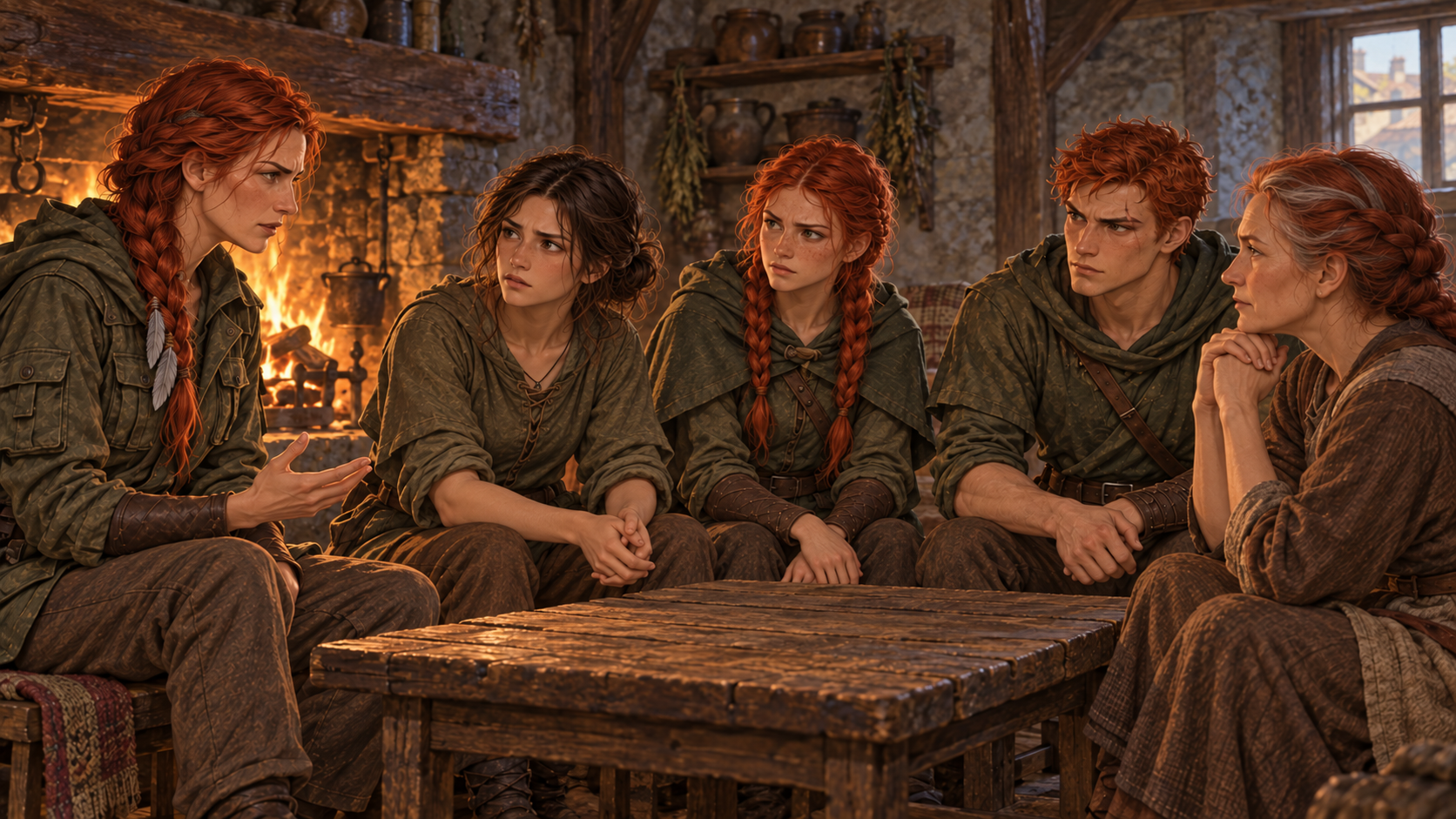
The meeting took place by the hearth: Pirig, Sirel, Ilva, Harek and V, because instead of closing the door, Pirig let V in. “It’s about you. You’ll hear it.”
Ilva did most of the talking, and as V listened, she understood the woman’s role in the group: Ilva was the one who saw and reported; her sentences were short but complete, like a scout’s map. In her forties, two grey feathers in her braid, a level voice.
The dead man’s name was Malden. And Malden wasn’t just anyone’s son. He was Bargas’s son: Sidra’s biggest merchant, the man who controlled the gemstone trade, the man who had paid for both bridges to be built. V’s stomach soured as the description unfolded. Of course. Of course he wasn’t just some street thief. Of course his father was the most powerful man in town.
But that wasn’t the worst of the news. Ilva seemed to have arranged it from bad to worse. The story had spread a long way; merchants from Yavzin said people were talking about it there too. With one small difference. Rumour had dressed the corpse of the truth in an entirely different set of clothes. In the story being told in town, a strange girl had offered to sell Malden the stone around her neck; the bargain had been struck, the money counted. Then the girl had taken both stone and money, drowned Malden with magic and fled into Tishar. There was no mention of what happened under the bridge, of the three men, of the cord being pulled. There was a murderer in the story, and the murderer’s description was V’s.
“I…” V’s voice came out and faded. “I didn’t sell him anything. He…”
She stopped. She didn’t need to explain it again to people who already knew the truth. What came next was worse. The day after it happened, Bargas had put together a party of thirty. Hired men, hunters, two trackers, and the party had entered Tishar carrying torches. Torches. V looked up the moment she heard the word and saw Harek’s jaw tighten half a millimetre at the other end of the table, saw Sirel’s eyes find hers for a second. The three of them shared the same silent sentence. If it sees fire, it comes.
On the first night, deep in the forest, something had attacked the party. According to the survivors, something shapeless and as vast as the darkness itself, something with a shadow in the dark. Seventeen of the thirty men had been torn apart. The rest had barely escaped with their lives. The story in town now had a new chapter: the girl had made herself a monster out of the forest’s darkness, and the monster had eaten the men who came after her.
“Vharn,” V said hoarsely. “It was Vharn that tore them apart. The torches…”
“Not your story,” Sirel said. She was speaking for the first time, and her voice was more clipped than ever. “Theirs. About you.”
And the last piece: Bargas was no longer sending men into the forest. Bargas was doing something bigger. Assembling a delegation. Merchants, town elders, associates from Yavzin. The delegation’s destination was not Tishar.
“They’re going to the Nyvras,” Ilva said. “They’ll demand the girl. Either her.” A pause; the level voice grew a degree flatter. “Or her body.”
In the silence, a log collapsed in the hearth, and as V watched the sparks rise up the chimney, one thing became perfectly clear: her story had set out before her. In strangers’ mouths, in strangers’ words, it was travelling beyond the mountains, and the Nyvras would first meet her through the sentences of Bargas’s delegation. Murderer. Thief. Maker of monsters.
“Then I have to get there first,” V said. Her voice didn’t shake, which surprised her too. “I have to tell my own story.”
Pirig gave her a long look, that reading, weighing look, and bowed her head with the weight of a decision. “Not tomorrow,” she said. “The morning after. We need a day to prepare.” Then she turned to her daughter, and a silent sentence V could not read passed between the two women. Sirel’s chin rose a millimetre: I’m coming too. Pirig’s eyes closed a millimetre: I know.
No one asked who was going. Among Serndals, apparently, these things arranged themselves without discussion.
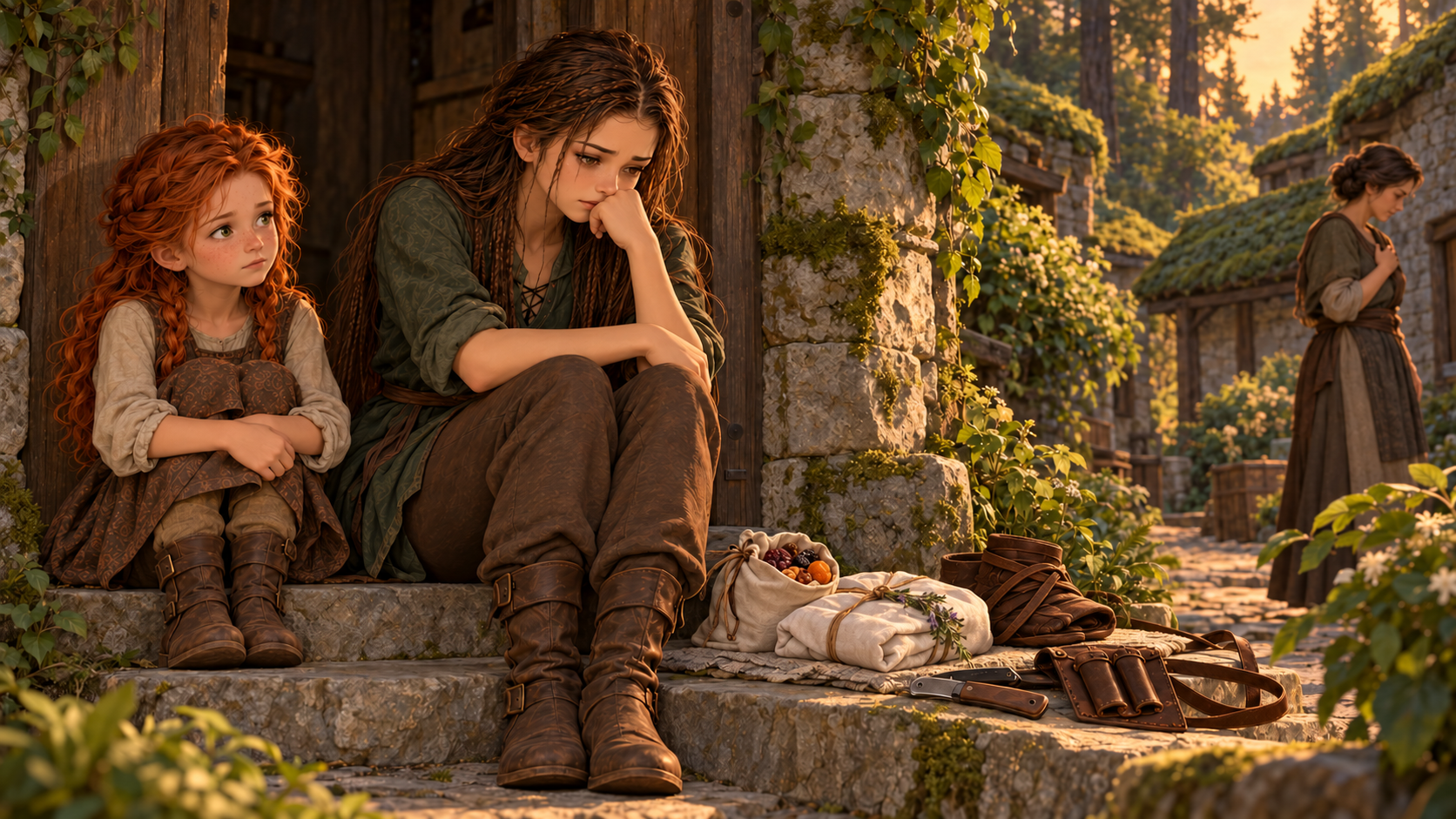
On the day of preparations, V lived through the strangest rehearsal for goodbye of her life.
The village had heard she was leaving. V didn’t know how; in Keral, information found its own course, like the stream, and all day things arrived at the door of the stone house. No one spoke, no one hugged her. A pouch of dried druvil. A new pair of leather foot-wraps, made to fit V’s feet. A small folding knife. A handful of klessar wrapped in clean cloth. Each person left what they had brought at the door, put a hand over their heart and went away, and by afternoon V was sitting on the threshold, looking at the pile in front of her, fighting the knot in her throat. They don’t even know me. I made their stream stand up once and made water fish for their children. That’s all. The shelf would not accept this file. Its label was simple, and V was resisting putting it on, because once the label stuck, leaving would be harder.
Roval came. Beside the three knives he had given her, he laid a leather shoulder sheath he had stitched himself: three slots, made to fit V. Of all the gifts, V liked this one best. Wearing it, she looked like a Serndal. With one small difference: a Serndal with black hair and brown eyes. If she braided her hair like Sirel’s for the journey, she would feel more confident still. Tarn brought no bow; he placed a small, flat whetstone in V’s palm and delivered his farewell speech: “Knives go blunt.”
Enna spent half the day at V’s side, and the growing silence of a child who normally never stopped talking accumulated like a stone in V’s chest. In the evening, she finally burst out: “I can come too. I’m small, but I’m fast. Faster than Verral. You can ask.” V took Enna by the shoulders and used the girl’s own weapon against her: “You’re staying here because I’m giving you a job. Keep my water-show audience together. When I come back, I’ll make a proper downpour over all of us. But no audience, no rain. Deal?” Enna weighed the seriousness of the assignment and sealed it: “Deal.” Then she hugged V round the waist, and V left the labelling of this file for later.
That evening, Pirig sat her down facing the hearth one last time, and this final conversation became one of the longest V had heard in Keral.
“The road is long, and I’m not coming,” Pirig said. “So let me tell you what I need to tell you now, without rushing. I don’t want you learning half of it on the road when you’re tired.”
She raised her fingers one by one, as though each were a name. “Sirel is coming. You know that already. Ilva is coming; her eyes speak all the forest’s language that you cannot see, so she’ll walk ahead. Tarn is coming; his patience keeps things in check, and his experience may be the one thing you can rely on in the mountains. He’s the only one of us who never hurries anything. Not even his own life.” She smiled at that last sentence. “Roval wants to come. We’ll know tomorrow morning; his hands make weapons and stitch wounds, and you’ll need both. And Harek is coming.” For the first time, there was the shadow of a smile in Pirig’s voice. “Because Sirel never even considered sending you without him. Six of you. There’ll be twenty of you as far as the Tishar border. Fourteen will turn back; the six of you will go on. Beyond the border, a crowd is no use. A crowd means noise, and noise means being found.”
“What about after the mountains?” V asked. “I mean… what’s the route? Where exactly are we going?”
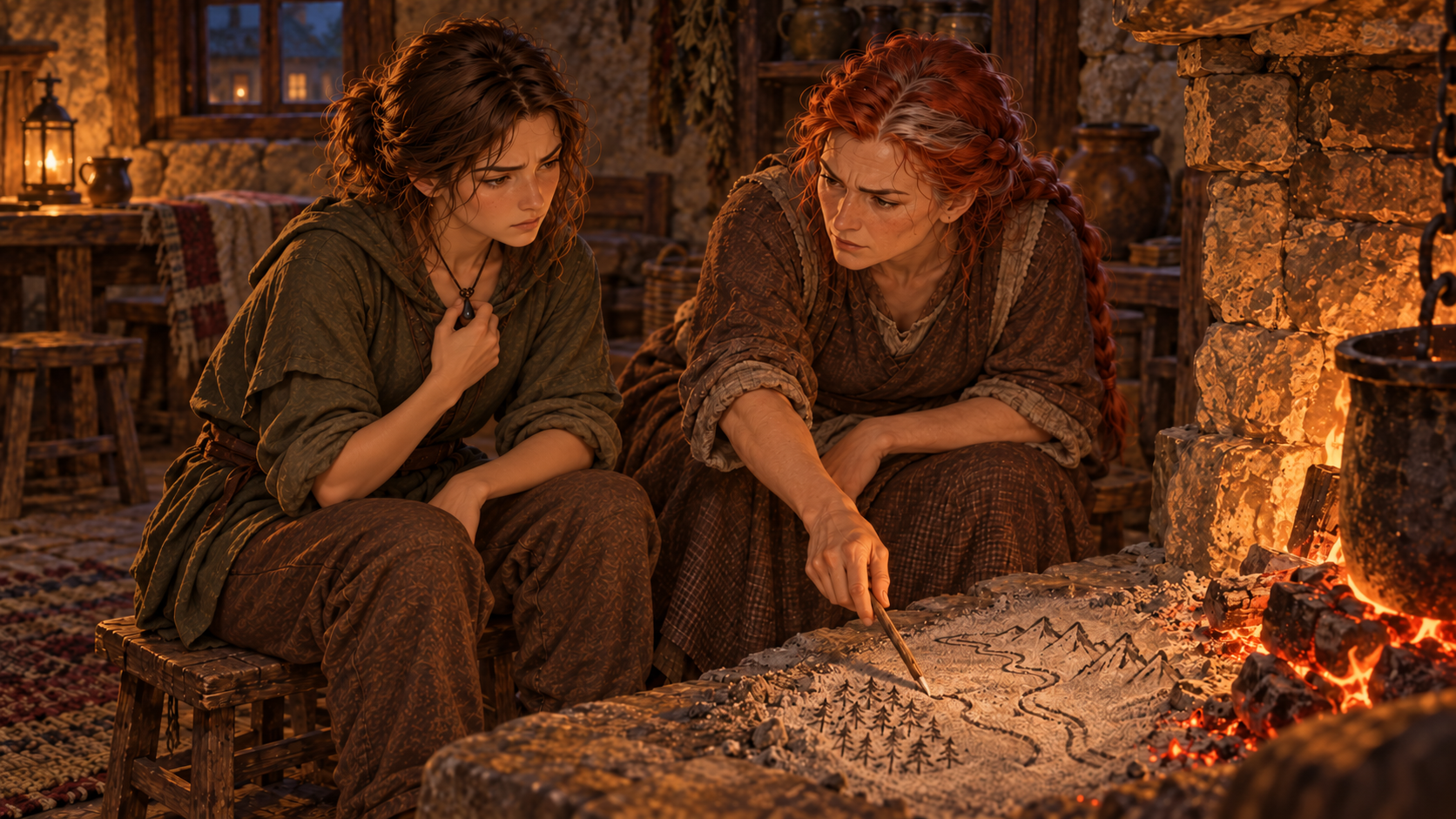
“That is the real question.” Pirig reached a stick into the ash beside the embers and slowly scratched out a map. V’s first map of Tishar: a broad, uneven patch; on its western edge, mountains like a jagged wall. “Tishar ends here. You’ll reach the border in five days. The forest is yours. That’s the easy part. Beyond the border, these begin.” The stick came to rest on the jagged lines. “And listen carefully, because from here on I’m telling you what I know, not what I’ve seen. I can’t give you the road itself, only everything that has been gathered about it. What three generations of the Vaerin line have heard from merchants, fugitives and the few men who returned alive. Remember the difference: what I know is the map. What I don’t know is what the map will do on the day.”
“If the mountains are that bad,” V said, “isn’t there another way?”
“There is. The traders’ road to the south, round the foot of the mountains. Safe, wide, it even has inns.” Pirig swept the stick in a long curve south of the map. “And it takes three full weeks. Bargas’s delegation will go that way. There are a lot of them, they have baggage, and merchants know the merchants’ road. If you take it too, Bargas’s story will be waiting when you reach the Nyvras’ gate. Not to mention the chance of meeting the delegation itself on the way.” The stick came back and tapped a point in the middle of the mountains. “Cross through the pass, and it’s nine days, ten at most. You’ll arrive at least a week before them. If you want speed, the price is the mountain.”
V looked at the jagged lines in the ash. “What kind of price?”
“There are two. First, the mountain itself: the higher you climb, the more snow you’ll find. The season makes no difference. At that height, there is no season, only snow. In the throat of the pass, the wind will freeze a man where he stands. Your furs are being prepared; Roval has packed accordingly. Your water will freeze. For you, at least, that won’t be a problem. Perhaps that makes you the luckiest person in the caravan.” That shadow of a smile appeared at the corner of Pirig’s mouth and faded.
“And the second price?”
Pirig lifted the stick from the ash and was silent for a while, looking into the fire. But this wasn’t one of her knowing silences; it was a silence that weighed things, chose words.
“Laryns,” she said at last. “The mountains aren’t empty, child. A people live among those rocks. Grey skin, two fangs, silent. They hate everything with warm blood, and the pass crosses their territory.” The stick cut two sharp notches, one on either side of the pass. “This is what I know about them, and all of it came from other mouths: they stay in their dens by day and hunt at night. They are the colour of rock; you don’t see them, you know they see you. They watch before they attack, sometimes for days; they don’t hurry. The mountain itself tires their prey for them. And their fangs…” Pirig raised her head and met V’s eyes. “Their fangs and fingertips carry poison. Our books record no antidote. I’ve heard accounts of men being bitten. I’ve heard none of men surviving it.”
A log crackled in the hearth, and V realised the sound had made her jump. “Wonderful,” she said, wrapping the tremor in her voice in sarcasm. “Freeze or get poisoned. Quite a menu.”
“There’s a third item on the menu: get through.” Pirig’s voice was level. “Some have. Few, but some. Three rules. Learn them: at night, keep the fire small and hidden behind rock. In the mountains, light is an invitation. The Laryns are silent, but they have a scent; Ilva’s nose may not recognise it, but it will know it doesn’t belong. And never split up on the slopes. A Laryns doesn’t take the herd. It takes the one that strays.”
V nodded, filed the rules, and just then Pirig did something strange. She leaned forward, lowered her voice and added one more rule; but this one was not an instruction like the others. It was more like a riddle, one its owner had not quite solved either:
“And one more thing. There’s an old merchant’s saying, left by a man who came back alive from the mountains. If anyone asks me what it means, I say I don’t know, because I don’t. But the Vaerin line does not throw away words it doesn’t understand. It keeps them. The saying is this: ‘The home of the poison is also the home of the antidote.’” Pirig leaned back. “He was standing beside a dead Laryns when he said it, or so the story goes. Take those words. Put them in your pocket. I hope you never need them, but if one day in the mountains you come across something that makes no sense, check your pocket first.”
V took the words, and the words settled on the top shelf of the file along with their lack of meaning. Home of the poison. All right. We’ll open it when the meaning arrives.
“Say we get through,” she said. “What’s on the other side?”
“On the other side, you go down. Two days, perhaps three; going down is faster than going up, but it eats your knees. And at the end of the descent, in the middle of the valley, you’ll see Osdarf.” Pirig’s stick moved to the western edge of the map, beyond the mountains, and drew first a broad, sprawling patch, then a single long line through its centre. “Osdarf is really two cities, one inside the other. The outer one is the kind of place you know: inns, markets, stables, noise. A great town spread across the valley. People of every race live there and trade.”
V’s eyebrows rose. “Wait. You said every race. Nyvras… in the market? When a woman shouted that word in Sidra, people ran. Men begged for mercy. Now you’re telling me Nyvras buy and sell bread?”
“Both are true, child, and both have the same cause.” Pirig let the stick rest on the ash for a moment. “People don’t fear Nyvras for what they do. They fear them because they know what they can do. Sidra knows Nyvras from tales; tales have no measure, and so the fear has none either. Osdarf knows Nyvras as neighbours, and being neighbours doesn’t kill fear. It teaches it manners. In Osdarf, no one cheats a Nyvra, no one treads on a Nyvra’s toes, no one knocks on a Nyvra’s door at night, even by mistake. There, fear isn’t a scream. It’s etiquette. Make use of it accordingly: no one in the town will point at you and shout ‘Nyvra.’ But no one will be pleased to see you either.”
“And the inner city?”
“The inner city is beyond the wall.” Pirig’s stick returned to the long line through the patch, and her voice dropped a little of its own accord. “And ‘wall’ is not enough to describe what you’ll see, so prepare yourself now: imagine a mountain of stone, but one that was built, not born. That is where the Nyvras live. When they built that wall, how they built it, the answer is as closed as the wall itself.”
“There is a gate, though, isn’t there? I mean, there’s some way in.”
“One gate. I have heard three people describe it, and all three said the same thing. No one but a Nyvra has passed through it, or if they have, I haven’t heard. Guards stand in front of it, Nyvra guards. A merchant’s business ends at that gate: goods change hands there, money is counted there. A man born in the town who dies in the town still doesn’t know what lies beyond the wall. No one who isn’t a Nyvra knows.” A pause. “Neither do I. I’m telling you that plainly so you don’t imagine I know what awaits you inside. My map ends at that gate.”
V looked at the line in the ash and imagined the noise of the town. Inns, markets, life, and in the middle of it all, a gate that answered none of the sounds. Silence surrounded by noise was more frightening than an empty place. “And we,” she said, “are going to knock on that gate.”
“No.” Pirig’s answer was so definite that V looked up. “Listen carefully, because this is the most important thing I have to tell you.” Her hand moved south over the ash map. “Go through Osdarf and walk for another half-day. At the end of it you’ll come to a river; they call it the Vesra, it comes from beyond the Wall. Nobody has ever seen where it emerges, it seems to rise at the foot of the Wall, fed by snow from the mountains, cloudy as milk, you’ll recognise it. There’s only one stone bridge over the Vesra; old, narrow, its parapet broken. Cross it.” Her finger settled on one last point in the ash. “And beyond the bridge, inside the bend of the river, you’ll see a house standing alone. A stone house with wide eaves, water channels running through its garden. Far from the Wall, far from the town, the home of someone who chose to live alone among so many people. Everyone in Osdarf knows that house, and nobody goes there.”
“Who is it?”
“Her name is Dravena.” Pirig made no attempt to hide the softening of her voice as she spoke the name. “She is a Nyvra. She knows what you need. Someone with the right to go beyond the wall who has turned her back on it. Don’t ask why; the answer is not my story. You will knock on her door. You, no one else. And I’ll give you your first sentence: ‘Pirig sent me.’ Those three words will open it.” A pause; Pirig’s eyes moved from the fire to V, holding that same look of a calculation completed that V had seen on the first day. “What happens after the door opens is yours: tell her everything. The stone, what you do without words, the town, your fear… All of it, in order, hiding nothing. Dravena knows healing, and those who heal cannot heal what is hidden. And Vivienne…” It was the first time Pirig had called her by her name. “Dravena will ask you questions. You won’t like some of them. Answer them all. Those questions aren’t meant to weigh you, but to know you, and what you need most in the world right now is a Nyvra who knows you.”
“How do you know her?”
Pirig dropped the stick into the fire, and the ash map slowly darkened among the embers.
“Some answers,” she said as she stood, “are still on their way.”
V started to rise too, but Pirig’s hand touched her shoulder.
“That is your road,” she said. “Mine goes another way.”
V sat down again. A thin layer of ash had settled over the embers in the hearth; the lines that had been an entire journey a moment ago no longer showed which was a mountain and which a river.
“You’re leaving too?”
“For the Olmur Mountains. Krenhar.”
V waited. She looked at Pirig in a way she hoped made clear that neither name meant anything to her.
“The Ikalar… Another people. They have wings. They don’t have much to do with other peoples.”
“When you say wings…” Without finishing the question, V spread both hands beside her shoulders. “Are we talking about flying people?” Pirig nodded.
V lowered her hands. That needed a separate stretch of time to think about, and a few more questions could fit inside that time, but for now she chose the most important.
“What have they got to do with me?”
“I don’t know. I’m going to find out.” Pirig sat back down on the stool she had left. “They have an archive where they keep very old records. They are said to have guarded it since the earliest times we know of. They are said to hold writings whose authors no one remembers any more.”
“And they’ll let you in.”
“I expect so. Whether they’ll open the archive, I’ll find out when I get there.”
V found the stone at her neck through her clothes. Pirig’s gaze dropped to her hand.
“I’ll look for the place you came from,” she said. “And for that stone. Whether anything like what you’ve told me has happened before, whether anyone wrote it down… Someone else may know something we don’t.”
“Are you keeping my necklace?”
V had tightened her grip on the stone as she asked. Pirig saw; she did not reach for it.
“No. No need.”
“What if you don’t find anything?”
“Then I’ll have looked there.”
V watched her for a while. That wasn’t the answer she had wanted, but apparently Pirig’s answers made no effort to fit the shape people wanted.
“So you’ll go while I’m away.”
“Yes.”
V let go of the stone. She felt the necklace settle back into place beneath her clothes.
“If you find something, tell me too.”
Pirig’s face softened.
“Telling you is why I’m looking.”
On the morning of departure, Keral broke its mould differently this time: with noise.
V heard it as she approached the northern exit of the village, and at first she didn’t understand. Mornings in Keral began with whispers; this was a hum. Then she stepped into the clearing and saw: the twenty-strong travelling party was loading up, and half the village had gathered around them. But this time no one stood in silent layers with hands over hearts. They were talking. Passing pouches, tugging straps, balancing the mules’ loads for the third time, interrupting one another. V brought her surprise to Sirel, who answered before she could ask, tightening a buckle on her bag:
“Goodbyes are quiet.” She nodded towards the crowd. “This isn’t goodbye. Work.”
V studied the twenty people. Everyone was busy with something. Five of them are coming with me, she thought, and noticed something missing from the crowd: Roval wasn’t there.
In his place stood a young man she recognised from Roval’s workshop but couldn’t name. A boy, really, compared with the other Serndals. Slender beside Roval, but with perfectly solid shoulders when considered on his own, long red hair tied back, and a row of knives on his belt.
“Where’s Roval?” V asked Sirel, but the answer came from behind her in a familiar rumble:
“Here.”
V turned. Roval wasn’t dressed for travelling; he wore his work apron, and the expression on his face took V two seconds to solve. Worry and joy wrestling inside the same beard. “Not coming,” he said, and supplied a reason of Serndal proportions: “Baby.”
“…Baby?”
“His wife’s time has come,” Ilva said as she joined them, a mischievous edge in her voice preparing the first dig of the morning. “Pains started last night. The great bear’s been pacing outside the door all night. You should see the ground. He’s worn a trench.” One of the beads in Roval’s beard twitched in anger; Ilva ignored it. “First child. Father doesn’t go to the mountains.”
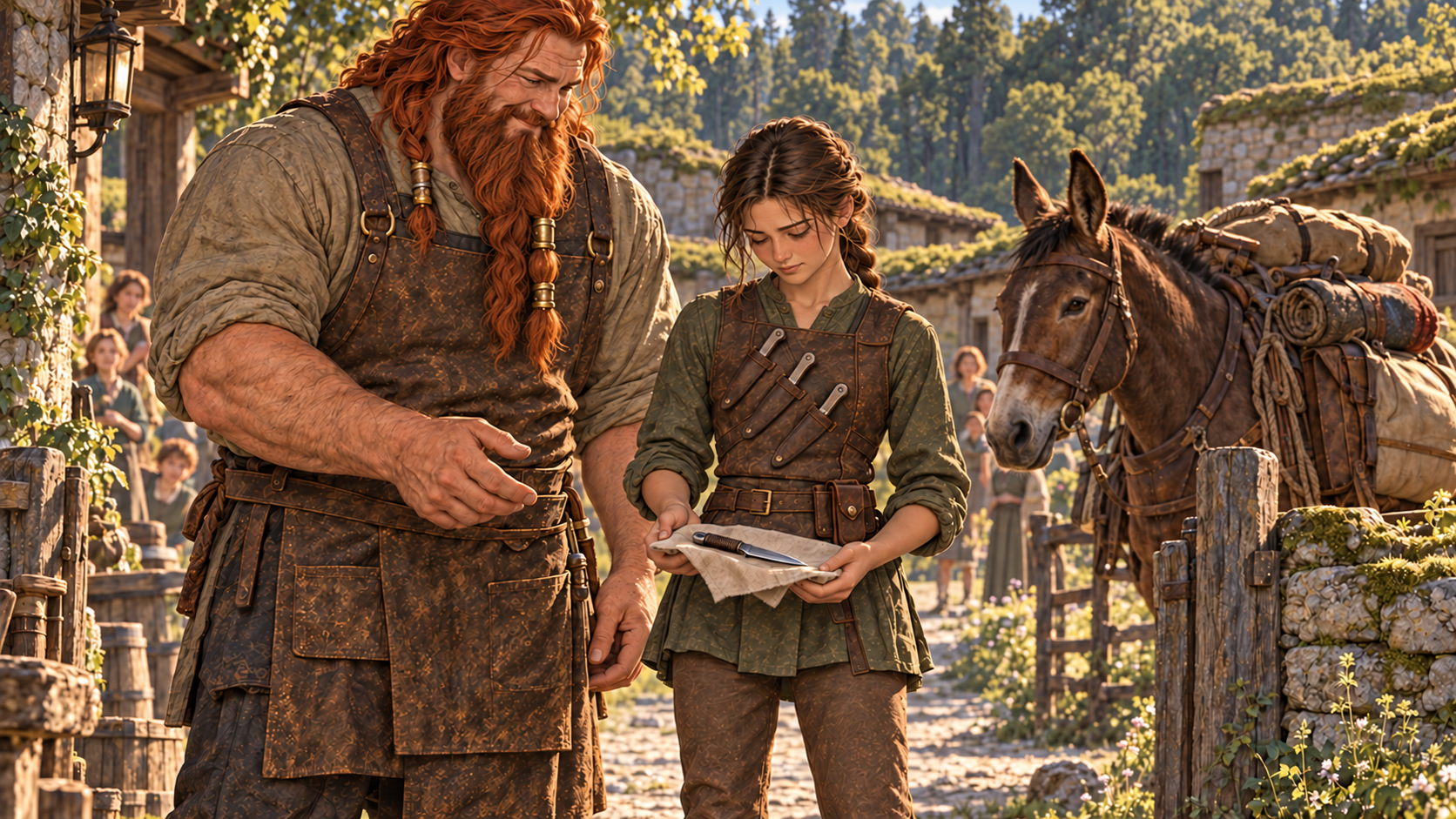
“Father doesn’t go to the mountains,” Roval agreed, and turned to V. He looked at her for a while, then took a cloth-wrapped object the size of a palm from his apron pocket and placed it in her hand. V unwrapped it: another knife, but different from the three older ones she carried. New, light, its handle slimmed to fit her palm, its balance exact. Clearly forged over many nights, as though to order, for one hand alone. “Fourth,” Roval said. “For your hand.” A pause; the beard shifted with the weight of a smile. “Three can be spent. The fourth stays.”
Something knotted in V’s throat, and she hid it behind a joke: “So, are we celebrating a girl or a boy? The baby, I mean.”
“Don’t know.” Roval shrugged, and for a second an unguarded light shone from beneath the granite surface. “Healthy. That’s all.”
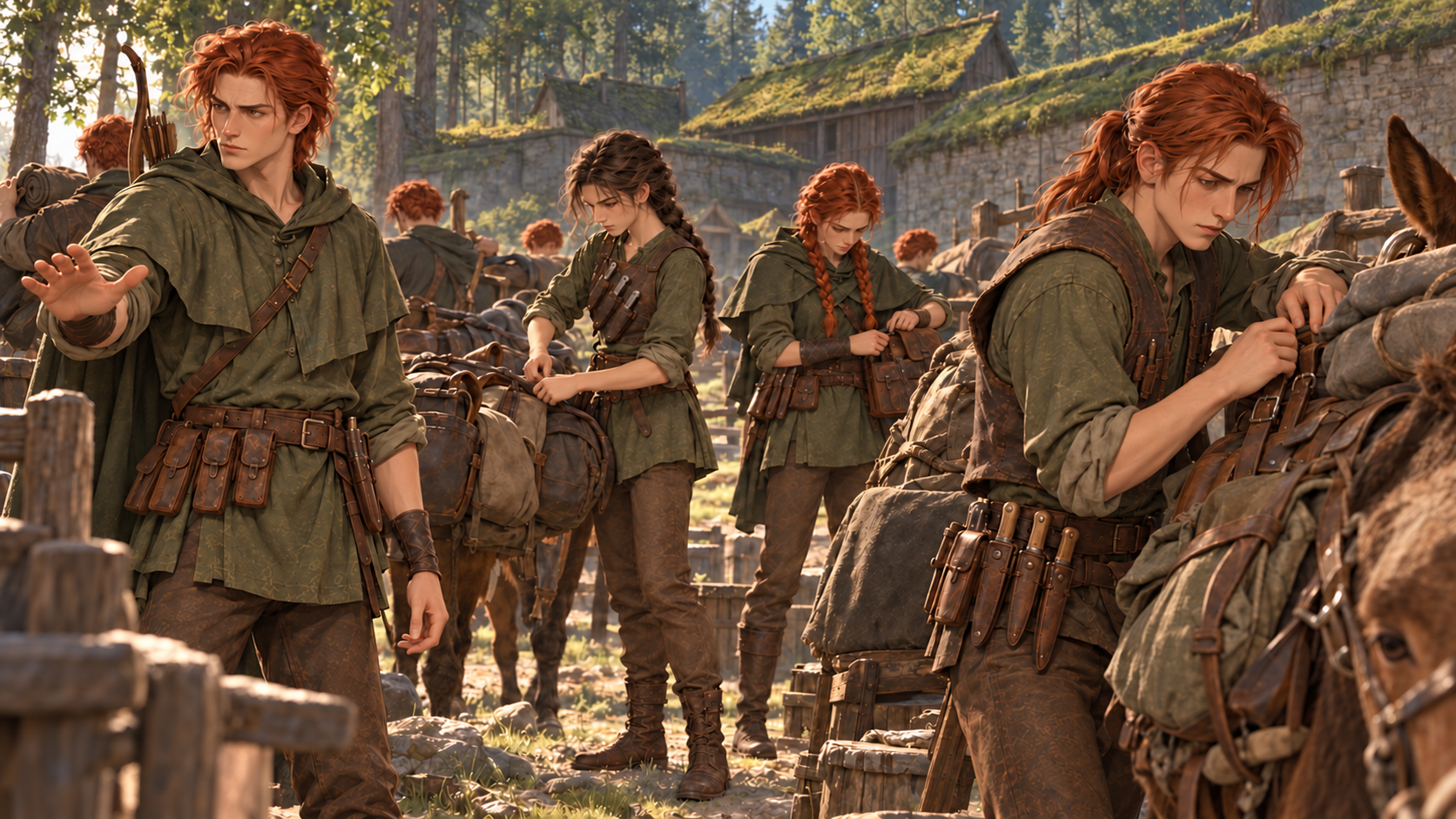
The young man taking his place was called Orsel. Roval’s apprentice; his knives made by his master, his silence deeper than his master’s. He greeted V with a bow of the head. Then immediately wandered towards the mules, muttering to himself.
The second thing she noticed was something far too present.
Someone was in charge of the escort, the fourteen members of the twenty-strong party who would turn back at the border. Another eighteen- or nineteen-year-old, a tall, well-turned-out Serndal; V caught his name, Gerat, amid the shouts of loading. Gerat was good at his work: he arranged the line, divided up the mules, chose the scout, quick hands, a measured voice, clean decisions. He had one flaw, and V caught it in three minutes: whatever he did, every other sentence his eyes returned to the same spot. Loading a mule, that spot. Discussing the route, that spot. And that spot was Sirel, checking her straps, oblivious to all of it.
V followed the glances. One. Two. By the third she was sure; by the fifth she was enjoying herself. A file opened: Gerat. Escort commander, or something like it. Capable, organised, reasonably handsome, though they all look the same anyway, and his eyes keep escaping. She recognised the kind of look, too; Elenie had spent two terms giving it to a boy in the year above who played on the school basketball team, and V had spent those two terms teasing her. A note, underlined: This information, at the right moment, is priceless. Against the “If you tell anyone, I’ll kill you” account: I have something now too, red-haired goddess. We’ll settle up.
After watching Gerat for a while, V went over to Sirel. “I have a question.”
Sirel looked at her.
“That boy, Gerat, I think. Why is he telling everyone what to do?”
“He isn’t.”
V looked towards the front of the column taking shape. Gerat had just sent two people to the back, changed the load on one of the mules, then sent someone over to Ilva. “Sirel. I can see it with my own eyes.”
“He’s getting things in order.”
“Why him when Harek’s here?”
This time Sirel turned to V. “Harek has other work. You.”
V was silent for a few seconds. “So I’m using up the whole man?”
“Yes.”
“Very inefficient.”
Sirel did not answer. V looked at Gerat again. “If Harek weren’t here, would Gerat be my babysitter?”
Sirel paused briefly. She was clearly weighing something in her head. “Yes.”
“I’m trying to understand how this works. Then who would…” V gestured at the column. “Arrange this group, or lead it, whatever you call it?”
“Still Gerat.”
“Why? I thought I’d be his whole job.”
Sirel bent to pick up her pack. “Gerat keeps people together.”
“What does that mean?”
“Harek protects one person. Gerat doesn’t lose twenty.”
V looked back at Gerat. Without turning, he had raised a hand; two people at the very rear of the column ran forwards as though they had been waiting for the movement.
“Is he Harek’s deputy?”
Sirel thought for a moment. “Sometimes.”
“Why does nothing among your people have a proper name?”
“It does.”
“What is it?”
“Gerat.”
V took a deep breath. “I should have expected that answer from you.”
“One last question.” She moved a little closer to Sirel. “Why is everyone here so young?”
“They aren’t.”
“Sirel, you’re seventeen. Harek’s nineteen. Now this Gerat boy doesn’t look much older than me, and he’s telling twenty people where to go. Are there no older people in the village?”
“There are.”
“Where?”
Sirel looked over her shoulder at the people behind them. “Here.”
V looked too. They were there, of course. People walking beside the packs, tending the mules, two women talking at the back. V had seen them; she just hadn’t counted them because she hadn’t seen any of them at the front of the group.
“Then why aren’t they doing it?”
“They did.”
“When?”
“When they were young.”
V walked a few steps in silence. “There’s a piece missing from that answer again.”
Sirel sighed. “A Serndal learns a job. Then does it. After doing it enough, passes it to someone younger.”
“At what age?”
“Depends. Most after thirty.”
V almost stopped. “You retire at thirty?”
“Retire?”
“You know, you do a job for years, then one day you don’t have to do it any more. Someone else does it instead. And you stay at home.”
Sirel raised an eyebrow. “At home? Why?”
“Because you’ve done enough.”
“Who decides?”
V stopped. “Usually… your age.”
At the expression on Sirel’s face, she added, “All right, it sounds stupid to me too when I explain it. Doing something for a long time, then stopping. Someone else does it now, and you don’t get involved unless you’re needed. Is that what happens with you after thirty?”
Sirel shook her head. “Not that.”
“What’s the difference?”
“We don’t give up the work. We give it to someone. You teach. You do it when you’re needed. But you don’t stand at the front.”
V looked at the group again. The picture looked different now. The young were at the front, the older people behind; but being behind was not the same as stepping aside in V’s world. It was more like someone putting their hands in their pockets and staying close enough to take them out if needed.
“Why?”
This time Sirel did not answer straight away. At last:
“Pirig says, if the one who knows always does the work, one day the only one who knows dies.”
V slowed.
Sirel went on: “So you do it when you’re young. You get it wrong. Someone who knows is beside you. Corrects you. Then you know.”
“And after thirty it’s someone else’s turn.”
“You don’t wait for your turn. Someone gives it to you.”
V turned that over in her head for a while. “It’s the exact opposite in my world.”
“I know.”
V turned to her. “How do you know?”
“You tell me.”
V looked back at the crowd, more carefully this time. There were young people hurrying about, and more experienced people apparently paying them no attention. But now she could see their eyes checking everything.
And the children.
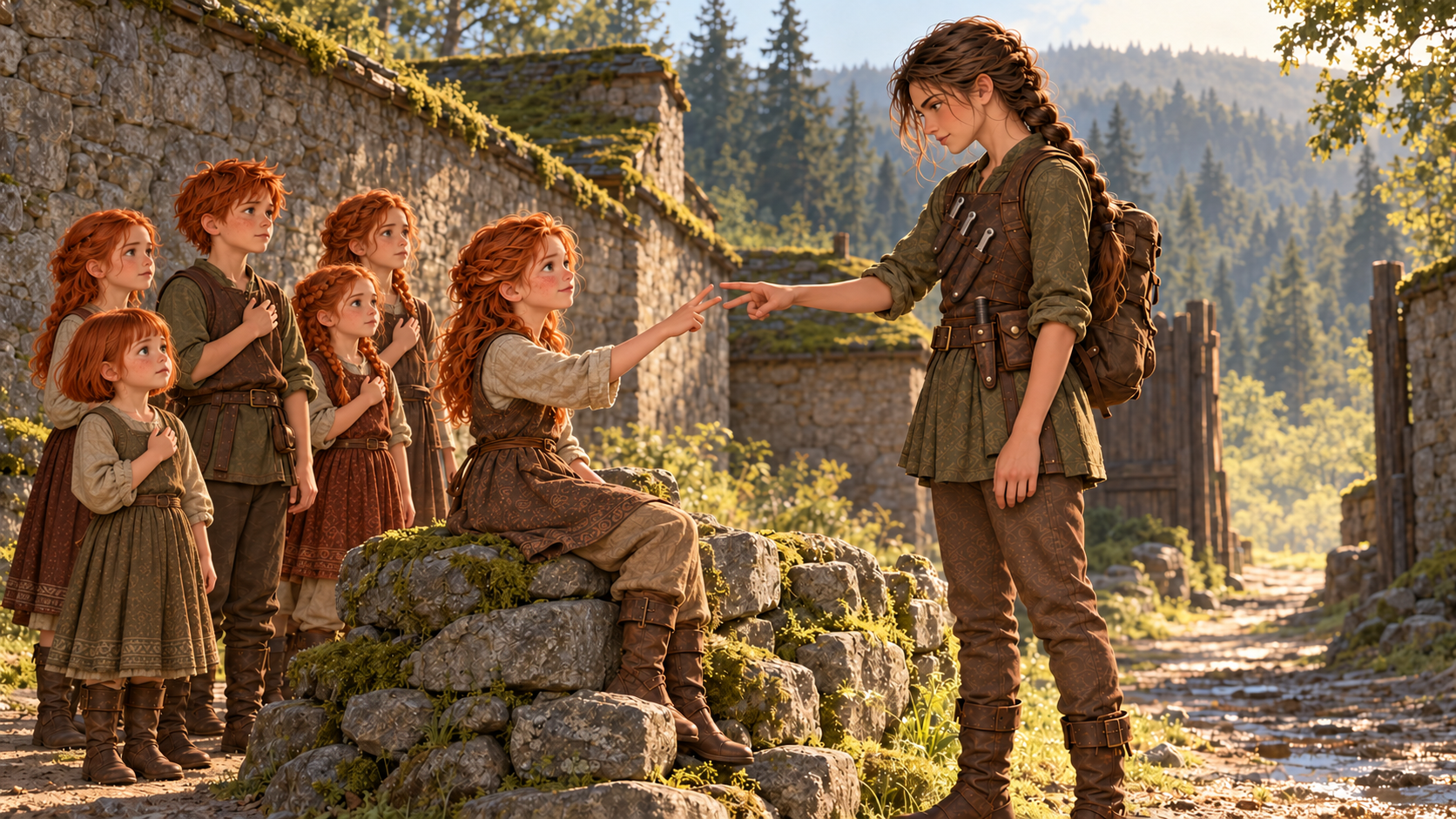
Enna had settled on a low pile of stones beside the northern exit, and her audience was drawn up behind her like an army: Verral, Verral’s sister, the sister’s friends, all the streamside regulars, smallest at the front, tallest at the back, every one of them lined up on Enna’s explicit instructions. As V approached, Enna leaned down from her stones with a commander’s solemnity:
“We’re ready.”
“Ready for what?”
“To wait.” Enna nodded towards the army behind her. “I’m in charge. We’ll go to the stream every morning. You don’t miss training, you said so. And every evening we’ll look at the hill. Verral doesn’t believe it, but I made a watch rota, I drew it with a stone, I can show you.” One breath, one sentence: “The big rain. Over all of us. Promise, promise.”
“Promise, promise.” With two fingers, V renewed the agreement with the commander on the stones, and as she turned, she saw the army behind Enna put their hands over their hearts together. Small hands, serious faces, a greeting learned. The morning’s knot returned to V’s throat for the second time, larger now, and V pushed this file onto the shelf without a label too. The shelf had opened a separate compartment for files of this kind.
Pirig stood on the threshold of the stone house, and since all of last night’s conversation had already passed between them, only a look remained. Long, weighing, settled. Pirig did not put her hand over her heart. Did not bow her head.
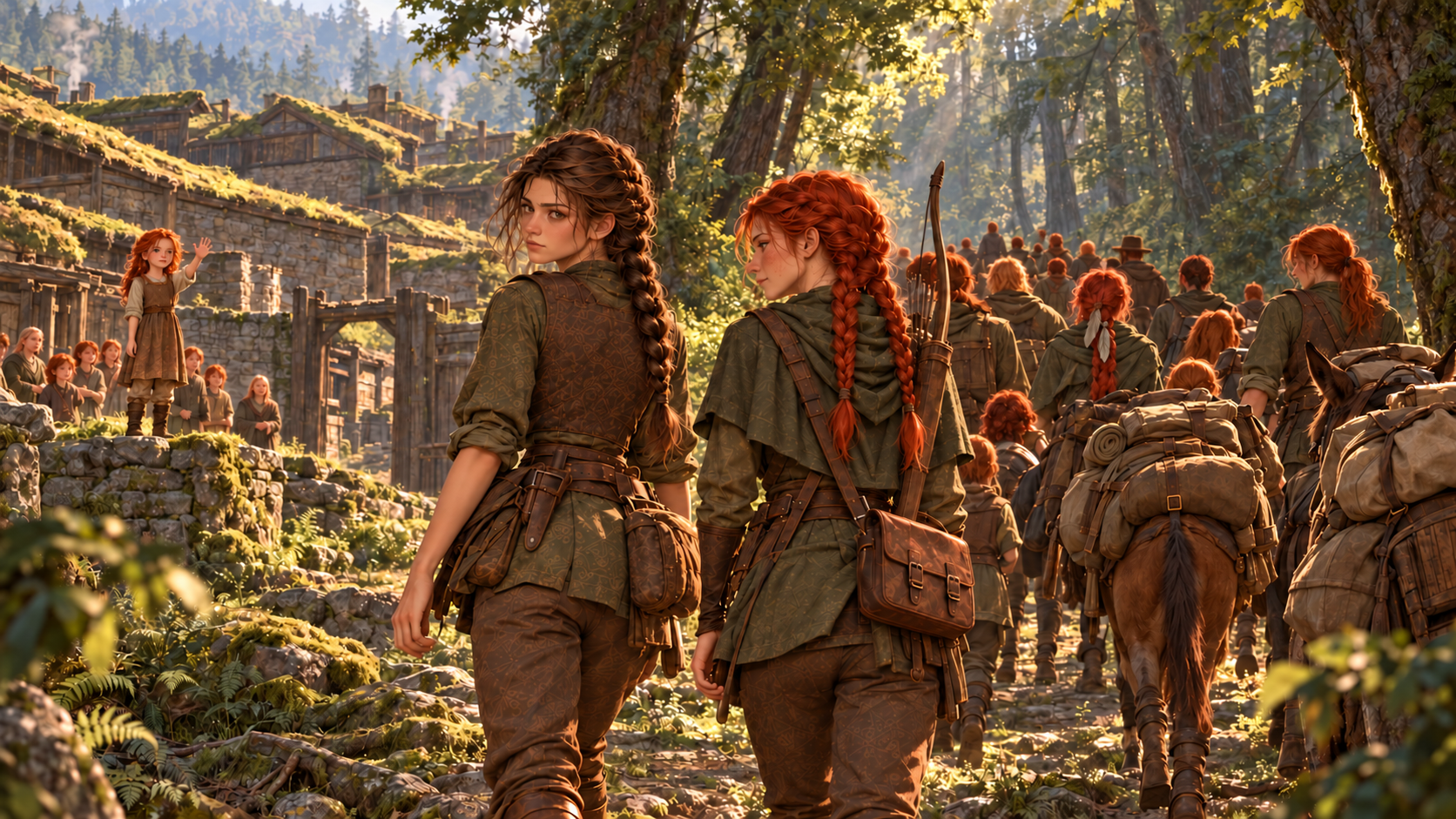
At the head of the column, Gerat’s voice rang out: one syllable that cut through all the noise. “Move.”
And the hum stopped as though severed by a knife. Twenty backs shouldered their loads at once; the mules fell into line; Ilva moved to the front, Gerat beside her, his eyes straying to their usual spot one last time. And the column flowed towards the northern tree line. Just before she entered the forest’s shade, V turned: Enna stood straight on her pile of stones, in front of her army, and her raised hand was not waving. It was open, like a promise. Rain. Don’t forget.
“Come,” Sirel said.
And V followed.