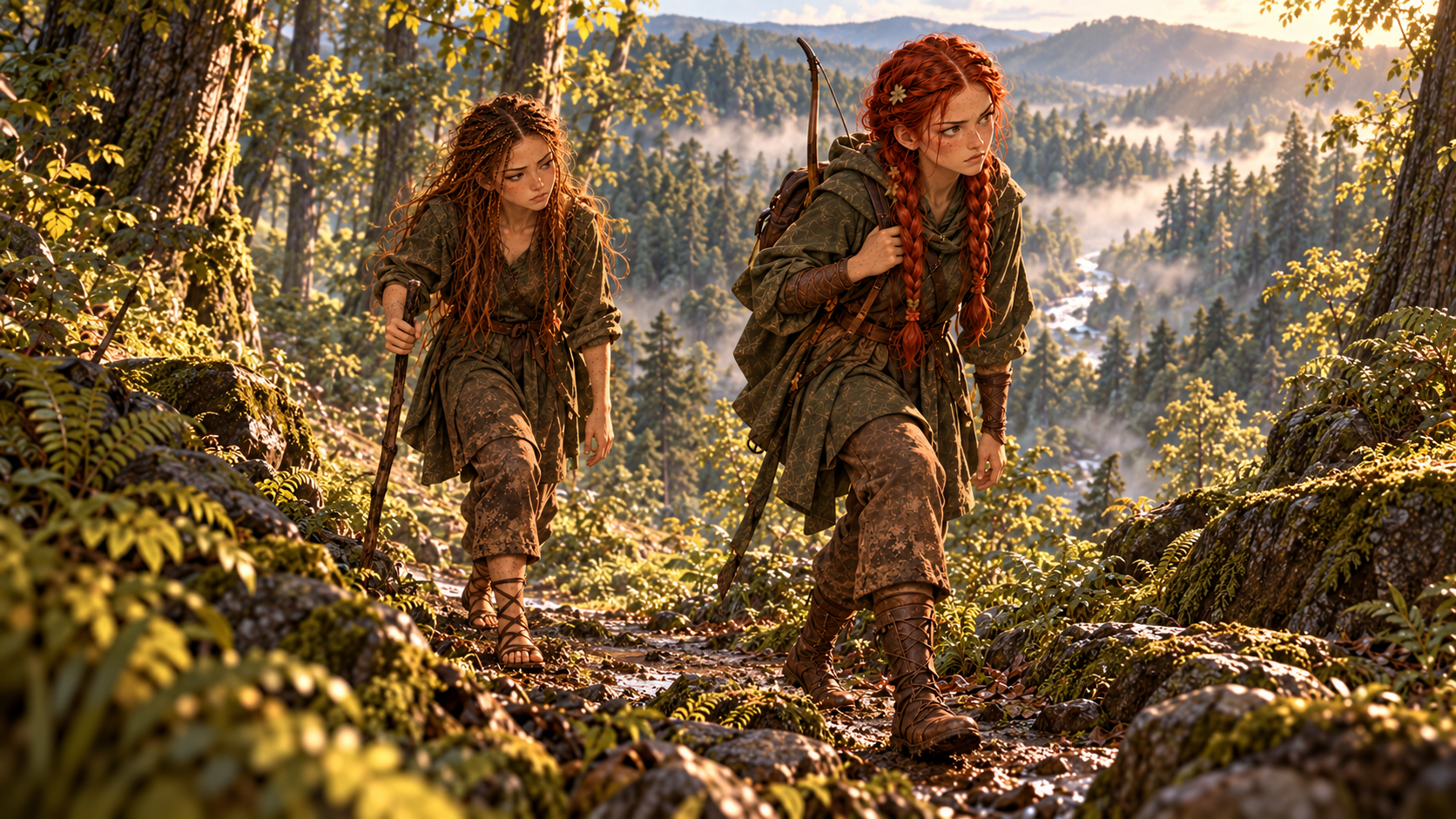
When morning came, V surfaced from somewhere between sleep and unconsciousness at a touch on her shoulder. When she opened her eyes, Sirel was ready to go: bag over one shoulder, bow across her back, as though last night had left no trace on her face. Sunlight came through the trees in pieces. As soon as V sat up, Sirel pointed upstream with her chin, towards the part of the forest that climbed steadily higher.
V looked that way for a while, then at Sirel.
“Where are we going?”
“To speak to Vaerin Pirig.”
“Vaerin... Pirig.” V turned the words over in her mouth. “Is that a name or a title? Who is that?”
Sirel adjusted the strap of her bag and gave V her usual allowance of words: “She knows.”
“Knows what?”
Sirel’s eyes dropped to the stone around V’s neck for half a second, then came back up.
“You.”
And she started walking.
V wanted to say, nobody knows me, I don’t even know me, but didn’t. She grabbed her stick and followed.
Walking was good. Walking was a plan, progress, countable steps, and V needed countable things more than ever.
Because the thing that couldn’t be counted made itself known from the very first stop.

Sirel stopped in the shade of a rock outcrop, took out her waterskin, took a sip and silently set it down beside V’s knee. It was a simple gesture, one she had been making for days, natural and unthinking between travelling companions. V picked up the waterskin. She was thirsty, thirsty with the thirst of someone who had cried all night; she pulled out the stopper and brought it to her mouth.
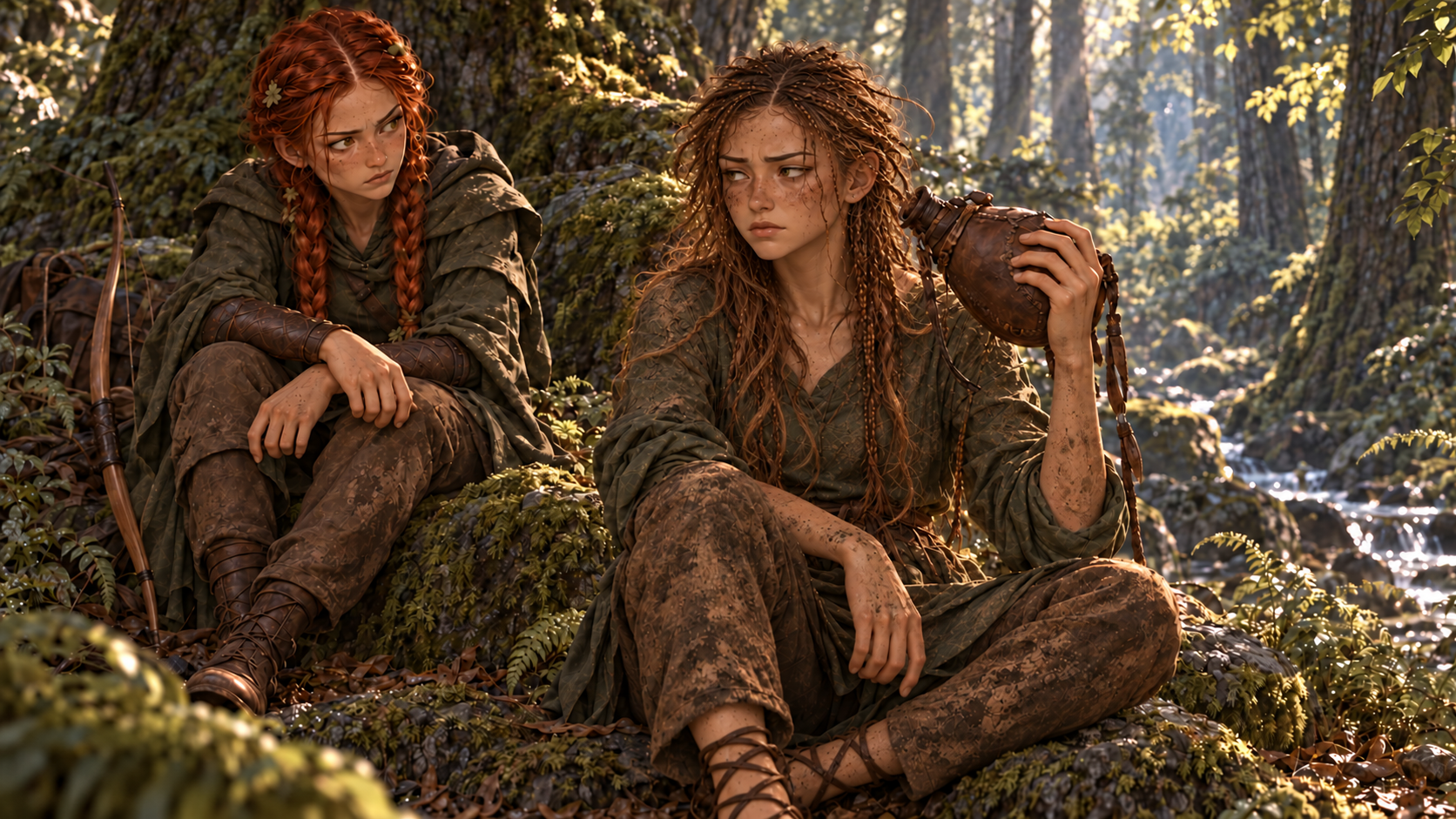
And in that last centimetre, her body slammed the shutters down.
It was hard to explain; despite all the insistence from the analytical department, V couldn’t even explain it to herself. Her throat was closing, but her throat wasn’t the problem. The smell of water filled her nose; water had no smell, V knew that, her years in the pool had taught her that water only smelled of chlorine or algae, but now it did smell, and inside that smell were the washing stones, the shadow of the bridge, a man sinking to his knees. V replaced the stopper and put the waterskin down.
Sirel did not take it. The waterskin sat on the flat stone between them like a question that belonged to neither of them, and stayed there until the break was over.
Towards noon, V became her own doctor. The symptoms were familiar; the chart her coach had drawn on the board at summer camp came back to her exactly as it had been. Tongue sticking to the roof of the mouth: two per cent. Headache, back of the neck: three per cent. Loss of concentration, V noticed a root at the last second and jumped over it, yes, that too. The diagnosis was clear, the treatment was simple, the road to the treatment was closed. Her body had split in two: one half was begging for water, the other would never forgive water again, and V kept walking down the narrowing corridor between them. She didn’t tell Sirel.
Towards late afternoon, Sirel did something that almost made V falter: she asked a question.
“Before the lake. Where were you?”
For days, V had been the one digging answers out of this girl with a pickaxe and shovel; the questions had always flowed one way, like a tax. Now the direction had reversed, and V immediately filed the reversal itself as more valuable than any answer she might receive: Something is going on in Sirel’s head.
“At home,” she said. “Somewhere else. Far away. In what way, I haven’t worked that out either. In a big city. I went to school. I swam.” I swam. The words left a strange, rusty taste on her tongue as she spoke; V swallowed the taste and kept walking. “Why did you ask?”
No answer came. But that evening, where they stopped to rest, V caught her: Sirel was watching her. Openly, not like a hunter, but like someone returning to an unfinished calculation. V recognised the look immediately, because it was her own. A file had been opened, but no label could be found.
“Tell me,” V said. “You’ve been a rock for days, and today you asked me a question. Something isn’t adding up. Tell me.”
Sirel was silent for a long time. Then she laid the words down one by one, like heavy stones:
“You couldn’t light a fire.”
“…Yes? We talked about this. Documentary budgets.”
“Nyvras can.” A pause. “You got cold. Got sick. Nearly died.” For the first time since they had met, a real line appeared between Sirel’s eyebrows. “Nyvras don’t die like that.”
V waited, mouth half open, for more; nothing came. Sirel had said what she had to say. But V could see the picture now, and it was herself seen from the other side: this girl had been watching her for days. She had watched a helpless thing that had come out of the lake, couldn’t light a fire, had surrendered to fruit in eleven seconds, and had neither shoes nor a lighter, and had confidently stuck the label human on it. Then the stream had stood up, the label had come off, and Sirel had been left holding exactly what V was holding: a file, but no label.
“So you don’t understand either.” There was a lightness in V’s voice she hadn’t expected; two lost people were half as lonely as one. “I thought you knew. You said I wasn’t human. You knew the word. What was it? Nyvra? What is a Nyvra?”
“I know the word.” Sirel looked into the dark, towards the road ahead. “I don’t know you.” A pause. “Pirig knows.”
That night, V woke to her own scream.
The dream itself faded; only its final frame remained: water standing like a curtain, and someone looking at her from behind it. Still half asleep, V heard with horror how her scream travelled through the forest. A hand closed over her mouth. A familiar hand, a familiar reflex, but this time it did not pull her or make her climb; it only covered her mouth and waited. Sirel’s head was raised, her eyes scanning the dark, her whole body transformed into a single ear. The forest listened. They listened to the forest. Far away, something small and harmless rustled and fell silent, and the hand moved from V’s mouth to her shoulder.
And there, under the weight of all those days, the dam inside V broke.
She tried crying quietly at first; they needed to be quiet, they were in the forest, it was out there, but this kind of crying did not negotiate. Her shoulders shook, her breathing broke apart, and the bill for all those days, her mother, Elenie, Ginny, the question of why she was here, was collected all at once. Sirel said nothing. She didn’t say, “It’s over,” because it wasn’t. She didn’t say, “Don’t cry,” because V needed to. She only sat there, close enough for her shoulder to touch V’s, leaving V free to pull away whenever she wanted, and until the storm passed, she kept watch against the dark.
When the sobs finally thinned out, V, her eyes swollen, wiped her nose on her sleeve and whispered, “Sorry. I screamed. It was dangerous.”
The answer came from the dark, short as always, but V could hear that, by Sirel’s measure, that tiny sentence was a hug:
“Water’s close. It won’t come.”
The next day, the bill grew.
When V stood up that morning, the world tipped left for a second; V straightened it and told no one. By late morning, small black dots had appeared at the edges of her vision; V called them flies, knowing full well they weren’t. At noon, eating the druvil Sirel handed her, she realised her jaw was getting tired. Getting tired from chewing. Her hands were shaking as she made a mental note of that. And towards late afternoon, on flat ground, with no root, no stone, no excuse, her knees were removed from the decision-making process and V found herself on the ground, on her knees.
The earth was cool. Damp. She needed to get up. Get up. Her body, somewhere with no phone reception, didn’t even answer this time. V stayed like that, on her knees, palms on the ground, head bowed, and a single thought passed through her mind, clear and cold: If it ends like this, that’ll be so stupid.
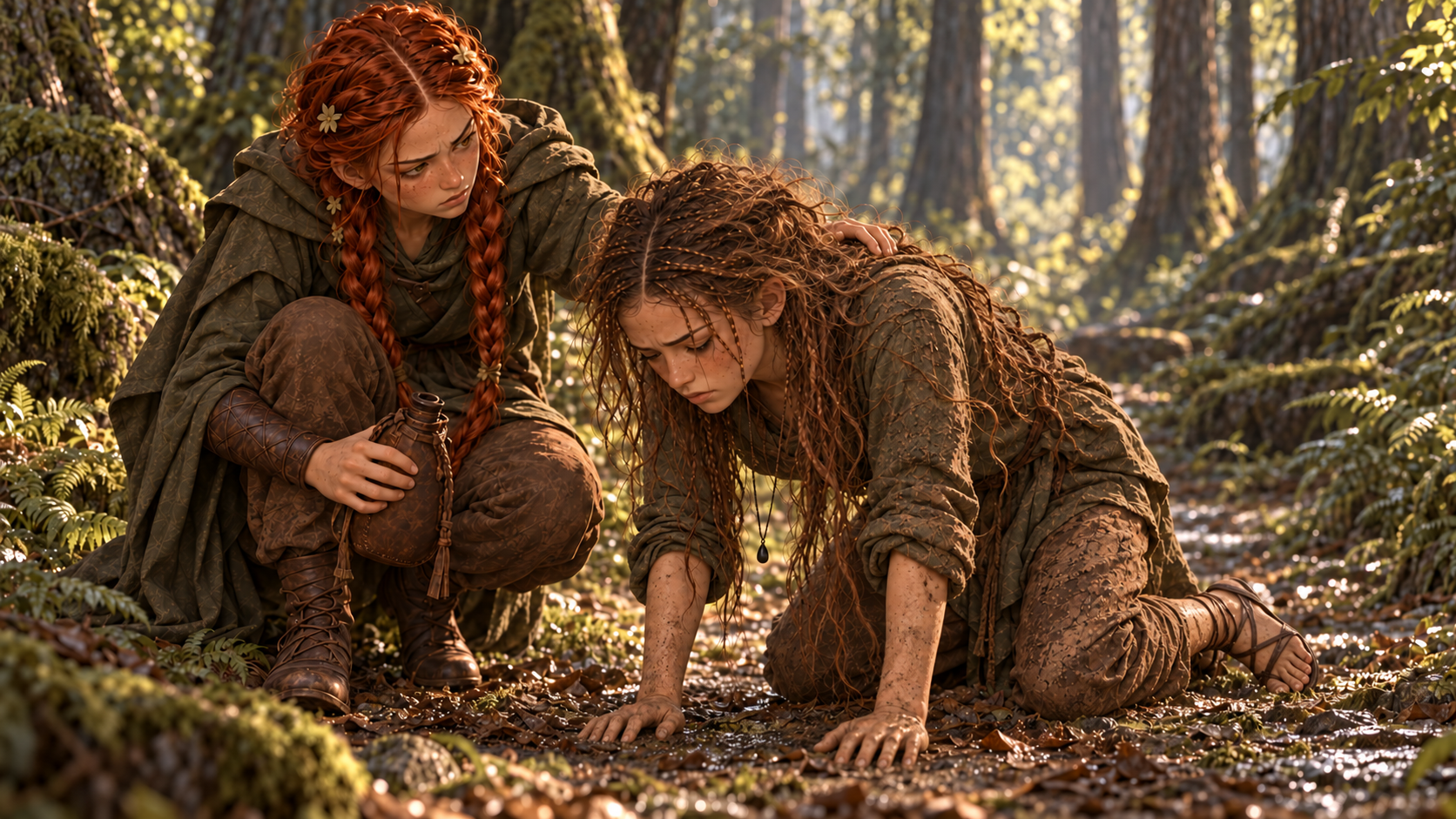
Sirel’s feet entered her field of vision. She crouched, looked first at V, then at the waterskin. She placed a hand on the back of V’s neck; her fingers stayed there for a few seconds. Whether she was counting her pulse or checking for fever, V couldn’t tell.
The waterskin rose level with V’s head, and V turned away as she felt the knot in her throat settle instantly into place.
Sirel did not bring the waterskin to V’s mouth.
She paused.
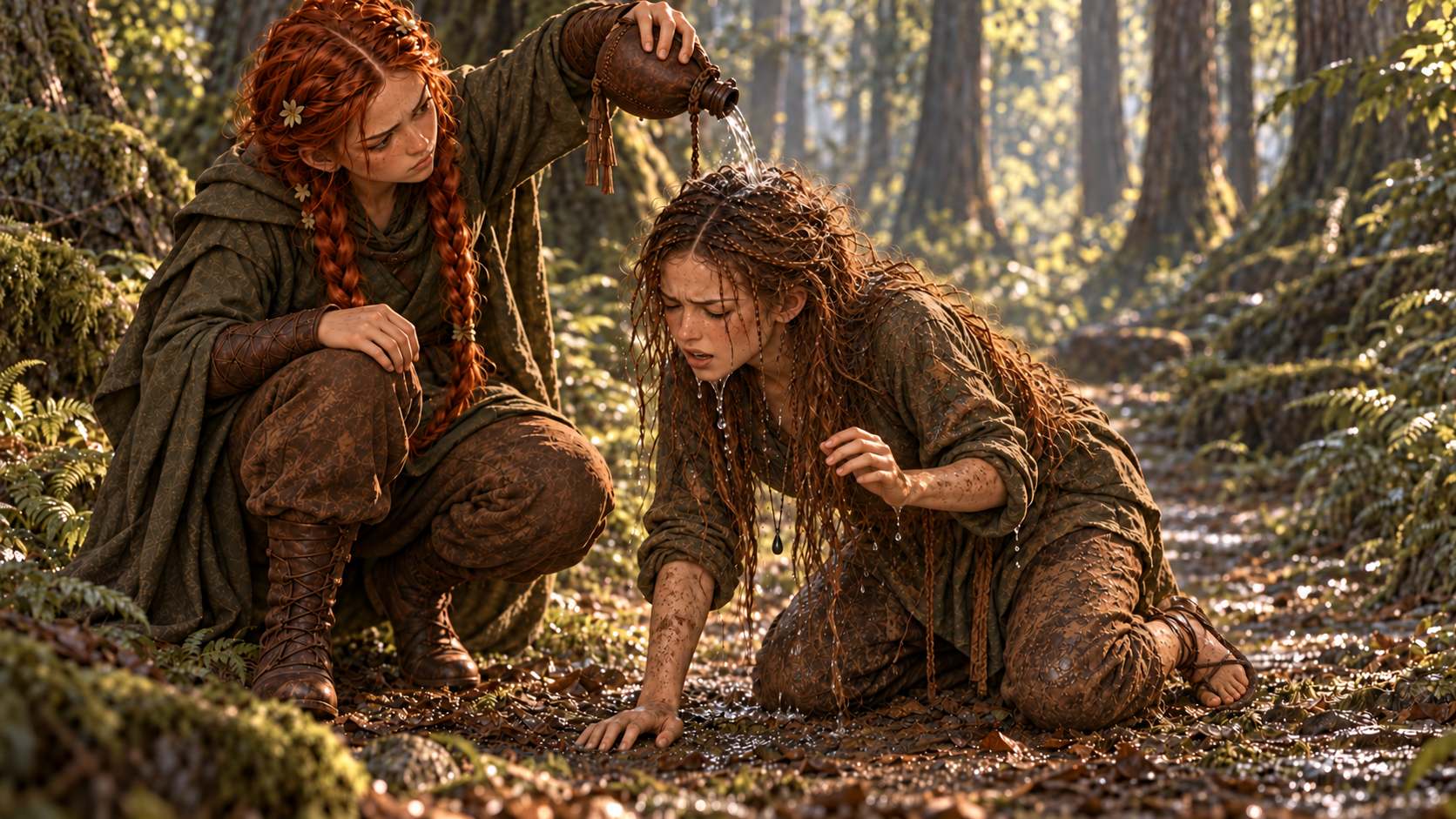
Then she emptied it over V’s head.
Cold flowed from her hair down the back of her neck, then along her spine, and a sound edged with anger escaped V’s mouth.
“What are you…”
Her voice cut off halfway.
Because everywhere the water flowed, it left something behind.
She knew the tingling. From the shopping centre, the canteen, the stream… But this was different: a current that filled rather than destroyed. From the back of her neck into her shoulders, from her shoulders down her arms. The trembling quivered once more, like a string at a touch, then stopped. The black spots at the edges of her vision receded as though wiped away with a wet cloth. The emptiness in her knees filled. V watched like a spectator as her palms pushed against the earth and her body, the body that had refused to answer five seconds ago, straightened itself.
She remained on her knees, soaked through, breathing hard. Her heart beat strong and steady. She felt as though she had been asleep for months and had only just woken up.
And she was horrified.
“What…” Wet hair clung to her face; she didn’t brush it away. She looked at her hands. Her steady, strong, treacherous hands. “What did you do to me?”
“Not me.” Sirel shook the empty waterskin. “Water.”
“But I… I can’t even drink it. My body won’t accept it. How?”
V’s analytical department found the answer before the question, and the answer settled heavily in her stomach: her body wasn’t rejecting water.
Her body loved water.
Water didn’t need her mouth to get inside her; her skin was enough. Her body wasn’t the part refusing it. The part that remembered the washing stones was. That part had just been crushed without being asked. V sat soaking wet on the ground, feeling strong for the first time in days, and hated feeling strong, because the place that strength came from was the place where the man’s eyes had sunk beneath the surface.
“This is unfair,” she said. Her voice came out like a child’s; she didn’t care. “I can’t drink it, but… it feeds me. I’m afraid of it, but it… What kind of relationship is this?”
She looked up. Sirel was still watching her. This time there was something on her face V had rarely seen there before: a question whose answer had just been found.
“Did you know this?”
“I do now.”
V looked at the empty waterskin, then at Sirel.
“So you experimented on me?”
One of Sirel’s eyebrows rose almost imperceptibly. She stood up without offering a hand and waited for V to get up on her own.
“The stream runs beside the road,” she said. “You’ll walk beside it.”
“I’m not drinking.”
“I didn’t say drink.”
“I’m not touching it.”
“I didn’t say touch.”
V got to her feet. Her knees held.
“So what is this now, treatment?”
Sirel did not answer; she walked on. But for the rest of the day, V noticed that their route kept following the stream, that they always stopped somewhere they could hear the water, and that their camp for the night was set up within a stone’s throw of it. Sirel was pushing her towards water in her own way: without words, without announcement, without negotiation. Beside it first. Then, perhaps, in it.
That evening, Sirel took two bitter leaves from a pouch, boiled water over the last embers of a small, smokeless daytime fire and handed V the wooden cup. V took it and sniffed. What was inside was water; she knew that. But it was dark green, bitter, hot. Nothing about it resembled the stream. The part of her body that brought the shutters down sniffed, hesitated and did not bring them down. V drank. It was horrible. It was the best thing she had ever drunk.
Looking into the bottom of the cup, she summed up the day: she was something with water powers, and she was afraid of water. She could command water and could not swallow it. Water gave her strength and V did not want that strength and without it she could not walk.
“Statistically speaking, I’m in a ridiculous situation,” she said aloud to no one.
As Sirel covered the embers with earth, she answered without looking up. “It’ll pass.”
“How do you know?”
A half-second pause. Then Sirel stood, put the question on the shelf they both knew by now, the shelf of unanswered questions, and went to take watch.
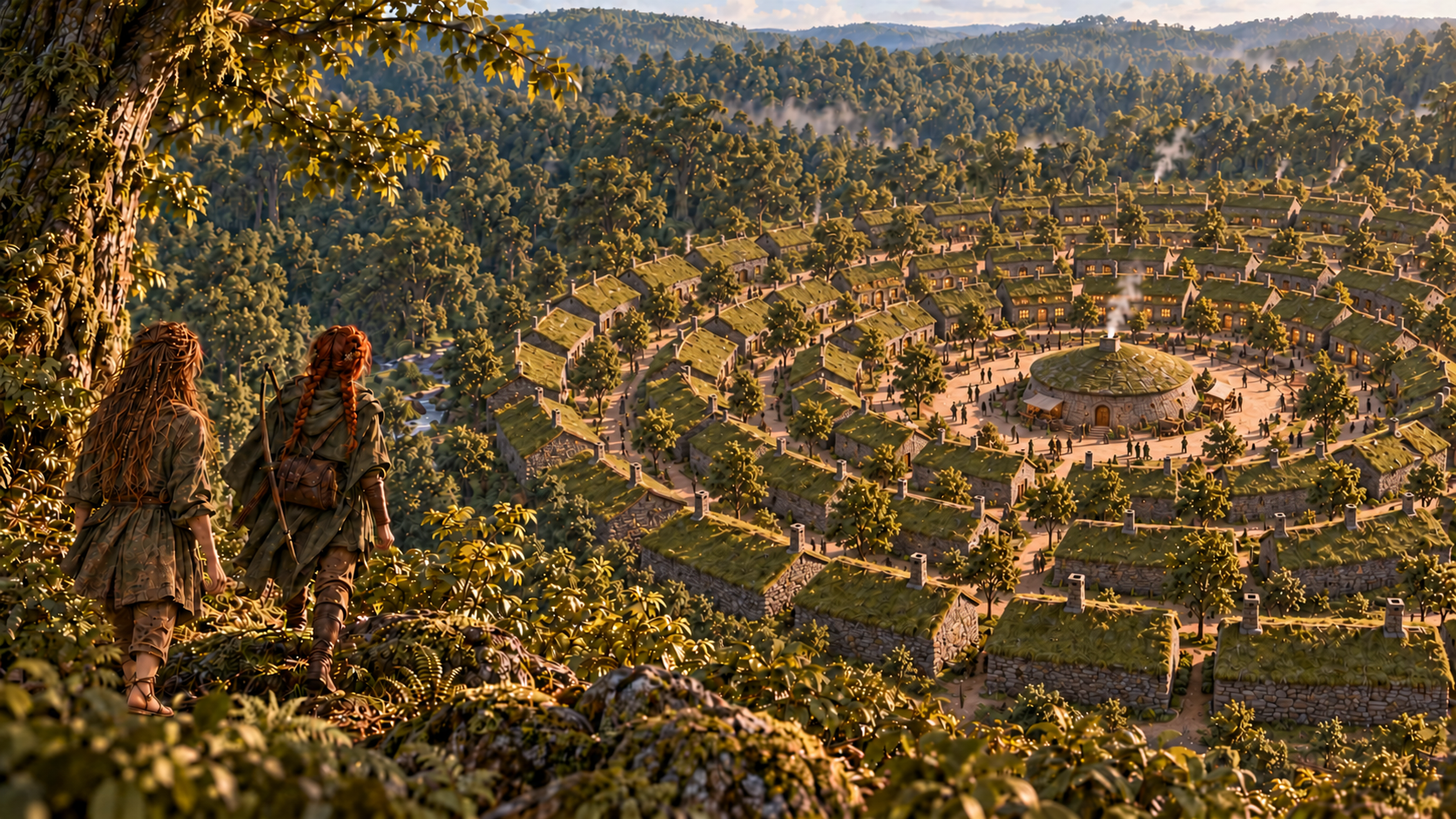
On the afternoon of the third day, the forest suddenly ended before them. As though cut away, like a shoreline, and below, nestled between two hills, V saw houses. From this height, their roofs formed a circle. As though the whole place had been laid out to an architect’s plan. With a stream running between the houses, circling them and winding away. Of course there was a stream. V had accepted by now that streams in this world were never going to leave her alone. She felt as though she were looking at the maps from geography class. And in the middle of the roofs, standing apart from the others, a round building.
Sirel stopped at the edge of the forest. But unlike at Sidra, she did not stay in the shade; she took a step into the sunlight, and V understood without asking: This place was hers.
“Keral,” she said. “Home.”
V repeated the name as though willing it to settle on her tongue. “Keral.”
Then Sirel turned and looked at the stone around V’s neck, more openly than she ever had before.
“Hide the stone,” she said. “From everyone.” Her eyes shifted to the round building halfway down the slope. “Not from the Vaerin.”
V adjusted the neck of her top, tucked the stone beneath the fabric against her skin and followed Sirel down the slope.
When she saw smoke rising from the chimneys, V looked towards the fires. “Vharn? Doesn’t it see those?”
Sirel pointed with her chin at the water below. “River.”
V thought about the line the river traced around the village. “So it doesn’t come because of the river.”
“Won’t cross.”
Keral grew as they descended the slope and drew closer.
This was no ordinary trick of distance; V realised that as they approached the layers of houses. From above, there had seemed to be a hundred roofs at most. But now, walking among the houses, she realised a hundred was nowhere near it. There had to be far more.
The lower halves of the walls had come from the river: flat stones stacked one on top of another, without mortar. V approached one house and, despite Sirel’s puzzled looks, examined the way the stones fitted together without gaps; she tried to slip her little finger between two of them and couldn’t. The upper halves came from the forest: split logs interlocked at the corners, their knots left untrimmed. The roofs held earth; there was grass on them, moss, and on one, a sapling that must have landed there the season before had put on height.
That was why she had counted a hundred from above. She hadn’t counted the rest because the rest hadn’t looked like roofs; they had looked like a continuation of the hillside.
As she walked, she noticed something else, or rather, the absence of something. There were no windows in the outward-facing walls. Neither high nor low, not in any of them. Every opening faced inward, towards the centre.
The houses were irregularly placed: none lined up with the next, no street ran straight, each house blocked only half the sightline of the one before it. And every house seemed to face the centre. The analytical department processed the data in two steps: when V noticed the loose, uneven circular arrangement, layer upon layer of houses, all turned slightly towards the centre, she completed the sentence: This is a shield.
And at the centre of the shield stood the thing it protected: a round stone house, larger than any other building. A thin, steady thread of smoke rose from its chimney.
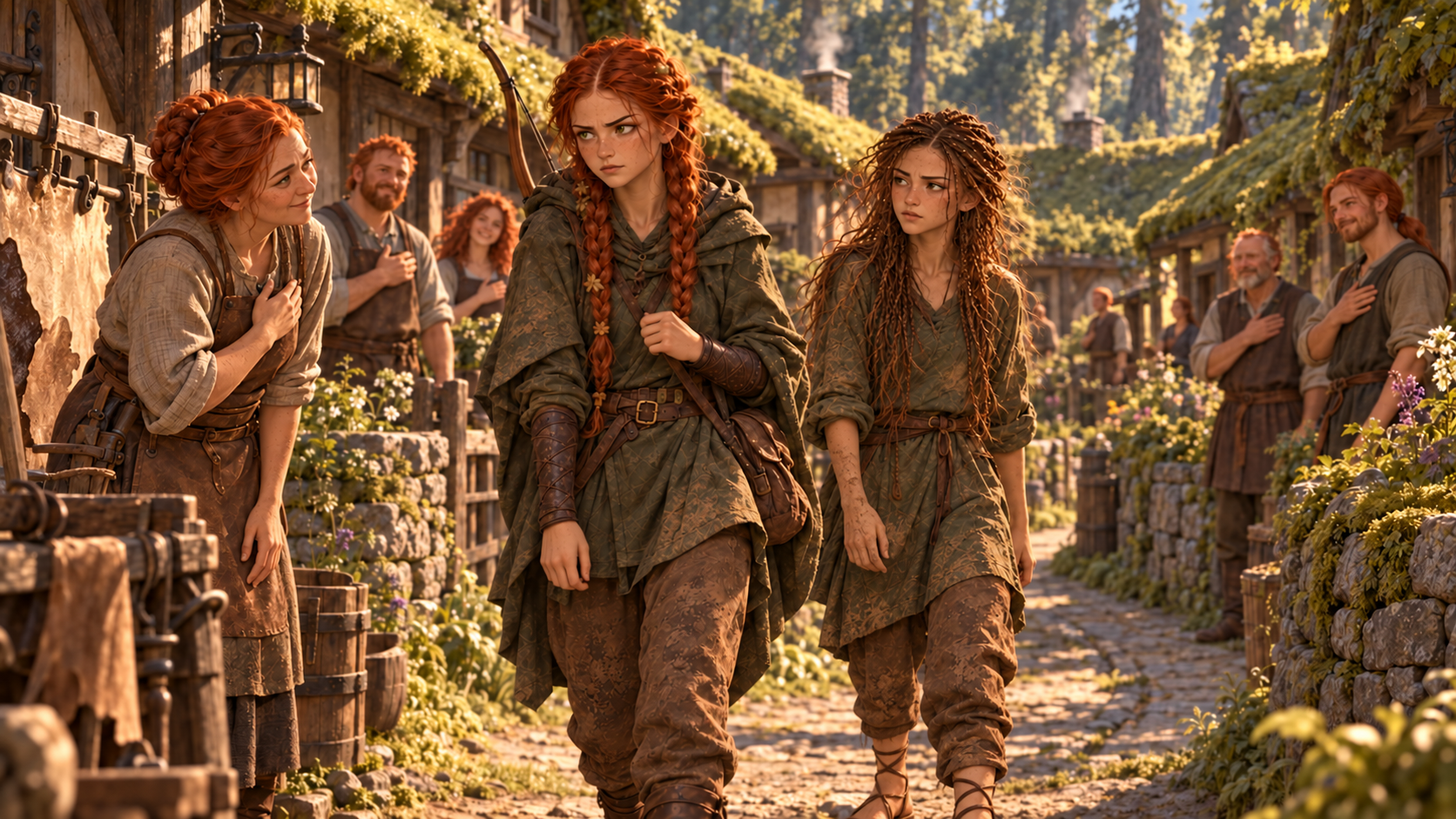
They met the first person in the second layer. A middle-aged woman stretching leather outside her door, red hair braided, green eyes on her work. She looked up, saw Sirel, and V witnessed something full of warmth: the woman’s face opened. She placed a hand over her heart and bowed her head. A slow, measured bow, as full as a sentence, and when she straightened again, her eyes were shining.
Sirel answered with a nod. Short. Clipped. She quickened her pace.
Then came the second. The third. A door opened, a window opened a crack, two people straightened up in a garden, and all of them, every single one, made the same gesture: hand to heart, head bowed. No one shouted, no one ran, no one said “Welcome”; joy here was expressed not in sound but in posture, and those postures, as far as V could read them, were a festival.
And none of them, not a single one, was looking at V.
V was used to that from Sidra, but this was different. In Sidra, she had gone unseen; here, she didn’t matter to anyone. Every gaze, every hand over a heart, all that silent celebration flowed towards one person. V looked at that person walking beside her and noticed something interesting: with every greeting, Sirel’s shoulders climbed another millimetre. Her jaw had tightened. Her gaze was locked on the door of the stone house ahead to avoid meeting anyone else’s. The girl who had shared the darkness with a Vharn in the middle of the forest without so much as twitching seemed to be buckling under the affection of her own people.
V filed that too, and as she did, she noticed something else. Something that had been in front of her all along but was only now taking shape in words: everyone looked like Sirel. The same shades of red hair, the same green eyes, the same sharp jawline, the same quiet way of walking. Old and young, women and men; as though a single face had been multiplied in a corridor of mirrors. V was walking through an entire town of Sirels, and the voice in her head summed up the situation in its usual measured way: Right. So the population policy here is: Sirel.
Then something shot out from the fourth layer of the shield and shattered the entire quiet arrangement.
Something small, red and fast burst like an arrow from between two houses, cut straight across the path and, before V could work out what it was, hurled itself against Sirel’s leg. Collided was the right word; the hug came a second after the collision. Two thin arms locked around Sirel’s knees and a red head buried itself in the fabric.
V waited for Sirel to stiffen.
Sirel did not stiffen.
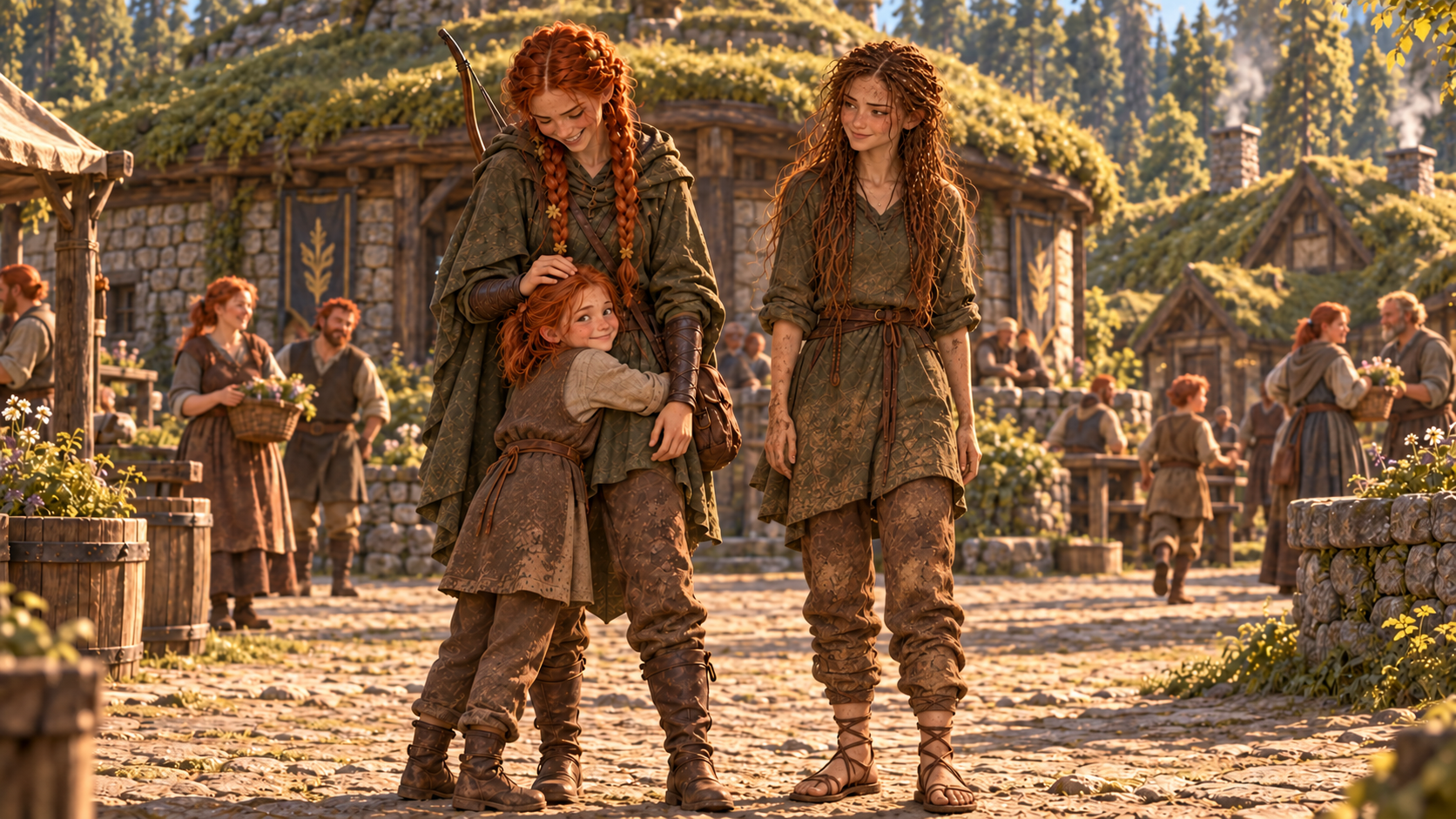
On Sirel’s face, on that granite landscape V had spent days mapping, something broke, no, opened, and V witnessed one of the most unexpected sights of her life: Sirel was smiling. Not that old half-millimetre twitch; a full, defenceless smile that changed the entire geography of her face. And it suited her so well that for a second V felt she was looking at something she wasn’t supposed to see, as though she had glimpsed the inside of a room whose door was always locked.
“Enna,” Sirel said. Even her voice was different.
The red head came away from the fabric and V looked down: a girl of about ten. V’s analytical department delivered its report with unnecessary but irresistible precision: a copy of Sirel at seventy per cent scale. The same hair, the same eyes, the same jaw; only newer, softer, not yet sharpened.
“I knew you’d come back,” Enna said. In one breath, without pausing for air, spending more words in a single sentence than Sirel had in days: “Mum told me, she said soon, I looked at the hill every morning, Verral didn’t believe me but I knew, Mum’s never wrong, you know that.” She stopped. Her head turned to one side like a bird’s, and her eyes found V for the first time. “Who’s this?”
“Guest,” Sirel said.
Enna had no intention of settling for that answer. She let go of Sirel’s leg, took two steps and planted herself directly in front of V, then lifted her head and looked straight into her eyes, the way children did, without a filter.
And got stuck there.
V knew this pause.
Enna’s eyebrows drew together slightly, not in fear but as though she had encountered a puzzle, and in a whisper, but a child’s whisper, one everyone could hear, she asked her sister:
“Why are her eyes like that?”
“Enna.”
“But once you look, you don’t want to stop.”
“Enna.” Sirel’s hand found her sister’s shoulder and steered her towards the stone house. “Where’s Mum?”
The question was unnecessary. Because the door of the stone house had opened.
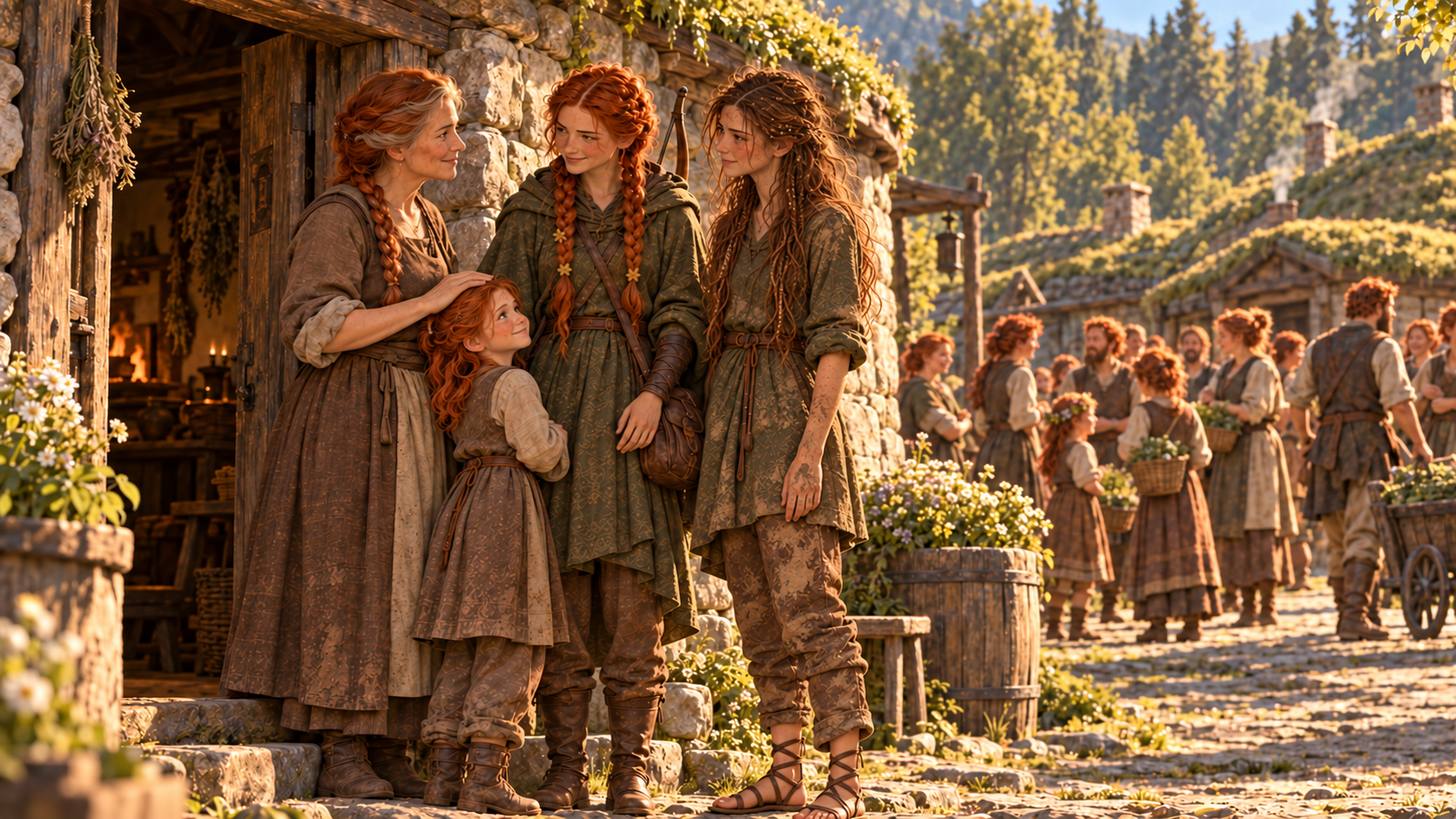
And a woman stood in the doorway.
If V had had to describe Vaerin Pirig afterwards, she would have summed her up in a single phrase: in place. The woman was not tall, not imposing; she wore no ceremonial robes, carried no staff, bore no insignia. A plain, earth-coloured garment, greying red hair drawn into a braid. But there was something in her bearing, as though she stood at exactly the right point in the world and had aligned the world around herself. All that silent celebration around them grew quieter still when she appeared on the threshold; one by one, those who had followed them returned to their work. As though what came next belonged to the family, and the crowd knew it instinctively.
Pirig looked at Sirel.
It was a long look. There was neither anger nor reproach in it. V involuntarily ran through the list of things her own mother would have said in such a situation, and not a single item on that list was present in this look. There was only a weighing gaze: one that took her daughter in from head to toe and found her safe and sound, whole, and also, in a way V could not quite grasp, changed.
“Daughter,” Pirig said.
“Mum,” Sirel said.
Two words. V had thought that, after days on the road with Sirel, she had finally understood the scale by which these people measured things. Those two words were an entire half-hour reunion in another family. Enna could not fit into the space between the two words and slipped between her mother and sister, and Pirig’s hand settled on her daughter’s red head like something that belonged there.
Then Pirig’s eyes found V over Sirel’s shoulder.
V was ready to be looked at; she had spent days being calibrated under Sirel’s gaze. But this was different. Pirig’s gaze was unhurried, warm, almost welcoming. And at the same time, it was taking inventory. V could feel herself being scanned: the clothes she wore, Sirel’s. The leather foot-wraps, Sirel’s stitching. The faint redness the cord had left on her neck; the gaze lingered there for a breath, then moved up to V’s eyes.
And there, Pirig did not do what Enna had done. She didn’t get stuck. She wasn’t mesmerised. Quite the opposite: for the first time in her life, V felt her own eyes being read, like a book finally meeting someone who knew its language.
Something stirred in Pirig’s face. It wasn’t surprise. It was something falling into place.
“You’ve come from far away,” Pirig said. Her voice was different: fluid, full, at ease with words. She hadn’t asked a question; she was stating a fact.
“Yes,” V said. “How did you kn…”
“You’re tired, you’re hungry, and you have a mountain of questions.” Pirig stepped aside, clearing the doorway, and nodded V inside as though she had been expected for years. “The mountain can wait. Food can’t. Come in, guest.”
As V crossed the threshold, she felt Pirig’s gaze drop for a moment, half a breath, to her chest, to the spot beneath the fabric where the stone rested.
She wasn’t sure she had felt it.
None of V’s questions were answered that first evening, and, strangely, she was grateful.
The inside of the stone house was what the outside had promised: low, warm, smelling of soot and dried herbs. Shelves ran along the walls; on them were pouches, jars, bundles of hanging herbs, stones marked with signs. A hearth in the middle, and over it a pot that smelled of meat and roots. V’s stomach, which had been living on druvil for three days, raised a loud objection, and Pirig put a full bowl in front of her without asking a thing.
The questions had lined up on the tip of V’s tongue. What is a Nyvra, what am I, that man, that water. But every time she tried, Pirig’s answer was the same: short, warm, closing like a door. “Tomorrow.” “Eat.” “I told you the mountain could wait.” V gave up after the third attempt; hot food, a real roof and the grass-stuffed bed in the corner had reduced her body’s bargaining power, after those three days, to zero. That night, for the first time since coming out of the lake, she slept without dreams.
In the morning, Pirig sat her down facing the hearth and set a cup of something hot and bitter in front of her. “Not water,” she said before V could ask, and began with none of the questions V had expected. She did not ask where she had come from. She did not ask whether she knew what she was. She said just one thing:
“Tell me what happened in the town.”
Something inside V locked. “Sirel must have told you.”
“Sirel told me what she saw. I want what you went through.”
“Why?”
“Because you’re carrying it on your back, and you can’t put it down until you name what you’re carrying.”
V looked at the cup. At the fire. And began to tell it. The only way she knew how: like a report. The inn. The bundle. Under the bridge. Three men. Escape-route calculation: zero. The sentences came out neatly, the chronology was sound; V listened to herself as though reading out a statement, and for a moment she thought, I can do this, and the statement reached the line where the man’s fingers found her neckline.
“He pulled the cord and…”
Her voice ended there.
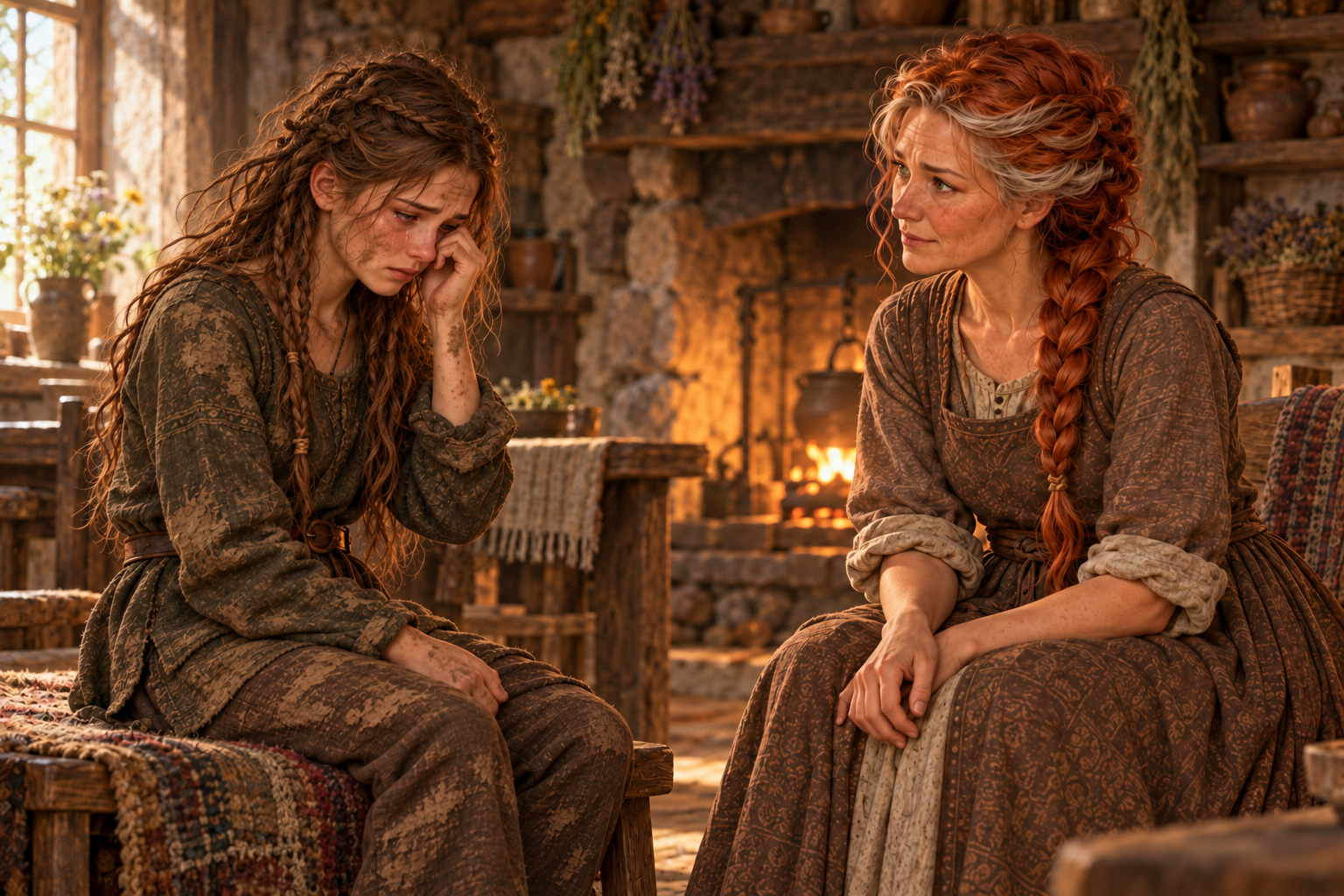
V opened her mouth; nothing more came. The thing behind the sentence, the thing that had spent days on a shelf, locked away, buried beneath the foundations of plans, pushed past the word, and V found herself crying. Not quiet, manageable crying, either; the kind that shook her shoulders, broke her breathing and tore her words apart. “I was looking at him and his eyes. I was just scared, being scared doesn’t kill people, when you’re scared you run, I couldn’t even run, I just stood there and the water… I didn’t tell the water anything.”
Pirig did not get up. Did not hug her. She sat where she was, on the other side of the fire, like a mountain, and calmly placed stones, one by one, into V’s storm:
“That’s right. You didn’t.”
“Then why?”
“Because no one taught you how to tell it.” She leaned forward. “Listen to me, guest. You must separate two things, or they will both eat you. One: a man died. That is real, it is heavy, and it will stay with you. It should. Don’t be afraid of it staying; you have a back that can carry it. Two: you did not choose to kill. There was a cord around your neck. The water saw that and spoke before your tongue did.” She leaned back. “You had no choice in anything that day. This is what you will learn: how to have a choice.”
“What if I can’t learn? What if I get scared again and someone near me gets hurt?”
“You’ll learn.” Two words, solid as stone. Then Pirig stood, opened the door and said something V was not ready for: “Come. We’re going to Leris.”
“Leris?” V asked hesitantly.
Pirig smiled. “The water that runs through Keral is called Leris.”
V’s whole body said no in a single contraction.
“I, look, I can’t even drink it, you know that, what am I supposed to do in a river…”
“You won’t drink.” Pirig stepped over the threshold into the sun. “You’ll stand.”
Leris ran broad and deeper than knee height along the edge of Keral’s lowest layer. Pirig stopped on the pebbled bank, took off her own foot-wraps and stepped into the water. Without a thought, as though it were an everyday task. Then she turned and waited. She did not offer a hand. Did not call. Only waited, and V stood trembling on the bank before the running water.
I’ve been in water thousands of times. Millions of times. Water is my job. Water is my…
Water, going into the man’s mouth…
“Your legs,” Pirig said, her voice carrying level and calm across the river. “Only your legs. The water doesn’t want more than your knees. Don’t ask more of yourself either.”
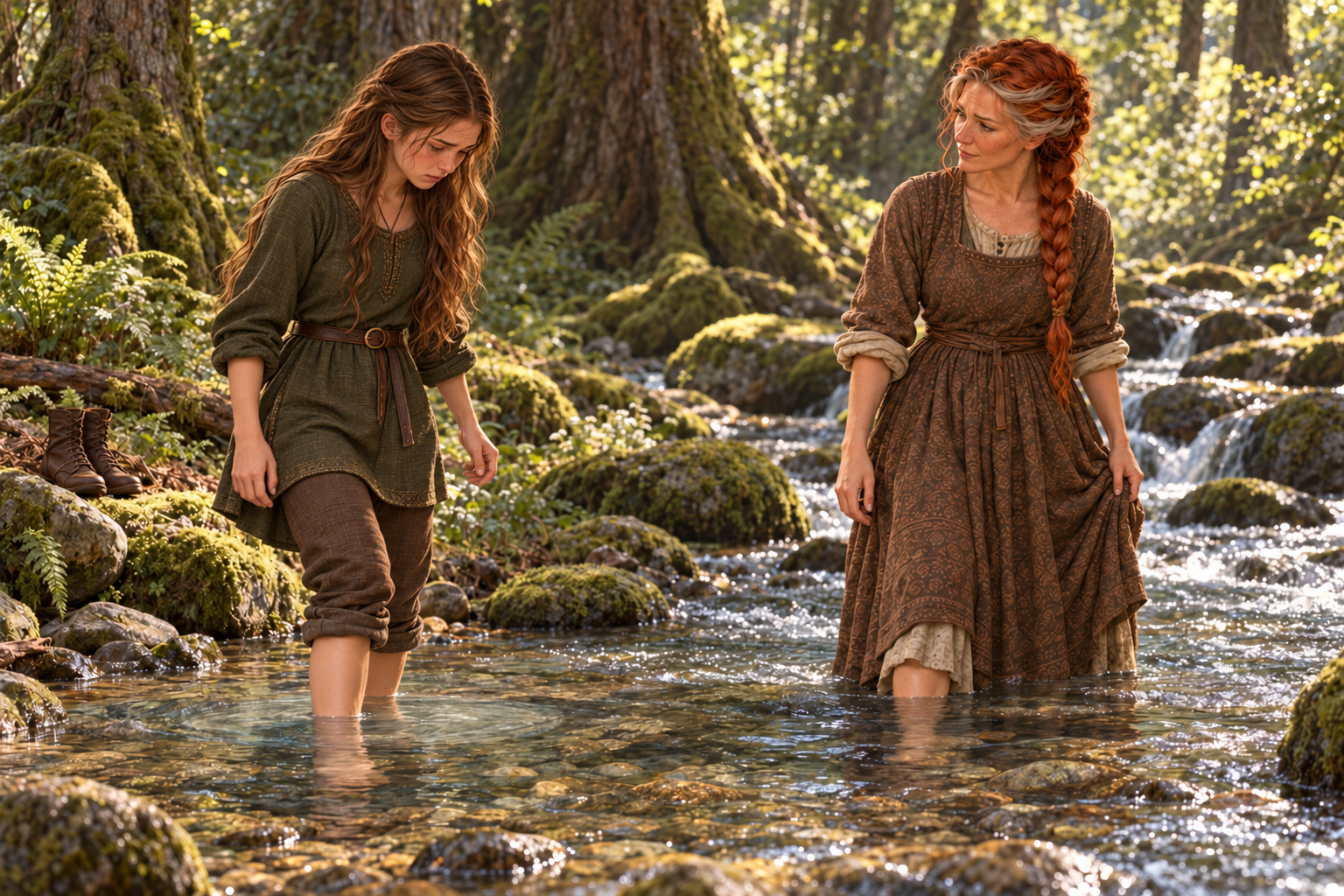
V took off her foot-wraps. The first step, onto ice-cold pebbles. The second, and water wrapped around her ankle.
V’s breath caught; she closed her eyes and waited. For the panic, the shutters, the man’s eyes. The panic came: in her chest, in her throat, familiar. But there was something else at her ankle, and it moved faster than the panic: tingling. Soft, warm. An impossible warmth in a flowing river. Rising from her ankles like an introduction.
And with her eyes closed, V heard the change in the sound of the water.
The current had slowed around her. She knew without seeing. The current that had struck her legs had drawn back, the water had stilled around her like an eye, as though the river were giving way to this trembling girl in the middle of its bed.
“Open your eyes,” Pirig said.
V did. Looked down. Around her legs, the water stood like glass, while the rest of the river flowed.
“Are you afraid?”
V looked inside herself and found the honest answer: “Yes. But…” She searched for the right word. “But it feels like I’m the one who’s afraid, not it. It’s just… staying still.”
“It’s still because you came.” Pirig stepped out of the water and tied her wraps, and said it as though it were the most ordinary sentence of the day: “You’re a Nyvra, child. Water is like your blood. Every day you ran from water, you ran from your own blood. You can’t master what you run from.” She nodded towards the river. “You’ll stand here today. Tomorrow too.”
V stood for a long time in the still eye in the middle of the flowing river. The panic came and went in tides; the tingling stayed. And when she stepped onto the bank, for the first time in days she could take three sips from her waterskin. Eyes closed, hands shaking. But she could drink.
Nyvra. The word was no longer a scream. It was a label. For the first time, V’s file had a label, and the label was terrifying, and even a terrifying label was better than none.
The next day, the questions changed direction.
“Now,” Pirig said that morning, across the hearth, “tell me about the place you came from. All of it. Your city of lights, your school, your water. From the beginning.”
And V told her. She talked until the sun changed position in the stone house’s window, with questions from Pirig, which were the best questions V had ever heard: questions that did not lead, did not judge, that opened another layer beneath every answer. She told her about pools, explained chlorine (“A poison you put in water to clean the water.” Pirig’s eyebrow rose for the first time all day), the buses, the phones, the jug hanging in the air, the lights, the philosophy assignment, the wall in the race, the shopping centre, the lake, the necklace.
At the word necklace, Pirig’s hand made a gesture in the air: show me.
V hesitated. Hide the stone, from everyone, not from the Vaerin. She drew her necklace out from beneath her neckline. Pirig came closer, crouched and looked. Looked for a long time. Her hands rested on her knees, and V noticed that they did not move a millimetre. It was deliberate stillness, the muscle of a decision. Eyes that had read every book in the world examined the stone line by line and did not touch it.
“Where did it come from?”
“It belonged to my father’s family. Mum gave it to me on my sixteenth birthday. That was what Dad had asked her to do before he died, so she kept it until then.” V swallowed. “What do you know about it?”
“Little.” Pirig straightened. “And I keep that little to myself rather than risk telling it wrong.”
That afternoon, the lesson began. Without warning, all at once.
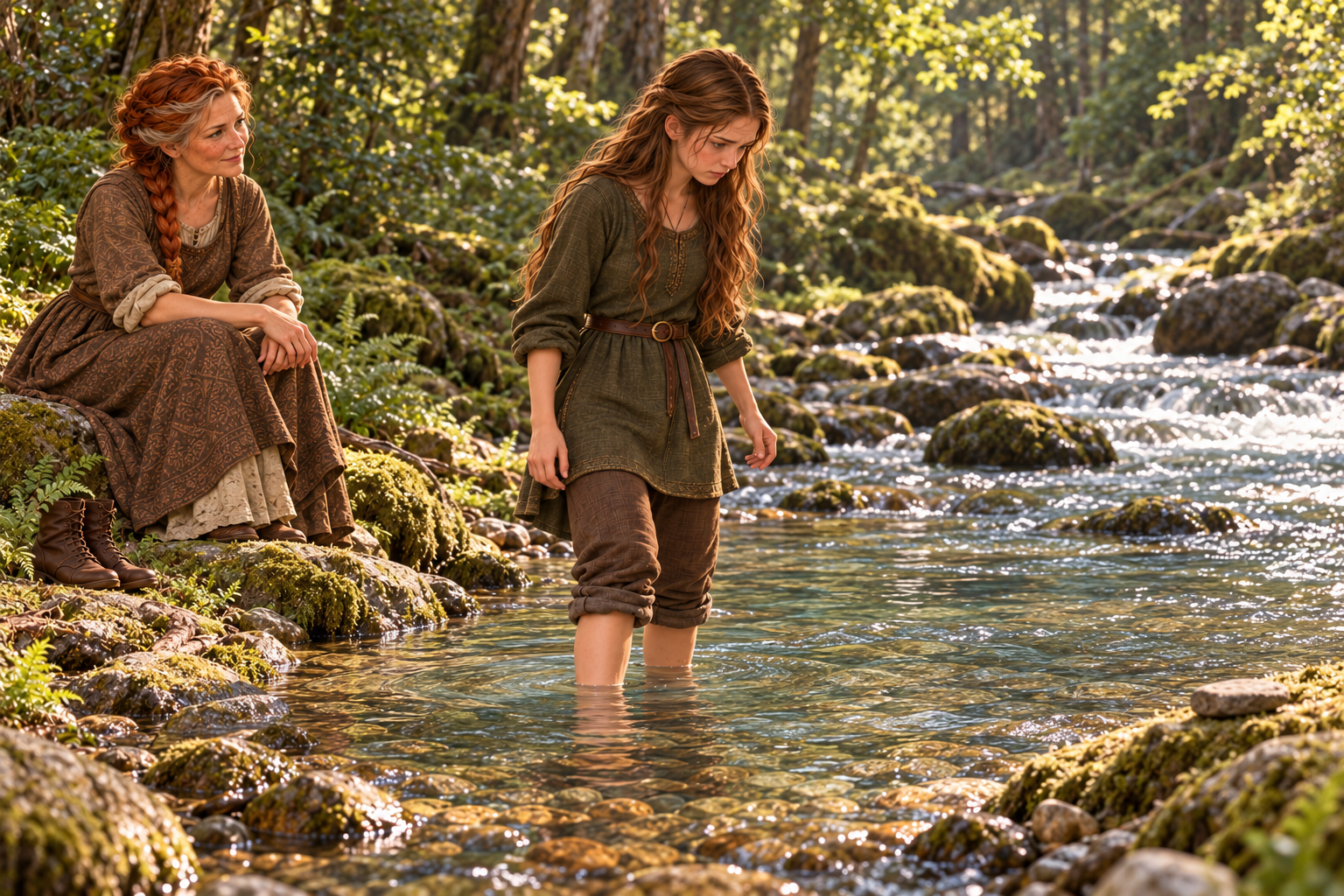
They returned to Leris. This time V took off her foot-wraps and entered the water of her own accord. The panic was still there, but now it waited at the door, not inside. When she reached knee depth, the water slowed around her again; that still eye formed of its own accord in the middle of the flowing river.
Pirig sat on a stone on the bank.
“Nyvra power flows along four paths,” she said. “Fire. Water. Emotion. Truth.”
V looked down. The water around her feet stood as though it had forgotten everything except her.
“I’m not going to ask which one I am.”
“Good.”
“Because it’s obvious.”
“Very.”
V breathed out through her nose. “Go on.”
Pirig pointed to a flat stone on the opposite bank.
“Take the water there.”
V looked at the stone, then at Pirig.
“How?”
“Tell it.”
“Tell it what?”
“That’s the problem.”
V waited a while. She thought Pirig would continue. She didn’t.
“Is that the whole lesson?”
“For now.”
“Wonderful. Very informative.”
The corner of Pirig’s mouth moved.
Then she spoke.
“A Nyvra calls on her power with a word. Tells fire what to do. Water where to go. Guides emotion and tells the body what to release, what to hold on to. And Truth Nyvras…” She paused. “We’ll talk about that later.”
“Why?”
“Because today you’re standing in water.”
It made sense. Irritatingly so.
Pirig pointed to the stone again.
“Tell the water to go.”
V frowned down at the water.
“Go!” Nothing happened. “Are we surprised? No.”
“Say it in the language of water.”
“Huh? The language of what?” V spread her hands. “What do you mean?”
Without answering V’s question, Pirig spoke a short word.
V repeated it.
The water did not move.
She said it again. More accurately this time.
Nothing.
On the third attempt, she shaped the word almost exactly as it had come out of Pirig’s mouth, and the stone opposite was still bone dry.
V put her hands on her hips.
“The only teacher who ever made me feel this bad before was my maths teacher.”
“You said the word.”
“Yes.”
“You didn’t say it to the water.”
V fell silent.
Pirig did not stand up. Did not come to her. She just sat on the rock on the bank and watched.
“A word is not sound,” she said. “Sound is the part of it that comes out.”
“Then what’s the part that stays inside?”
“I can’t tell you that.”
“Why?”
“Because I’m not a Nyvra.”
Pirig placed her hand on her knee.
“I know some words. From books, from what I’ve heard.” She tilted her head slightly. “But water doesn’t hear me. Neither does fire. I can show you where the door is. The hand that opens it is yours.”
V looked at the stone opposite again.
Then she thought of the stream.
The man.
The water had stood up without a single word being said to it.
V turned slowly towards Pirig.
“But I didn’t say anything in Sidra.”
The small expression on Pirig’s face disappeared.
“I know.”
“I didn’t say anything here yesterday either. The water stopped by itself.”
“I know.”
V was facing her fully now.
“You just said a Nyvra can’t do it without words.”
“No.” Pirig’s voice was calm. “I told you how a Nyvra does it.”
Only the sound of Leris remained between them.
V thought for a few seconds.
“Those aren’t the same thing.”
“No.”
“Then what is it that I do?”
This time Pirig did not answer straight away.
“That,” she said at last, “I don’t know either.”
For the first time in days, V heard those words from Pirig.
And she did not like them at all.
“I have the knowledge; I don’t have the blood. I can’t teach you beyond this point.” Pirig looked west, towards the mountains. “You’ll go to them.”
“Them? The Nyvras? I thought they were far away, I thought they didn’t come here?”
“They don’t. You’ll go.” Pirig’s voice had dropped into that level tone that left no room for argument. “And there is another reason for you to go, perhaps greater than the first: you fell through a lake, child. You passed through gates. I don’t understand gates, but perhaps the Nyvras do. If there is a way home for you, they are the ones who know it.”
As V took in what that meant, home, answers, a way, all at the same address, she laid her last question, the largest, against the body of the mountain:
“But where do I fit into this? If they’re far away and they don’t come here… I came from another world. There are no Nyvras there, no forest, nothing of yours. I fell through a lake and came out a witch. How am I a Nyvra?”
And Pirig did not answer.
She was silent. But this was not her “I keep that little to myself rather than risk telling it wrong” silence; V heard the difference. There was knowledge in this silence. Pirig’s eyes held V’s with that reading look, that finished calculation, and a shadow of the expression from the first day crossed her face: something falling into place. She knew. Or she was sitting on something very close to knowing. And she wasn’t going to tell.
“Some answers,” she said at last, “set out before the person asking. Yours is on its way.”
“What does that mean?”
“It means ‘not now’.” Pirig walked away and added without turning, “Besides, tomorrow is not a day for questions. My daughter has come home after months away, and we haven’t celebrated yet.” She turned to V; there was a smile on her face. “Tomorrow evening, there will be dancing.”
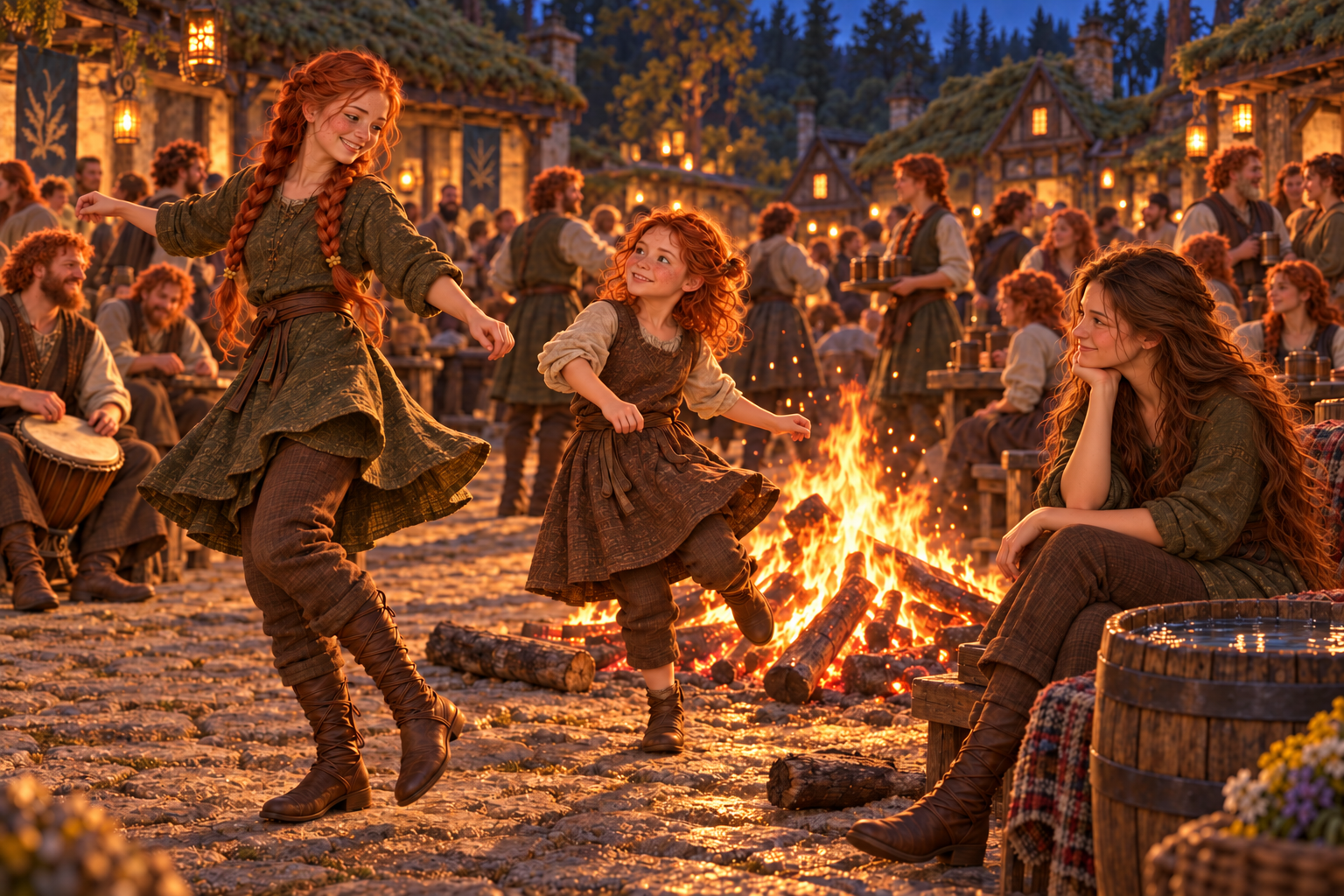
They danced.
V had known the Serndals, Enna had told her that was what these people were called, in a single mould. Quiet, measured, like stone, and that evening, around the great fire in the square, the mould shattered. There were drums: three separate rhythms, deep, felt in the chest, interlocking. There was something with strings, a wild, ancient relative of the violin, and it sounded as though the forest itself were singing. And there was dancing: lines, then circles, then patterns that unravelled and wove themselves together again. A dance in which feet struck the earth not with Sirel’s silence but deliberately, as part of the rhythm. The same people who had passed V without a glance during the day were now laughing aloud; someone had pulled Sirel into the middle of the circle, and Sirel was spinning. V realised she needed to rewrite her file on these people from the beginning: they spoke little because they had little need for words. Not because they had little need for joy.
The rhythm settled somewhere inside V. It was nothing like the music of her own world, but her body, the swimmer’s body that knew tempo through strokes, worked it out in the first minute, and V noticed her foot keeping time of its own accord as she sat on the log. For the first time in days, the thing on her shoulders, the thing that had been named but was still heavy, lifted a finger’s width.
And then Enna came.
Sweaty, hair stuck to her forehead, cheeks flushed red from the fire. She planted herself in front of V’s log and pulled her shoulders back without explanation. Wiped every bit of joy off her face. Lowered her chin a little.
Before V understood what she was doing, Enna spoke in a poor ten-year-old copy of Sirel’s voice:
“Eat.”
The corner of V’s mouth moved.
Enna took a step. She was imitating Sirel’s walk now; back rigidly straight, arms moving less than they should, eyes shifting from side to side as though she knew what everyone in the square was doing at once.
“Come.”
Another step.
“Sit.”
V made a sound through her nose.
Enna turned to her at once. She tried to frown like Sirel; when she failed, the result was more constipation than anger.
“No.”
V laughed.
Enna had found her audience’s weak spot. She put on the look Sirel gave when asked a question, as though annoyed first with the person and then with the question itself.
“Later.”
V lost it. The laughter came all at once. Something inside her stomach hurt, her eyes watered. Enna couldn’t stay in character any longer either and was laughing at herself, but she still tried to put her serious face back together and kept circling the square.
“She does this too,” she said, and suddenly stopped to stare across the square as though she had spotted an invisible danger. Then, very slowly, very seriously, she moved her hand to her waist.
V laughed harder.
“Enna, enough…”
“No.”
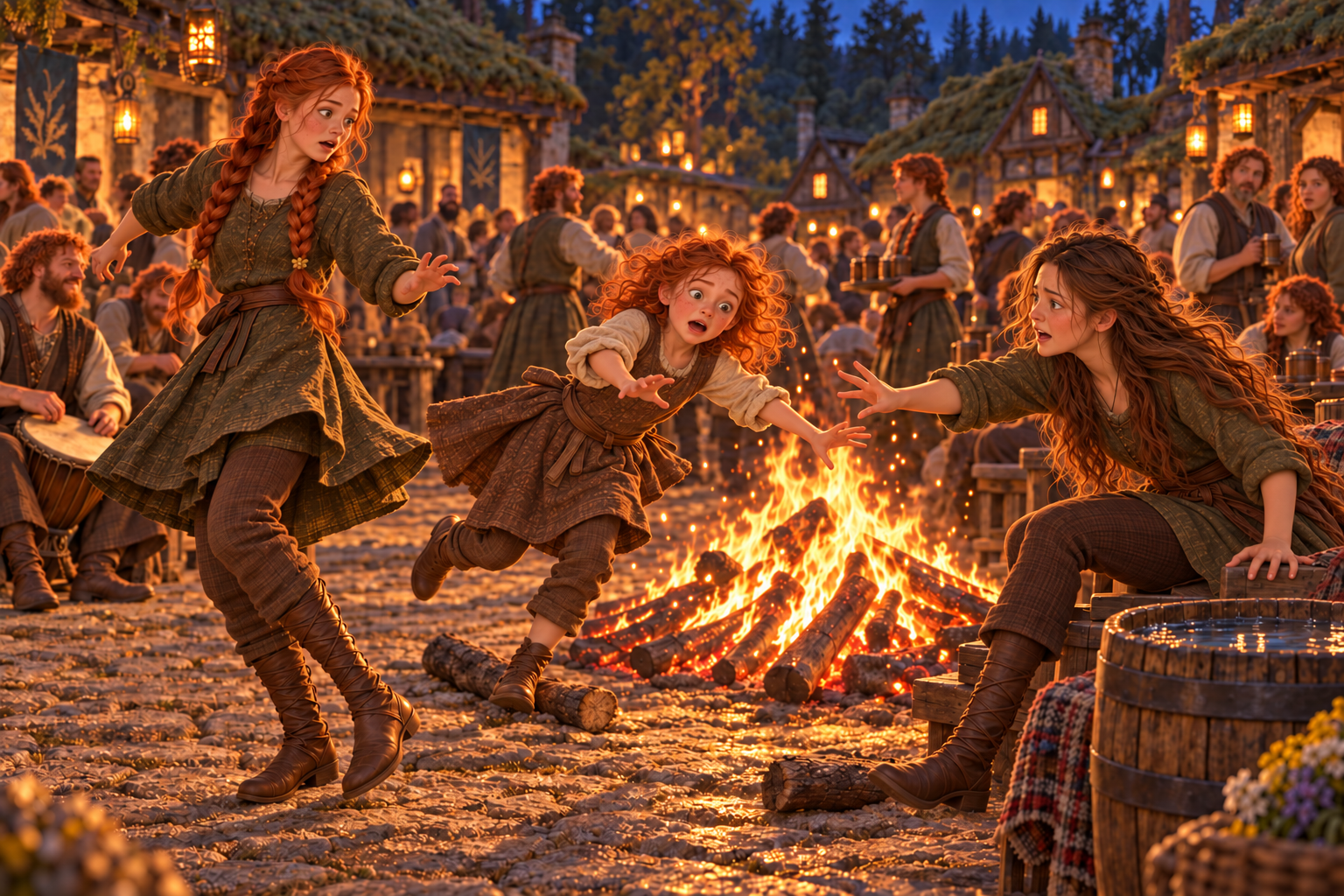
This time the word came out so Sirel that V doubled over. Enna took two triumphant steps backwards. On the second, her foot landed on something. One of the thick logs stacked at the edge of the fire. The log rolled beneath her foot. The smile vanished from Enna’s face. Her body went backwards, towards the fire. It happened so fast that V could not even stand up.
One moment there was Enna. The next, flames taller than a person behind her.
And the world turned off its sound.
No.
The warmth left inside V by laughter turned into something else. No word, no instruction. Her hand moved involuntarily, as though reaching to catch Enna as she fell.

A crack came from the barrel at the edge of the square. One of the wooden hoops snapped, and water burst out through the side. It was neither an arm nor a wave nor any shape V had chosen. Not a bucket, not a wall; just a great deal of water, very fast.
It hit Enna from the side.
Instead of falling into the fire, the girl changed direction in the air and landed on V two steps away.
V tried to catch her but couldn’t. They rolled off the log together. A second later V was flat on her back, Enna on her chest, and water was dripping from both of them.
The fire rose where Enna had just been.
The world turned its sound back on.
The crackle of the fire returned. The square had fallen silent. The drums had already stopped. The circle had halted. Hundreds of green eyes went back and forth between the wet child and the guest lying on the ground. Sirel stood in the middle of the circle, half-turned towards the burst barrel, her hand frozen on the hilt of the knife at her waist.
Before V could even breathe, she looked at Enna’s face. Water dripped from her hair, from the tip of her nose.
“Enna?”
Enna blinked.
Then she looked at the fire behind her. Then at the shattered barrel. Then at V.
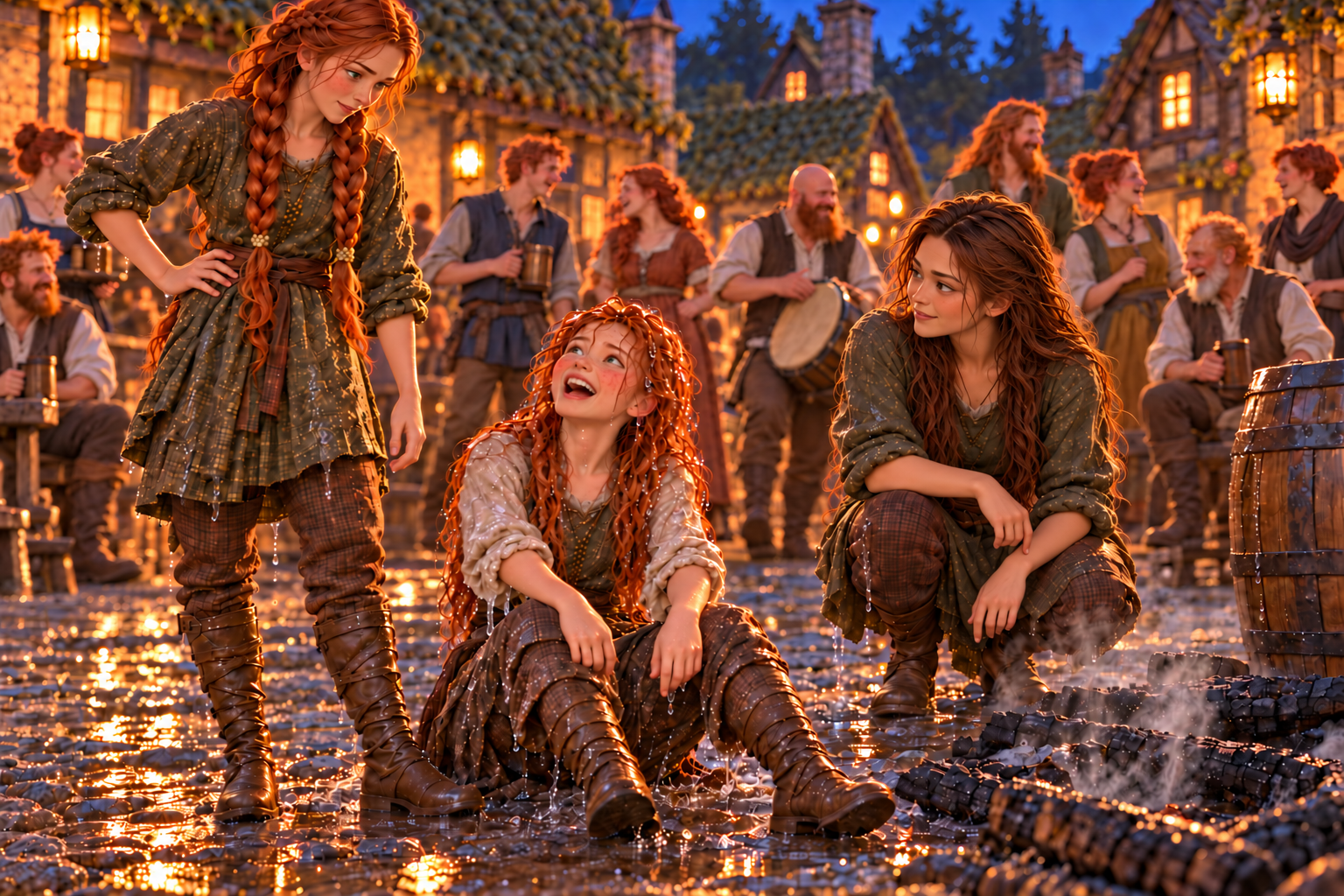
Her face slowly lit up.
“DO IT AGAIN!”
Soaking wet, eyes like lanterns, she sprang to her feet and bounced in the middle of the square.
“Did you see? Did you see that? Do it again, please, again.”
And before the first frame of fear could advance to the second, a child’s delight scattered it. Some people breathed out. Some laughed in short bursts. One of the drummers, perhaps to rescue the moment, perhaps simply from being Serndal, struck once, then again, and the rhythm returned like water finding its river again. The circle wove itself back together.
But Sirel did not return to the dance. She crossed the square, took two wooden cups and sat beside V on the log.
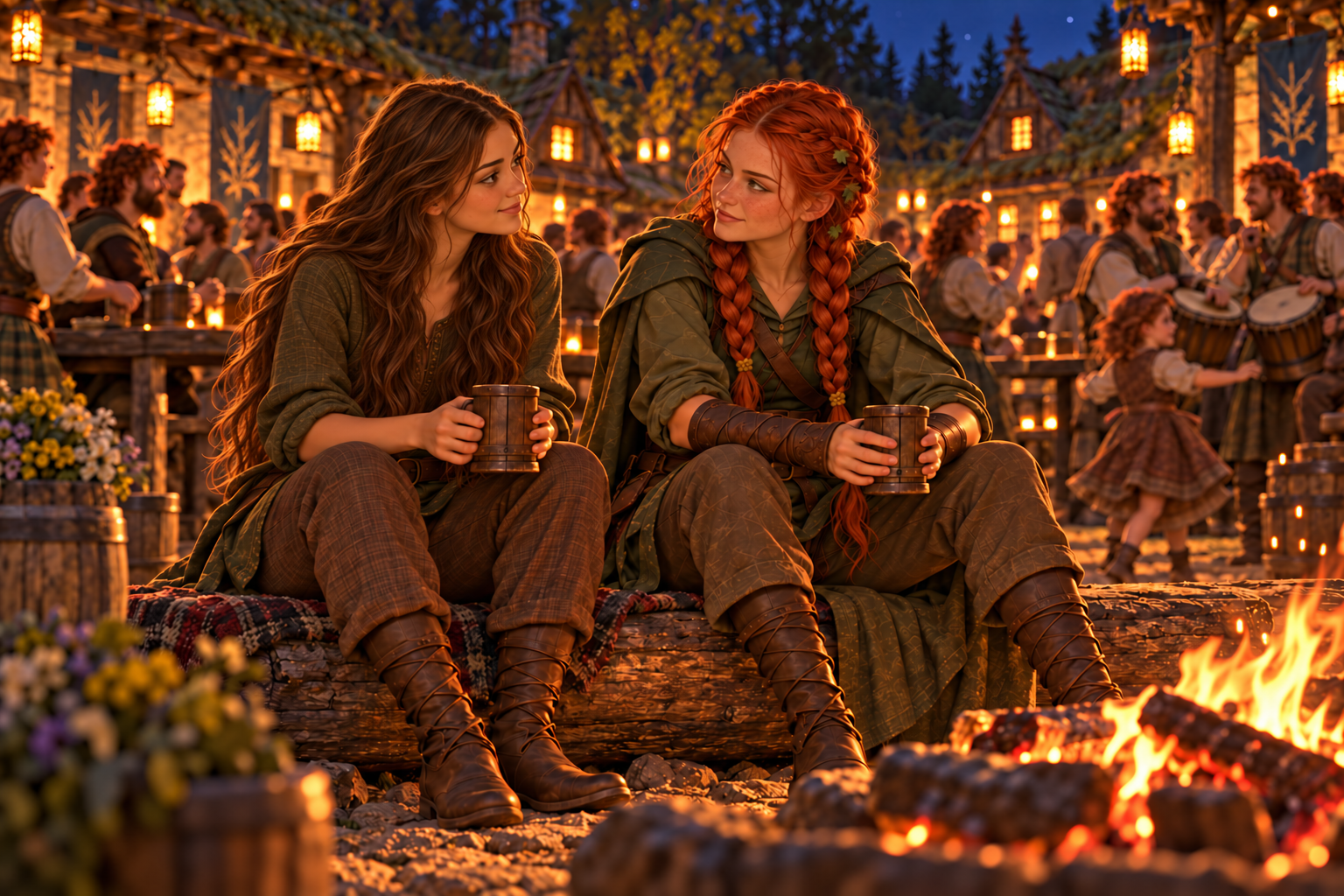
“Drink,” she said, holding out a cup. Then, for the first time V could remember, she added an explanation without being asked: “Sorvel. Honey, root, winter.” A pause. “Not much.”
V sniffed: sweet, spiced, with a warmed sharpness somewhere underneath. She took a sip; warmth travelled down her throat into her chest and burned there like a small hearth.
“Oh. Right. Now I understand ‘not much’.”
Sirel drank from her own cup. V noted that she was not drinking a little; half the cup had gone in one swallow, and she noticed the crowd-induced tension in Sirel’s shoulders loosening. They sat in silence for a while. But this was not the silence of the forest; it was an easy silence filled by the fire, the drums and Enna’s distant voice continuing her “do it again” campaign.
“You were scared,” Sirel said at last. It wasn’t a question.
“Scared the life out of me.” V looked into her cup. “Everyone’s faces… It was like Sidra. For a second. Then Enna…” She gave a tired laugh. “I think Enna saved me. For the second time. First with the impression, then by jumping around.”
“Enna.” The corner of Sirel’s mouth moved. That old half-millimetre. “Doesn’t know fear. Yet.”
“I hope she never learns.” V took another sip and, with the courage of the warmth, said what had been on her mind for days: “By the way. I haven’t thanked you. I mean, I did, when I was sick, but… the list got longer. Stone, fruit, shoes, fire, medicine, town, stream, bringing me here. I’m keeping a record, just so you know. When we go back, I mean, if I go back, I’ll buy you the best thing in my world.” She thought. “Though I have no idea what that would be. Should I get you a lighter? Now you’ll ask what a lighter is. You know those stones you use to make fire? Imagine a super-super-civilised version of those, a little tool that lets you make fire with one hand, just like that, no effort. That’s a lighter. No, wait, you put fire out with one movement, a lighter would be an insult…”
And Sirel laughed.
She laughed aloud. Short, husky, like a rusty hinge, but real, audible laughter that tipped her head back. V froze, cup in hand. A few heads nearby turned towards them; apparently Sirel’s laughter was a rare natural event even here.
“Whoa,” V said. “You laugh. Out loud. I saw that. I’m a witness and…”
Sirel’s face returned to its old granite state as fast as a shutter falling. She raised her cup a finger’s width towards V and said with absolute, measured, ice-cold seriousness:
“If you tell anyone, I’ll kill you.”
“…Right.”
“Then I’ll burn your body.”
“Understood.”
“No one will find you. Not even Vharn.”
“Right. Understood. No laughter. You’re a rock. You’ve always been a rock.” V bit her lip to keep from laughing and failed. “But between us, red-haired goddess, that’s not a bad laugh for a block of ice.”
“V.”
For the first time.
For the first time, she was saying her name. Not “guest”, not “you”: “V.”
“Drink and be quiet.”
V drank and was quiet.
First she looked at the fire, then at the girl beside her. The seventeen-year-old girl with freckles on her nose, holding her cup in both hands among her own people, her shell cracked for one night.
She tilted her head towards the sky.
My friend.
In another place, in another dimension, in another age, I have a friend who comes from a people who don’t speak and threatens to kill me. I know what Elenie would say: ‘Well, you certainly have a type. You’re not normal yourself, so why should the people around you be?’
The night wore on, the fire sank lower, and at some point, amid the drums, Sirel looked into the bottom of her cup and spoke as though to no one:
“You’ll go to the Nyvras.”
“Pirig said that, yes. ‘You’ll go to them.’ How, where, where’s the road? Those bits went into the ‘not today’ folder.” V looked at her. “How do you know?”
“Mum says everything.” Sirel finished her cup. “With silence.”
And she said no more; but V caught something in the girl’s look towards the mountains and added the last note of the night to her file:
Sirel knows too. And I think Sirel is coming too.
The next morning, it was not the sun that woke V, but Enna.
“Do it again.”
V opened one eye from her grass-stuffed bed. “Enna. The sun hasn’t even…”
“Do it again. A little one. Mum said you can do it by the river, I asked, she said yes, come on.” A pause; all ten years of diplomatic skill came into play, the lower lip pushed out. “Please?”
And V found herself by the river. In the morning mist, in water deeper than her knees, with an expectant audience sitting cross-legged on the pebbles opposite. Two people; but Enna and Verral counted as a crowd. The failure of her last lesson weighed heavily on her shoulders.
“Look, I tried the other day, it’s not working, I’m still…”
“But the water caught me,” Enna said with absolute logic. “It likes me. Splash me.”
It likes me.
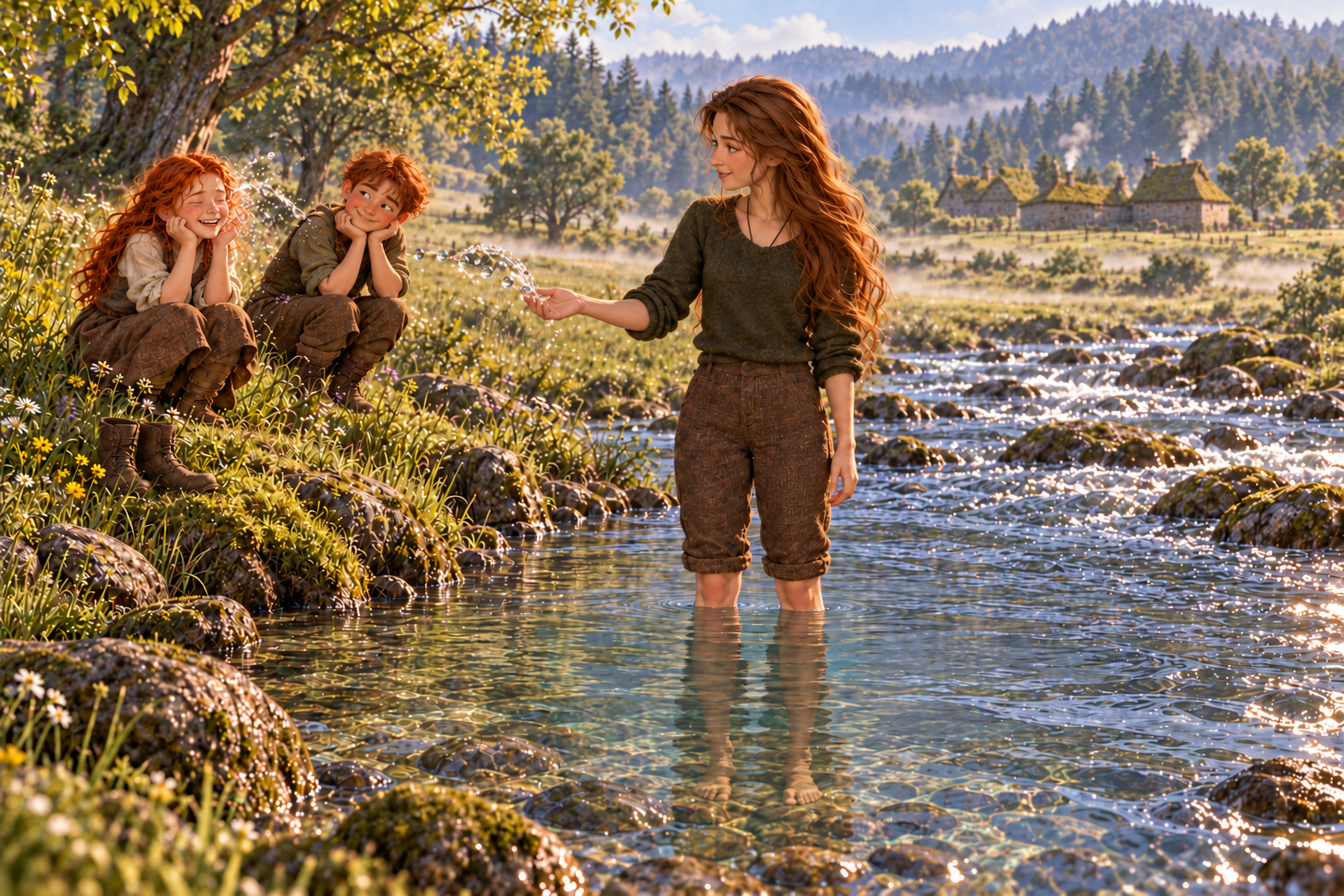
V looked at Enna’s protruding lower lip and laughed. The tingling in her chest came of its own accord, small and warm, and the water beneath V’s hand flicked like a tail and splashed a handful straight into Enna’s face.
Enna’s pure, high, delighted shriek split the morning mist in two.
“AGAIN!”
V looked at her own hand. It was wet and tingling and it wasn’t shaking.
So it isn’t about wanting it badly enough, she amended the file. Maybe emotion. Something pure, something I really feel. Like affection or joy.
For a moment she remembered Sidra.
Or fear.
“All right,” she said, rolling up her sleeves. “But afterwards, you’re teaching me how to throw stones.”