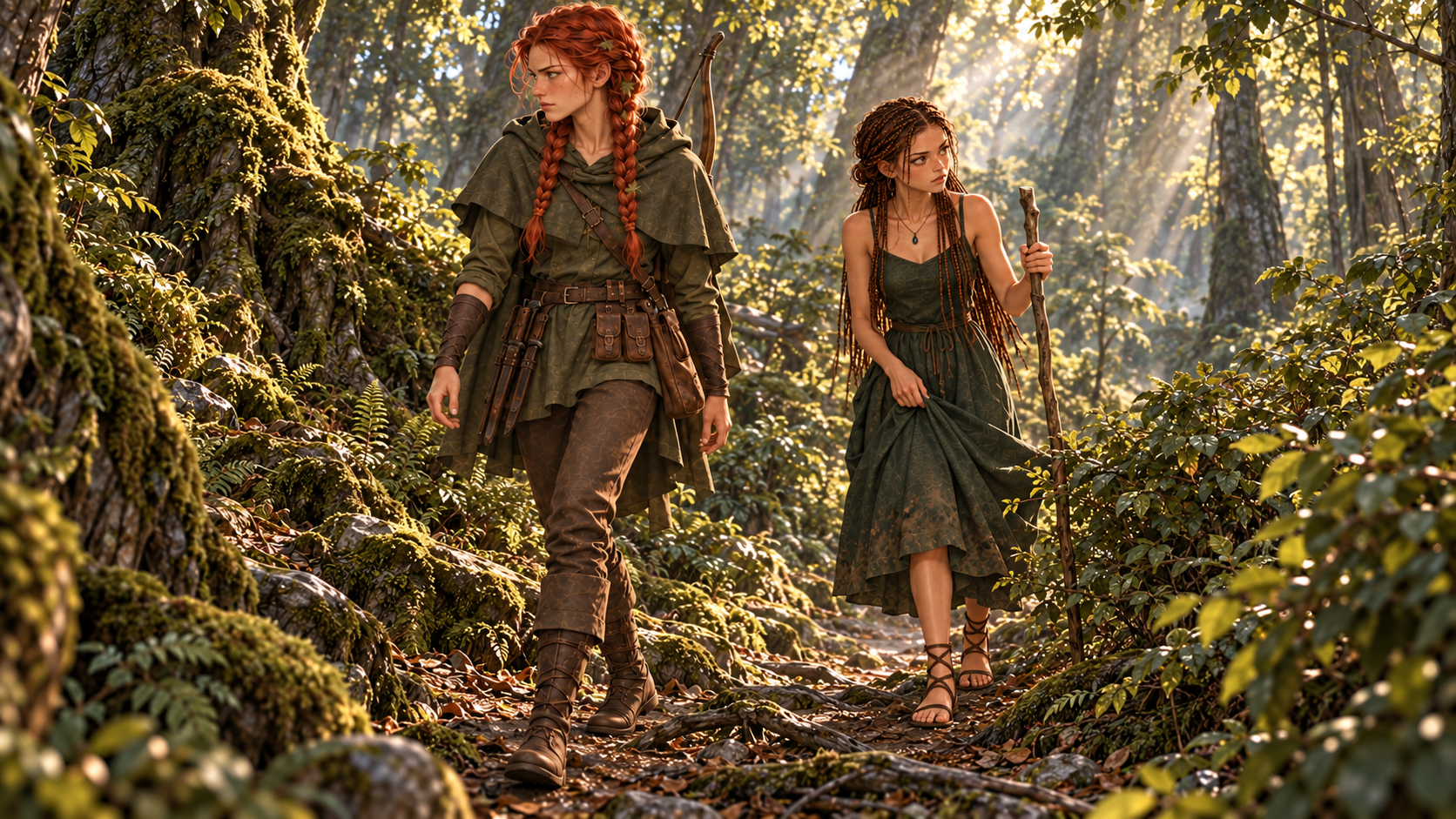
The walk would take two days. Sirel did not say this. What Sirel said, in answer to V’s “How far?”, was “Two days”, and V knew by now that, by Sirel’s standards, this was an enthusiastic briefing.
Before the first half-hour was up, Sirel stopped.
V stopped too. She did not ask why they had stopped; she was busy freeing the hem of her dress from a bush for the third time. It had dried, but the fabric was not made for walking. It tangled round her knees, caught on branches, pulled at her from a different place on every slope.
Sirel opened her bag. She took out two folded pieces of clothing and held them out to V.
V looked at the clothes, then at Sirel.
A dark green, long-sleeved top. Brown trousers. Both looked like Sirel’s clothes; or rather, slightly less worn versions of them.
“What?”
“Put them on.”
V looked at the clothes in her hands, then at the hem of her own green dress.
“You knew this half an hour ago.”
Sirel did not answer.
V decided that meant yes.
“Fine. Where?”
Sirel pointed to the thick trunk of the tree beside them.
“Of course it would be behind a tree.”
She went behind the tree. The trousers were a little loose at the waist, but stayed up once she tightened them with the thin leather cord Sirel had given her. The top fitted her shoulders better than she had expected; the sleeves were a little long. V rolled them up twice to free her hands.
She stood for a moment looking at the green dress she had just taken off, still holding it in her hands.
A few days ago, she had looked in the mirror and thought it brought out her eyes. Now it was mud-stained, creased and pulled out of shape in several places along the hem. V folded it. Not properly. She tried again, and this time managed it.
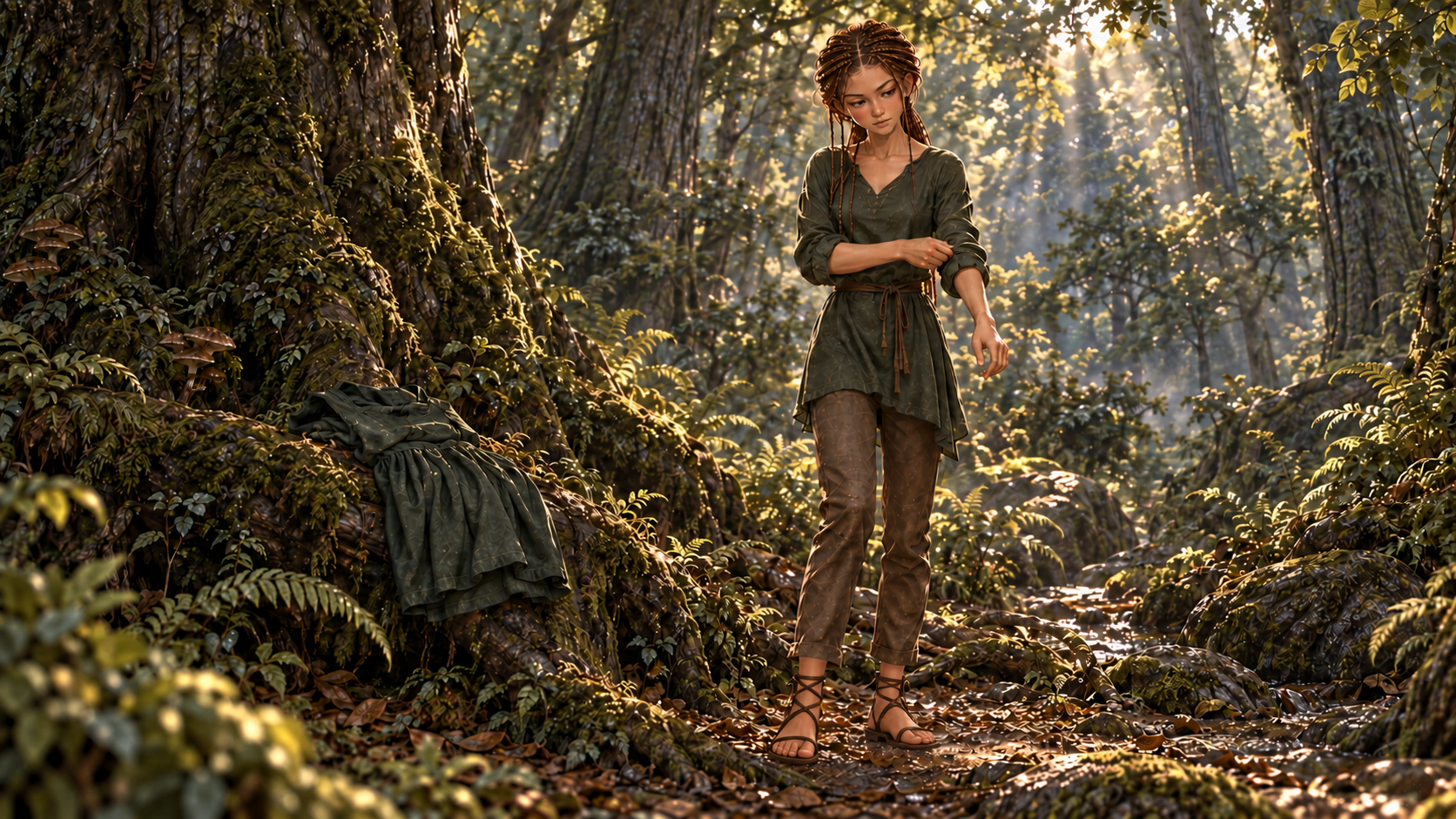
When she came out from behind the tree, Sirel looked her up and down once.
“Good.”
V raised an eyebrow.
“That’s it? That’s the entire fashion review?”
Sirel did not answer.
V held out the green dress.
Sirel took it. Looked at it once. At the muddy hem, the strained seams, the thing it had become, no longer any use at all.
Then she tossed it to the side of the path.
V picked it up. “Hey, do you know how much that cost?”
Sirel looked at her.
V said nothing. It was not really about the price. She just hadn’t wanted to throw it away like that right then. She draped the dress over her arm and started walking.
They went about ten paces.
Then Sirel stopped and held out her hand.
V looked at the hand, then at her face.
“What now?”
Sirel pointed to the dress.
V handed it over.
This time, Sirel did not throw it away. She did not fold it either. She opened her bag, pushed the dress inside, closed the flap and walked on.
V watched her go. She said nothing.

The first day passed in questions. V’s questions. Because Sirel did not ask questions. Sirel walked ahead, always the same distance away, without a sound, as though the forest were pulling its twigs out from under her feet. V behind her, with her stick, her leather foot-wraps and two days’ worth of accumulated questions. She soon worked out the system: questions fell into two categories, and the categories received different treatment.
Category one: these questions either got answers or were not understood.
“Is Sidra big?”
“Yes.”
“Is your home there too? Your parents and everything?”
“No.”
“What are the people in Sidra like? I mean… are they like me?”
“…?”
“What do they do for a living?”
“…?”
“What year is it?”
“The 985th Qureal year of Mintri.”
“Huh…?”
She had expected a more comprehensible answer to the year question. AD 350, BC 2465, something like that. Like in history lessons. Though she doubted this girl would use the idea of before or after Christ. From the look of things, she had gone back in time. Or had she gone forwards? Perhaps humanity had wiped itself out with too much technology and risen from the ashes or something. Coma and Limbo were still there as possibilities too.
“Are there cars?”
“…”
“Then who can I trust there?”
“No one.”
The answers were short, but they were real; V took each one and entered it into the file in her head. Category two was “lake”, and lake questions hit a wall.
“When did you see me? For the first time, I mean.”
“At the lake.”
V’s step faltered for half a second.
“When I came out of the lake? So you saw me. How did I come out? Out of the water, or… I don’t know, was there a light, anything?”
“The water.”
“Just the water. So that lake… is it a door? Something that opens onto other places?”
“…?”
“Has anyone ever come out of that lake before? Like me?”
“…?”
No answer to that one either. Sirel’s stride did not change, her shoulders did not change, nothing changed, and V noted that nothing changing was a kind of answer too. Doesn’t she know, or won’t she say? There was a chasm between the two, and V did not know which edge she was standing on.
“We’ve been walking for hours and haven’t seen anyone. Is there anyone else in this forest?”
“Yes.”
“You know how normal people say ‘yes’ and then explain? Well. I’m waiting.”
The answer came in the same steady rhythm and the same silence.
That afternoon, V left off asking questions and went back to her plan. The plan had been under construction in her head since the night before, and whenever she returned to the site, she felt the same thing: relief. Planning was good. When you were planning, you were not thinking about what your mother was doing right now. Whether the police had sent divers into the lake. Or whether you were lying in a hospital bed, whether Elenie… V caught the thought halfway through the sentence and buried it under the plan, in the foundations. Keep going.
The plan had three points.
Point one: get my bearings. Where am I, or what era am I in? Why am I here? Are there other lakes, other ways through? She needed information, and she was getting nowhere with this red-headed goddess of silence. Information lived where people talked.
Point two: understand. She did not know what sort of place she was heading for. Was Sidra made up of huge blocks of flats (which she would have loved, though a look at the red-headed goddess made it seem unlikely)? Or was it a town of little houses? Who would she ask, and what would she ask them when she got there? Was there a library or something? Hang on… were there even books? Did these people live entirely on dragon pears (she had named them herself)? Was there nothing else to eat? She would need money, and for that she would have to work.
Point three: Don’t stand out. Ask questions, but not too many.
She read the plan through three times in her head, stamped it, and realised that for the first time, the first time in two days, the future looked like a corridor instead of a wall. A narrow corridor. But a corridor.
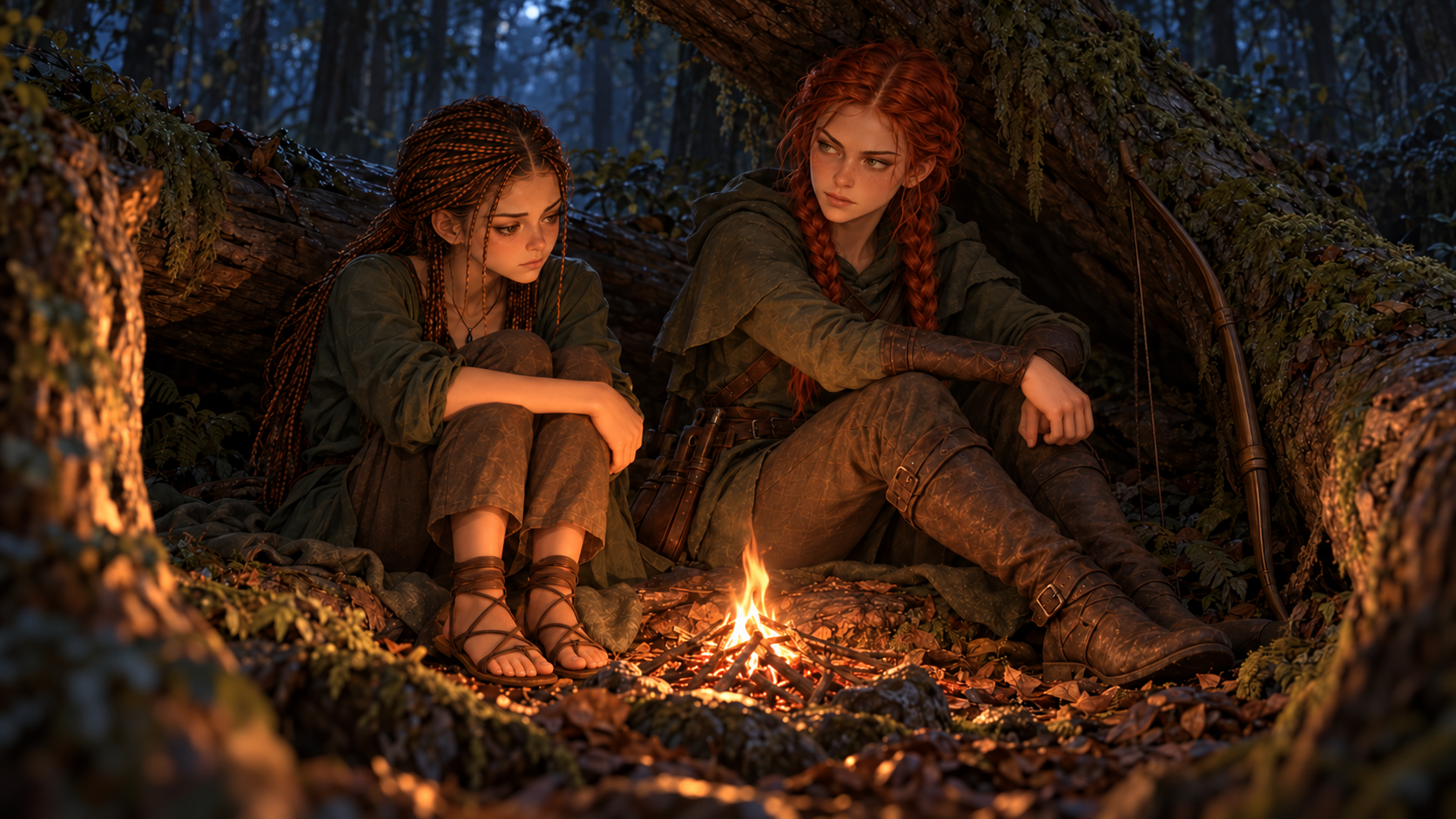
When evening came, Sirel pointed to a hollow between two fallen trees and lit a small fire, much smaller than the one V had seen at the lake. A palm-sized flame. V held out her hands and could not help asking:
“Could it be a little bigger? I mean, this is more the idea of a fire than a fire.”
“No.”
Something in her tone kept V from pressing.
Deep in the forest, night was a different animal from night on the shore. On the shore, at least there had been sky, lake, open space. Here, the dark was the same distance away in every direction: an arm’s length. The sounds were different too, closer, more layered. V listened for the questioning bird and could not find it. Apparently the bird did not come here. V decided not to dwell on it. She had barely made up her mind when Sirel emptied her waterskin over the fire.
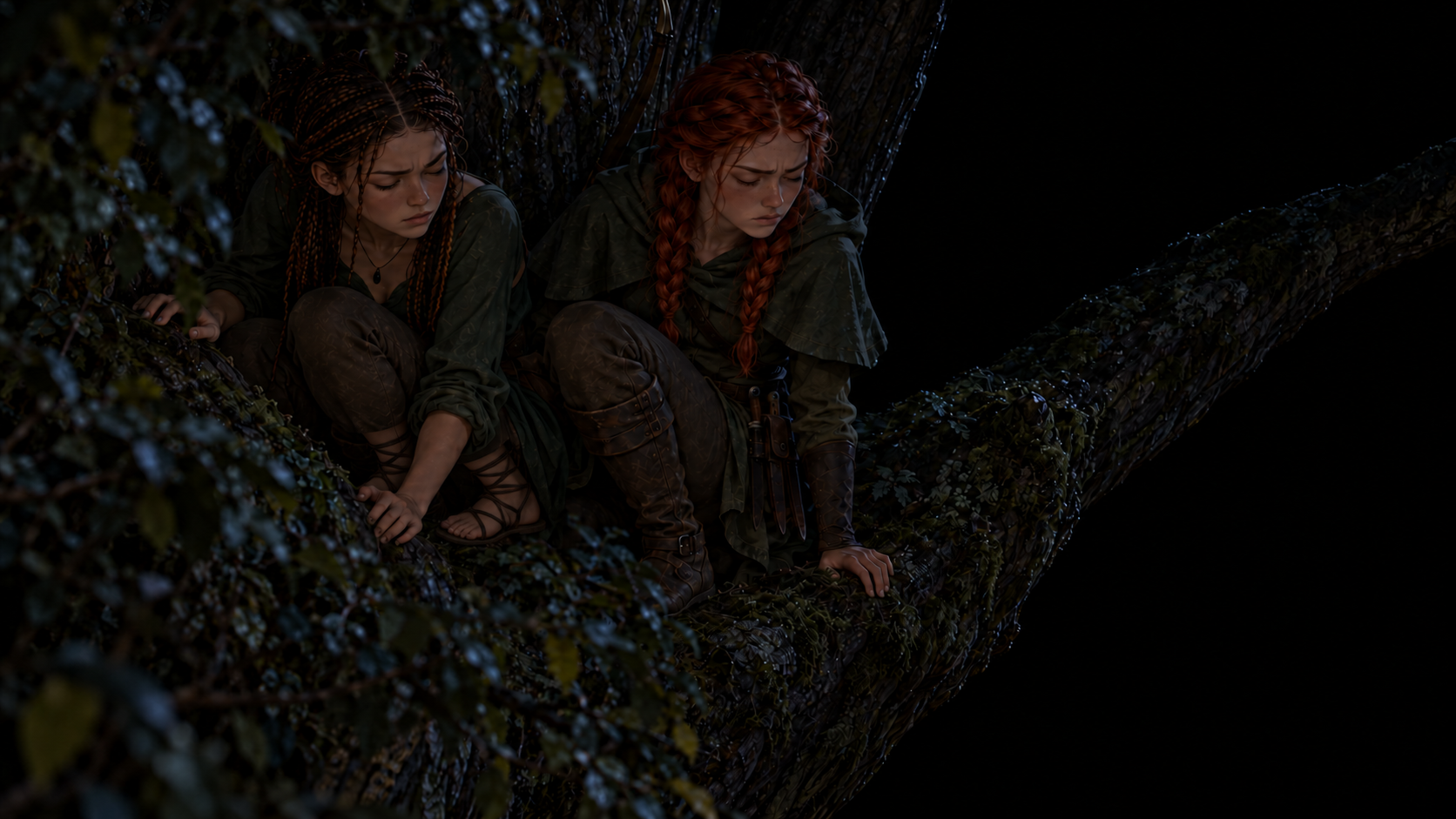
No whistle, no warning, no “keep quiet.” One movement. As V watched the smoke rise, Sirel pressed one index finger to her lips, caught V by the wrist with her other hand, and pulled: up. V did not question the climb; her body read the urgency in Sirel’s hand faster than words. The fallen tree’s trunk, a branch, a fork, the next branch up. Two human heights above the ground, on a thick branch, Sirel stopped her and pinned her against the tree with her own body.
And V heard it.
The ground heard it first. Before her ears did, her palms pressed against the bark heard it: deep tremors, spaced apart. Then came the sound: dry branches being crushed under sheer weight, without pause or care. The sound she knew from her first night in Tishar. But that night it had been distant, deep in the forest, and had gone away. This was not coming. It had come.
In the dark there was no shape; only volume. Like a gap between the trees that should not have been there, like a piece of sky without stars. There was a smell: somewhere between wet earth and something rotten, with a sharp, animal note beneath it. And there was breathing. Slow, deep, like bellows.
The thing stopped where the fire had been.
Over the embers. Its breathing changed: short, spaced, searching breaths. It was sniffing. The air in V’s lungs turned to stone. Beside her, Sirel was a statue; even her chest seemed not to rise or fall, and in the middle of her terror, V identified its true source: Sirel is afraid. The girl who threw stones, carried knives, lived alone in this forest, was not breathing.
Time did not slow as it had at the shopping centre. It did the opposite: disappeared. Afterwards, V would never know how long they had stayed like that. A minute, ten minutes, a season.
Then the tremors shifted. Moved away. Faded. And somewhere in the fabric of the forest, dissolved.
No one moved. A distant, very distant relative of the questioning bird called, and only then did the tension in Sirel’s body begin to ease, millimetre by millimetre.
“What?” V said. Her voice was somewhere below a whisper, and shaking. “Was. That.”
Sirel’s answer came through the dark. One word, a word V had never heard and would never forget:
“Vharn.”
“What does that mean? What is it, an animal, a gorilla, what? It was like a shadow, like smoke, but it was huge.”
“If it sees fire, it comes.” A pause. “Won’t come to water. Doesn’t like water. Here, it comes.”
V took that in, and as she did, the pieces settled into place with icy clarity. The tiny fire. The generous fire on the shore. Won’t come to the lake. Here, it comes. This was something with boundaries. Apparently, she told herself, silence had been a perfectly sensible way to elaborate on “yes” when asked if there was anyone else in the forest…
They did not come down that night. With her back against a branch and her weight against Sirel’s shoulder, V promised herself she would not sleep.
And that night, she kept her promise.
The second day passed in silence.
V had not run out of questions, but the night had changed something between them, and she was afraid that talking would spoil this new thing. Also: the word Vharn repeated itself in every empty space inside her head, and each time, V put it back on the shelf.
Towards noon, the forest began to change. The trees thinned, the darkness between them grew thinner, footprints appeared among the moss. A path. A real path that people used. Then the first roof showed between the trees, not tiles, but wood and grass, and something tightened in V’s chest: civilisation. How far had she fallen, that the sight of a roof could put a lump in her throat?
And V ran through the three points of her plan one last time. Get my bearings. Figure things out. Don’t stand out.
Sirel stopped in the shade of the last trees. Would not take another step. Her toes lined up with the boundary between shade and sunlight as though it had been drawn with a ruler.
“Sidra,” she said, pointing ahead with her chin.
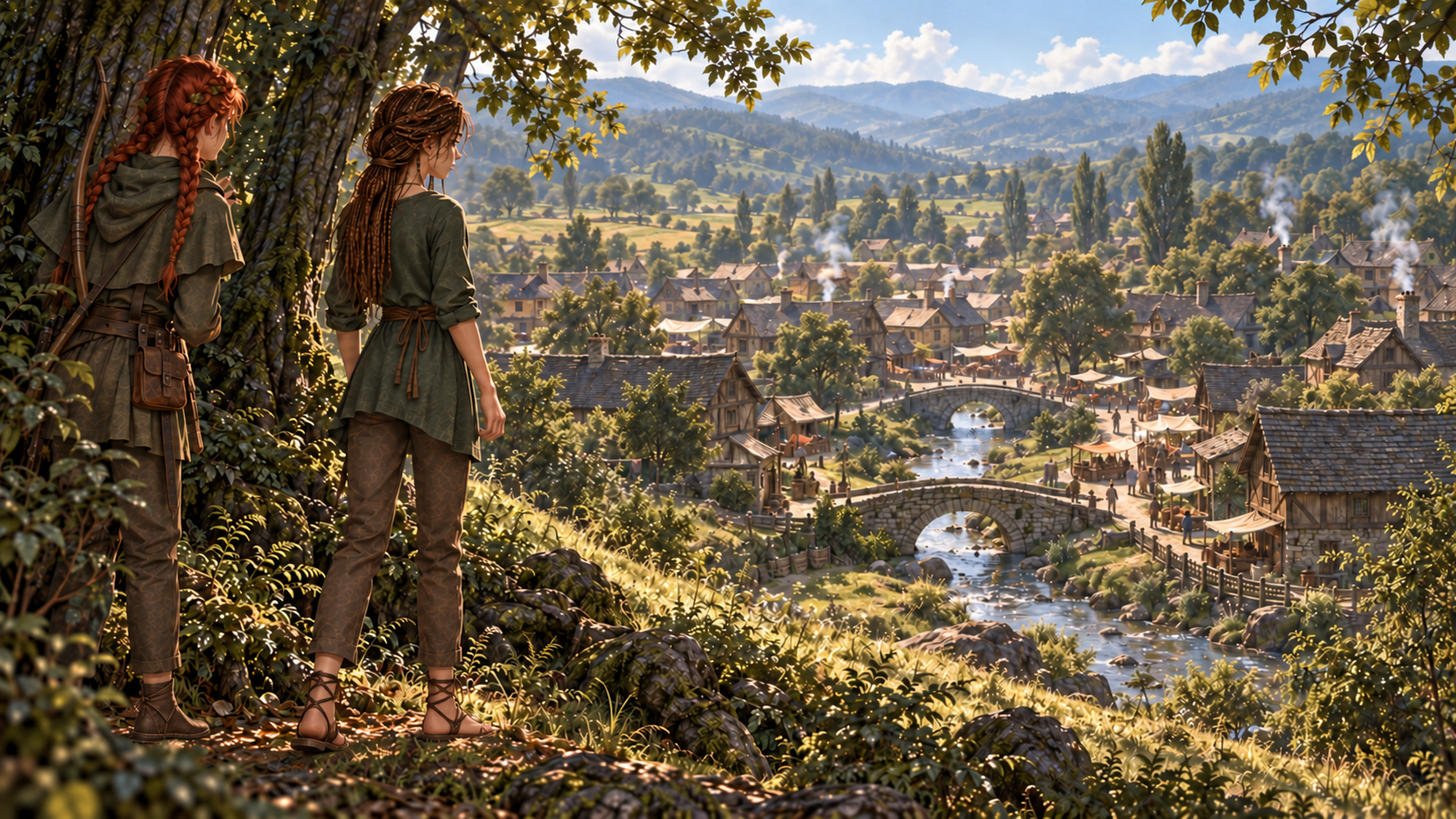
Below, at the foot of a gentle slope, lay a town. A stream divided it in two, winding out of Tishar like a silver ribbon, carrying two stone bridges. Roofs lined its banks: low wooden roofs with smoking chimneys. The wind brought V the sound of the town: a distant hammer, an animal lowing, and underneath, the hum that bound it all together; the hum of a crowd. V knew that hum from shopping centres. Universal, then.
V took two steps out of the forest into the sun and stopped. The redhead hadn’t moved. “You’re not coming,” V said. It was not a question.
Sirel did not answer. From the bag on her shoulder, she took a small leather pouch and held it out. V opened it: dried leaves, dark green, sharp-smelling. The smell of the bitter stuff Sirel had made her drink when she had the fever.
“Trade,” said Sirel.
“Am I supposed to… sell these? How much can they be worth?”
But Sirel had already turned away. No goodbye, no wave, no words. The way she had arrived. Three steps and the forest’s shadows took her, leaving V alone in the sun, a pouch of leaves in her hand.
“All right,” she said to the town. “Just you and me.”
Up close, Sidra was noisier and smellier than it had looked from a distance.
The smell came first: fresh bread, wet animals, smoke, and beneath it all, a sharp, unfamiliar spice, somewhere between cinnamon and burnt sugar. Then sound: hoofbeats, women bargaining, the rhythmic strike of a hammer somewhere, the steady murmur of the stream beneath the bridge. Then colours: awnings stretched along the main street. Faded red, mustard yellow, sun-bleached blue, with stalls beneath them.
No one looked at V.
V was not ready for that. For two days she had rehearsed this moment in her head: the crowd noticing the strange girl, the market falling silent, heads turning.
None of it happened.
A girl in muddy clothes and leather foot-wraps, carrying a stick, was just another drop in the market crowd. Because the crowd itself was already strange.
V realised that at the third stall: the seller had too many fingers. She didn’t count. She was trying not to stare, but there were definitely too many.
In front of the fifth stall sat a figure in a fur cloak, taller than V even sitting down, the fabric of their hood stretched over two protrusions that might have been horns.
No one looked at either of them.
So apparently, the bar for “strange” around here was set far higher than anything V had to offer.
Shelf for things to think about later, V told herself.
The shelf was filling up.
Seeing Druvil at a fruit stall almost made V happy. Pinkish skin, green tips, it was practically a familiar face.
A little farther on, she smelled something that made her forget all about dragon pears before she even saw it. The smell of bread made her head spin. The stallholder was a broad-faced woman with flour all over her arms, and she caught V looking.
“Fresh in. Three for two coppers.”
Copper. So money was copper here. Presumably there was silver and gold too. V had no copper coins; V had leaves.
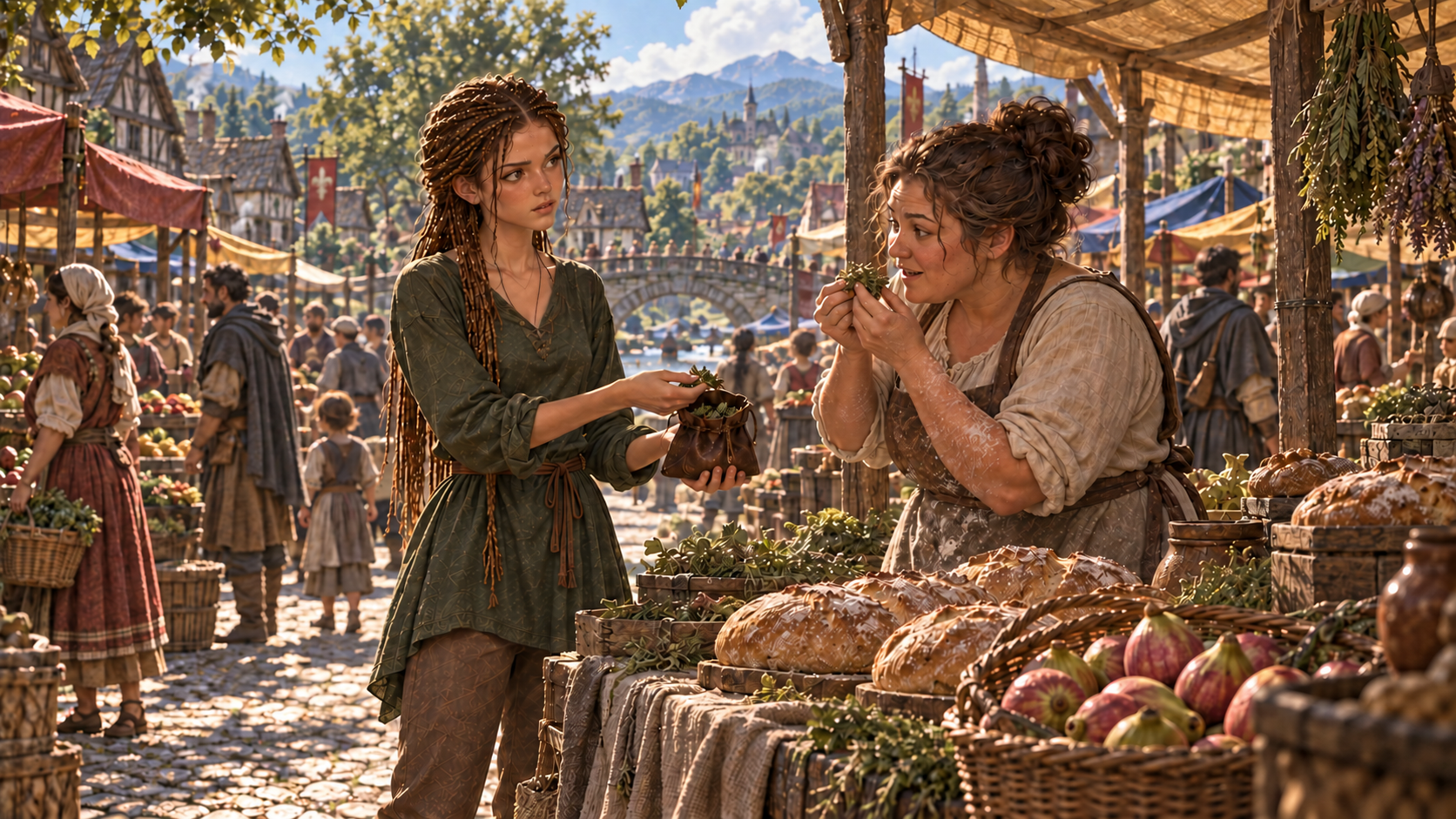
She opened the pouch and held it out, watching the woman’s face change. The woman smelled the leaves, raised her eyebrows, then looked at V again.
This time, really looked.
“Where did you get this?”
“From a… friend.”
The word surprised V as it left her mouth.
Friend.
The label had stuck itself on.
The woman kept the bargaining brief: half the leaves for a basket of fruit, two loaves of bread and, when V asked, one piece of information.
“This is Klessar, girl. Comes from Tishar. Nobody goes into the part of the forest where it grows. That’s why it’s valuable.”
A pause. A look.
“Who’s this friend of yours?”
“No one,” V said, too quickly.
Something flickered in the woman’s eyes, but she did not press.
V learned three things that afternoon.
One: everyone here spoke her language, and nobody found that strange. The shelf creaked.
Two: money was copper, and without any, V’s world shrank fast.
Three: questions were dangerous.
“Is there a bigger city nearby?” was normal. Yavzin was bigger, she learned.
“What country is this?” raised eyebrows. Looks became strange.
The lake in Tishar was called Lake Nevallar, and nobody went there.
“Why?”
That question made the blacksmith’s apprentice, slimier than Brian and leaning so close he was practically about to fall into her mouth, put down his tongs and stare at her for a long moment.
“What business have you got out there?”
Something in his tone sent V backing into the market.
That evening, while wondering where she was going to sleep, she found work.
If you could call it work.
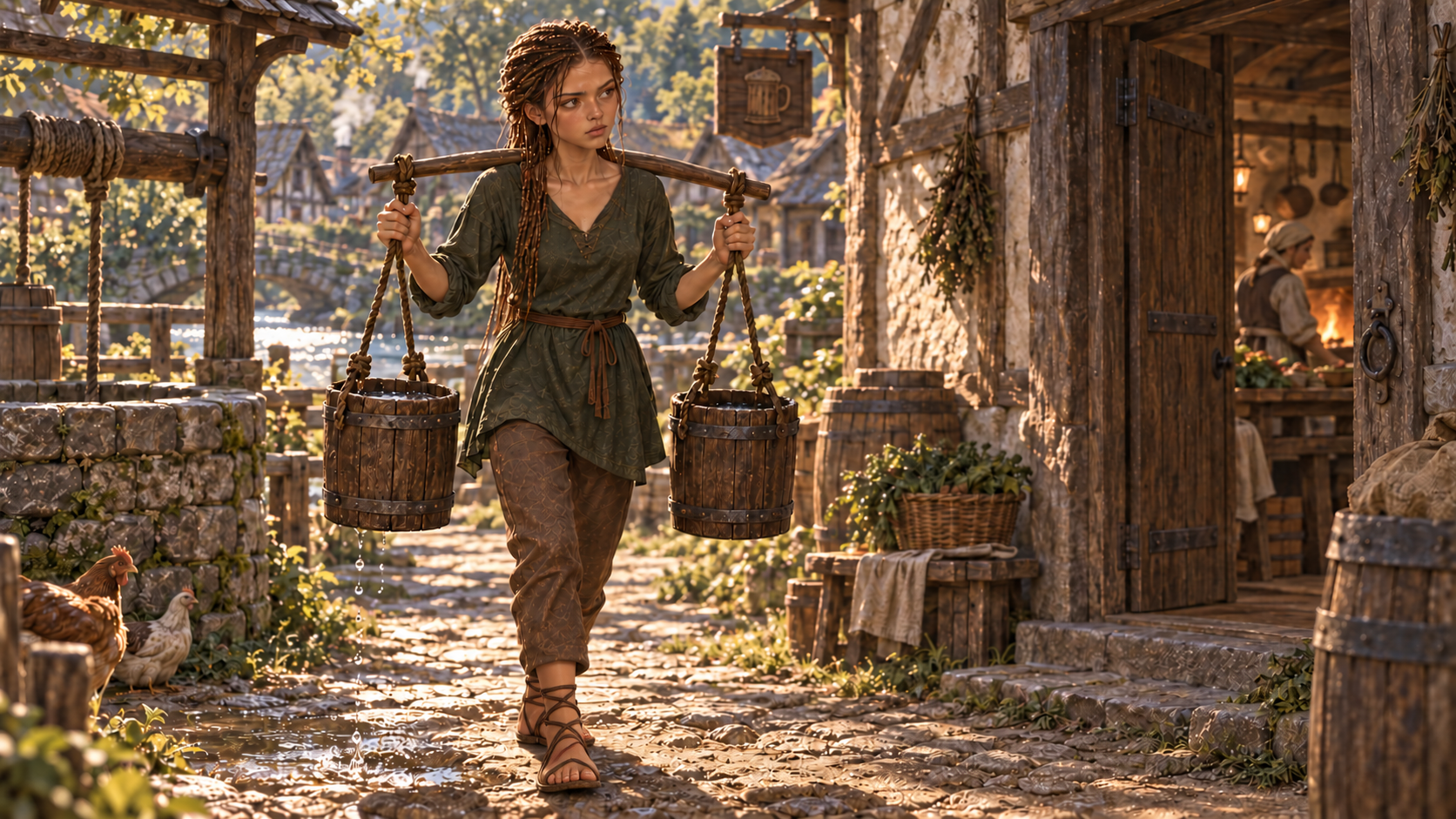
At the back door of the inn beside the stream, a woman with arms as thick as V’s legs was looking for someone to carry water from the well to the kitchen. V had barely said, “I’ll do it,” before two buckets were hanging from her shoulders.
For two hours, V carried water.
The buckets found muscles her swimming training had never met and introduced themselves one by one.
In return, she got a bowl of broth, a slice of bread and a corner of the inn’s hayloft.
V laughed to herself as she drank the broth. Her first-ever wages, and at sixteen she was going to be sleeping in a hayloft.
One for the star report: today I earned soup by carrying water. Coach Chris would be proud. Or have a heart attack. But if Mum saw where I’m sleeping, she’d never nag me about tidying my room again.
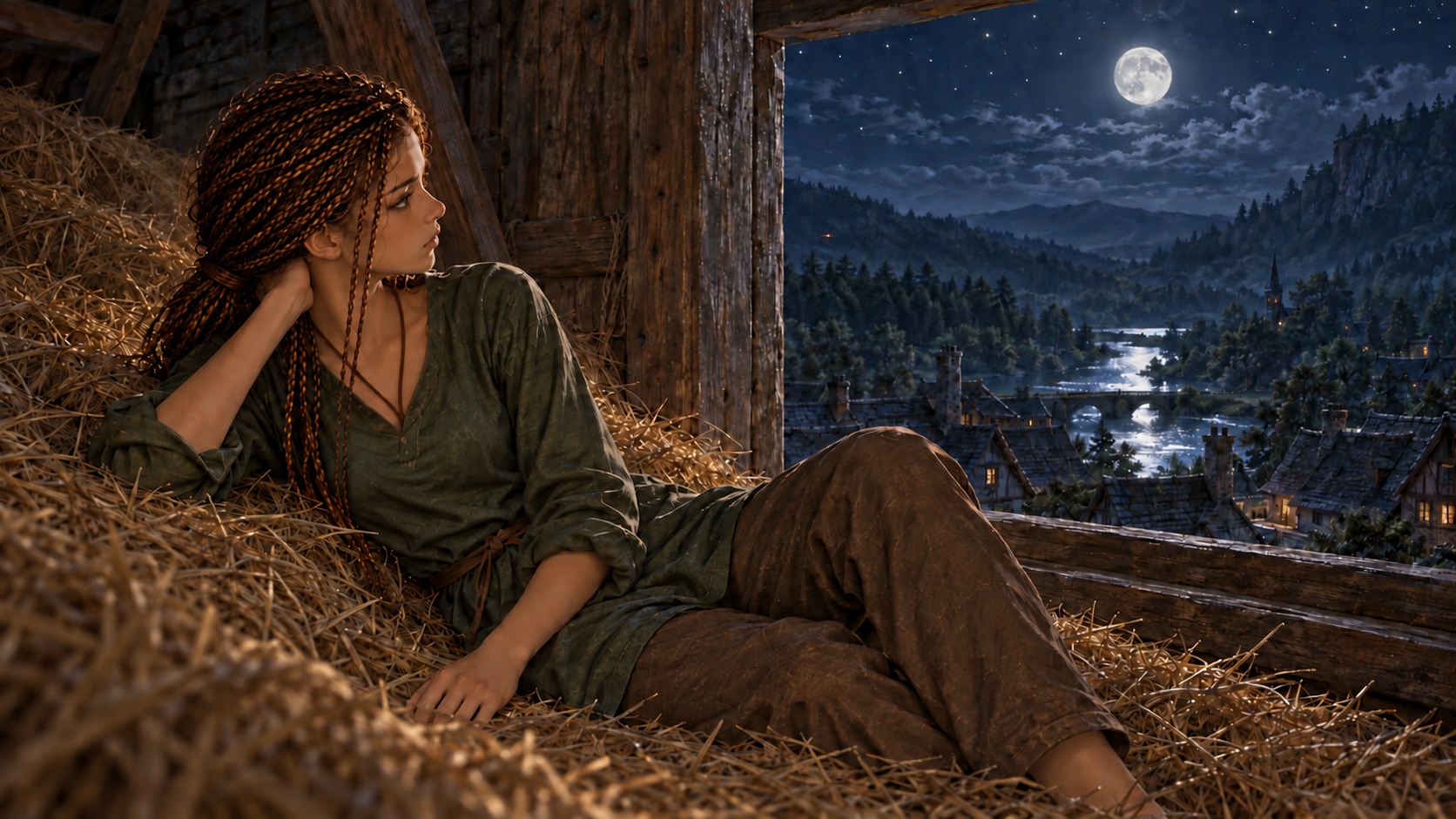
That night, in the hayloft, before sleep came, V looked out through the window opening. The town was asleep; the stream ran silver in the moonlight.
And across the water, where the rooftops ended, in the black wall of the forest…
for a moment, just a moment…
a glint of red.
V blinked.
Dark was dark again.
The red-haired goddess?
Can’t be hair. Not from this far away. My eyes playing tricks. Or maybe I just want to see it.
The shelf refused it.
V fell asleep before she could put the glint away.
The second day began with her necklace and ended with her necklace.

That morning, as she washed her face at the well, the neckline of her top had slipped, exposing the stone to the sun. V did not notice; someone else did. Across the well, a broad-shouldered man in a leather apron, some kind of trader or merchant, V couldn’t tell, broke off in mid-conversation to look at the stone on her chest.
He looked for a long time.
Then he smiled, and V disliked the smile enough to file it away.
The day went much like the day before: water, buckets, soup. With one difference: V now knew she was being watched. She knew the feeling from Tishar; the prickling at the back of her neck, no one there when she turned. Except that in the forest, the feeling had eventually turned into “fruit and fire.”
She didn’t know what it would turn into here.
Something inside her said nothing good.
Late that afternoon, the woman from the inn sent her downstream to the washing stones.
“Take this bundle to Verda. Go under the bridge. Come straight back.”
Beneath the bridge lay the first shadow of evening. The stream widened here, its far bank meeting Tishar, forming a still eye around the washing stones.
But Verda was not there.
No one was.
V had just decided to turn back when she saw that her way was blocked.
There were three of them.
V had not seen where they came from; one from the shadow beneath the bridge, one from between the freshly washed sheets, one from behind.
There were no birds here.
Nothing fell silent to warn her.
The one in front was the man from the well.
He was still smiling.
“Your necklace,” he said. “Pretty.”
His tone was conversational, and that was more frightening than if he had shouted.
“Where did you get it?”
The man took another step. V backed away without meaning to, but her back was already against the bridge’s stone pier.
The man saw that.
His smile did not change.
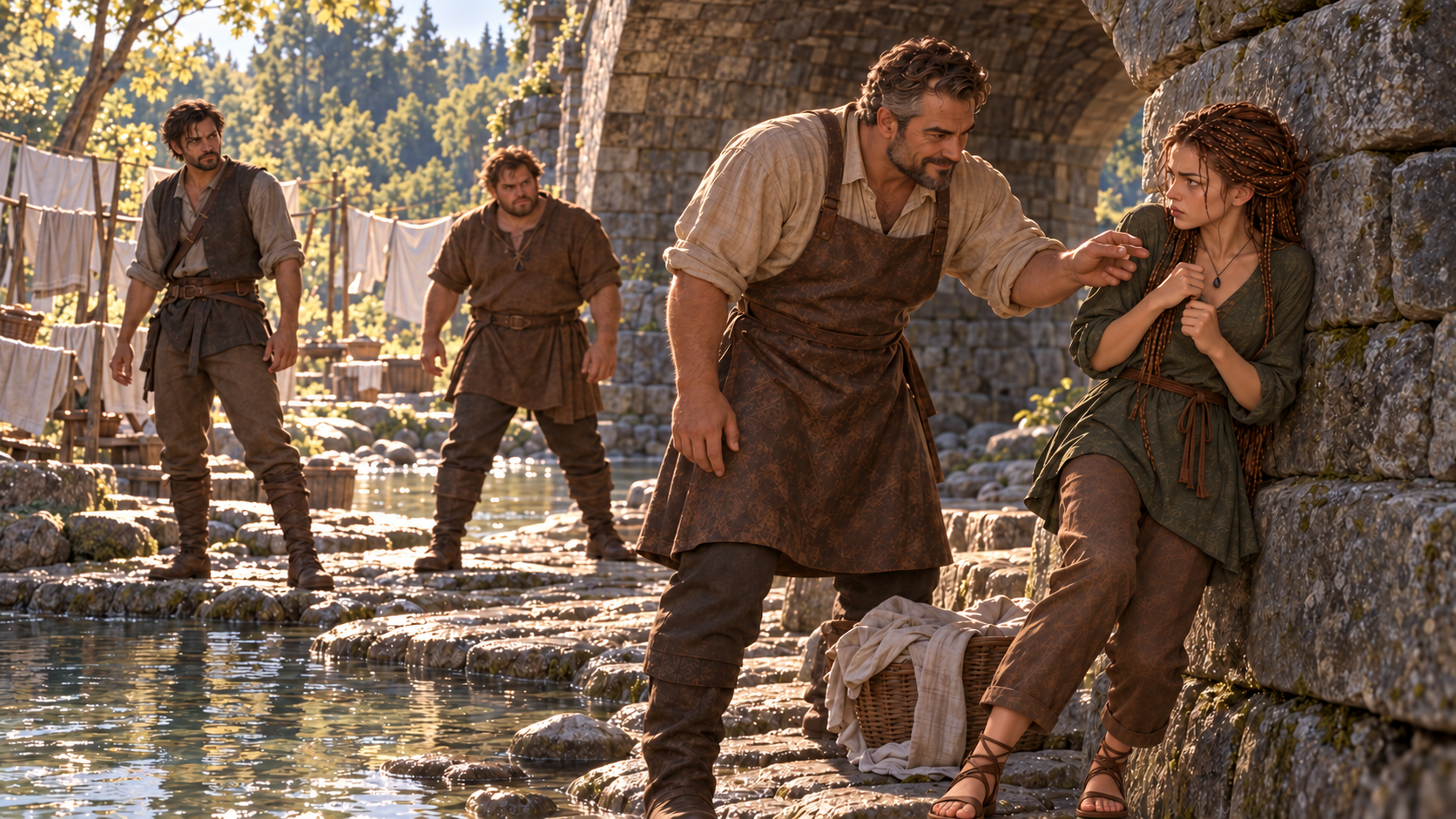
He reached for the necklace.
V drew her head back and pressed her shoulder against the stone. His fingers missed the stone by a handspan.
“Don’t touch it.”
His eyes lifted briefly to her face, then dropped back to the necklace.
“It’s not for sale,” V said.
Keeping her voice steady took more effort than any race she had ever swum.
“I didn’t say I was going to buy it.”
He reached again.
This time V’s hand got there first. She closed her fingers around the stone and pressed her fist to her chest.
That was when the slap came.
The blow snapped her head sideways. Before she had even understood what had happened, there was a metallic taste in her mouth and a high ringing in her ear.
The pain in her cheek was trying to wake something inside her.
Something strange was trying to rise.
It wasn’t anger; anger was too simple.
Her hand was still over the necklace.
The man’s hand was faster than V had expected. Right after the slap, his fingers found the neckline of her top, caught the cord beneath her fist and pulled.
The cord cut into her neck.
He pulled again.
It was about to snap.
Before V had even processed the pain in her cheek, another joined it at her neck.
And a door that had been locked for sixteen years came off its hinges.
The world muted itself.
By the time the tingling had climbed from her toes to the sore spot on her neck, the blacksmith’s hammer had gone silent. So had the hum.
The stream had not.
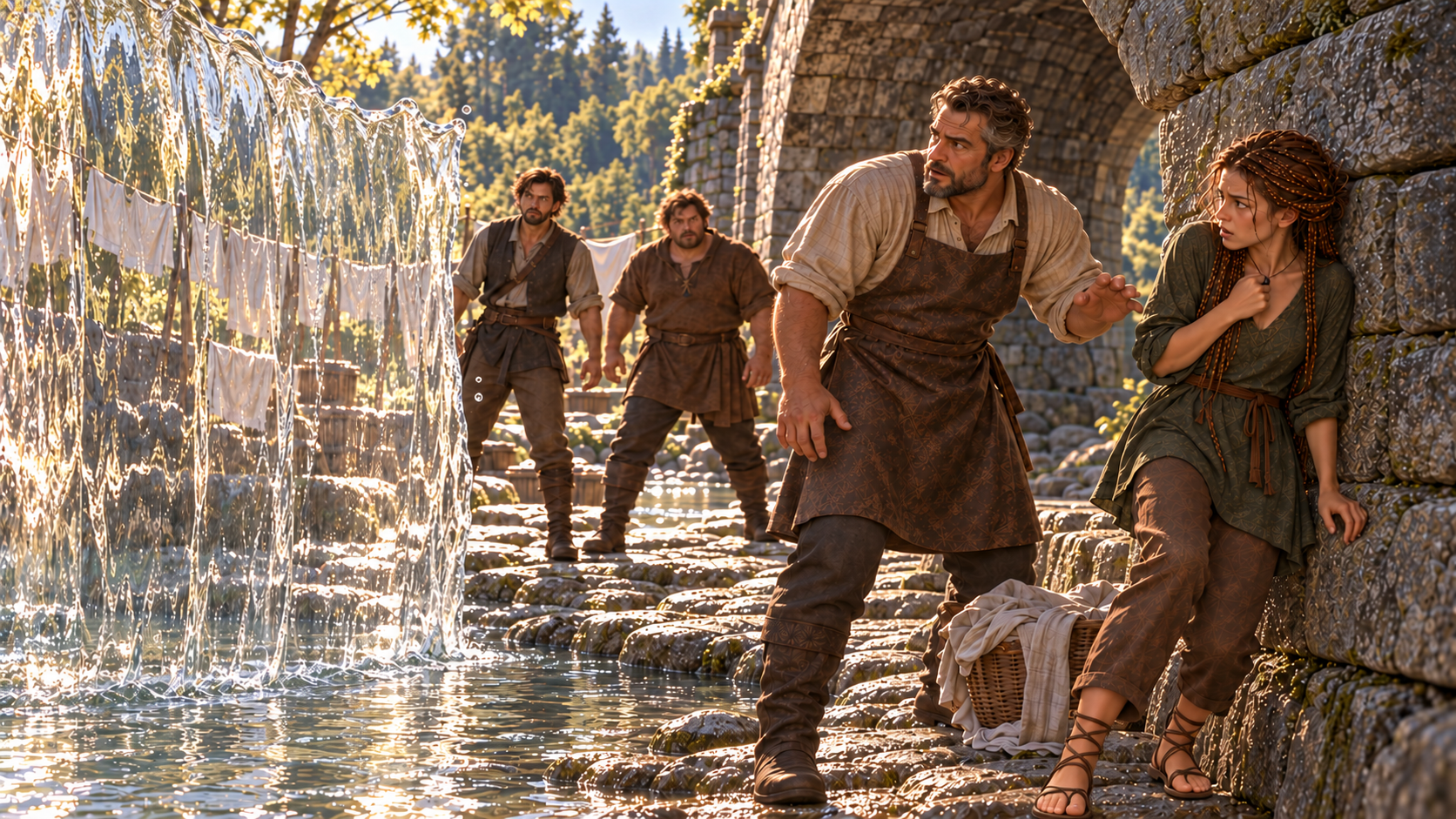
The stream stood up.
V saw it. Everyone saw it: the still water around the washing stones rose from its bed like a curtain, stood upright in the air for one impossible second, then closed around the man holding her necklace like an embrace.
The man did not fall.
He did not even get wet.
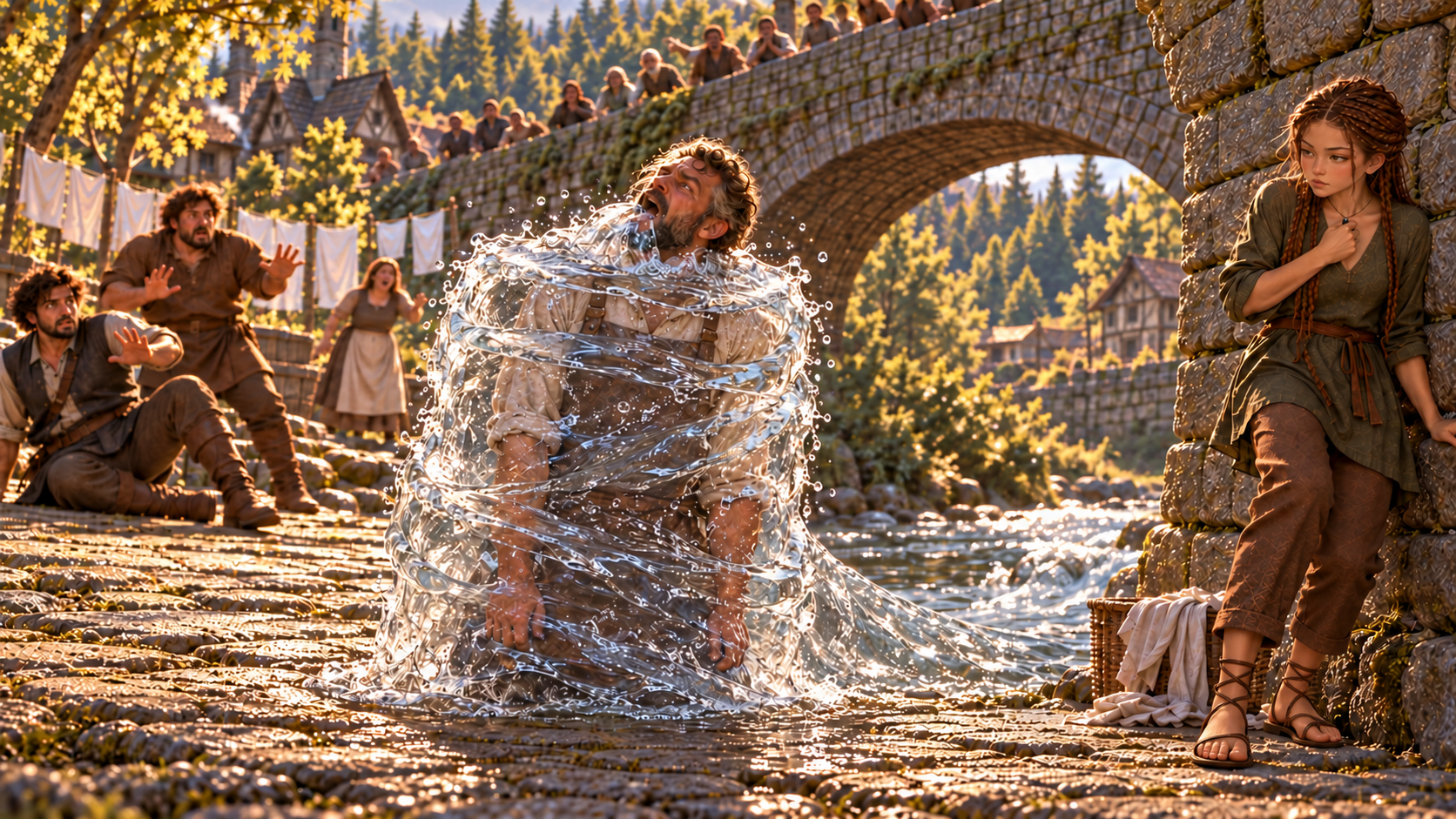
The water did not pour over him. It flowed into him. Through his mouth, his nose, through the opening of a scream that made no sound.
The man sank to his knees, his hands found his throat, his eyes found V, and V could not move. She ordered her legs to move; they answered from somewhere with no reception.
On dry stones, three paces from the stream, a man was drowning, and every cell in V’s body knew that the thing doing it was her.
Sound came back to the world with the scream of the innkeeper, watching from a distance.
“NYVRA!”
It was a word V did not know and everyone around her did.
The effect was immediate and absolute.
The other two men leapt back. One tripped and fell; instead of getting up, he scrambled backwards on his hands. The other threw both hands into the air.
“We didn’t know,” he said. “We didn’t know, I swear, forgi…”
V could no longer hear them.
Footsteps multiplied on the bridge above. Most of the people up there had not seen what had happened; all they had was the scream, the word Nyvra, and the man lying motionless on the dry stones.
Someone pointed down.
Someone else shouted.
“She killed him!”
“There!”
The word was spreading through the crowd, but what it meant did not reach everyone at the same speed.
Nyvra. Nyvra. Nyvra.
The man on the ground was no longer moving. A thin trickle of water ran from his mouth onto the dry stones.
Only one thought came to V.
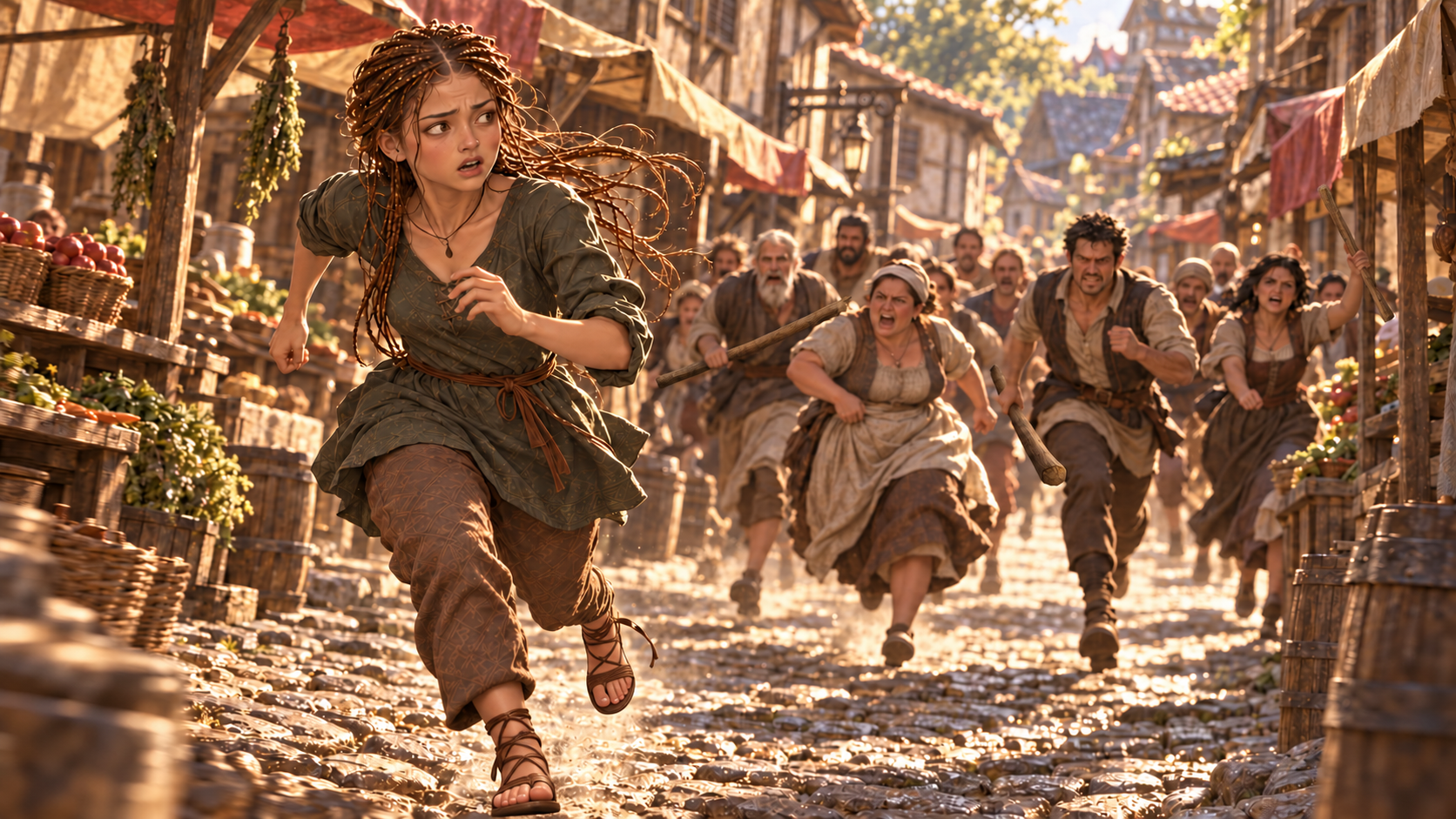
Run.
She ran without knowing where she was going.
Under the bridge. Along the stream. Someone’s garden. A fence. The other side.
The first sounds behind her were fear.
The ones after that weren’t.
Those who hadn’t seen what happened pushed forward; those who had stayed back. From somewhere at the rear of the crowd, someone shouted, “Catch her!” Another voice echoed it. A few people took off after her, and a few more followed without quite knowing why they were running.
The fear hadn’t disappeared. It had only shifted its place in the crowd.
“There! She went that way!”
Something whistled past her ear.
This was not one of Sirel’s stones. This would hurt if it hit, and it would not apologise.

Thankful for every year she had spent training, V ran uphill towards the forest, towards the black wall. Her lungs burned, one of her leather foot-wraps had come undone, and the stick was long gone.
Twenty paces from the tree line, the hoofbeats behind her told her a rider was closing fast. When she felt the horse breathing almost at her back, panic tangled her feet, or she caught on something, and she went down hard.
The rider shouted without even dismounting.
“Got her!”
The shout broke off into a muffled cry of pain.

V twisted around and saw him clutch his throat as he toppled from the horse. A heartbeat later, something cut through the air with a sharp sound, and the rider behind him went down too.
V didn’t understand what was happening.
She only knew she had to run into the dark.
She scrambled to her feet and ran again, towards the place those things had come from.
The shadows of the trees swallowed her.
Two steps in, a hand, a slim, strong hand, caught her arm and yanked her sideways, into the darkness behind a tree pressed against a rock.
V’s scream died under a palm before it was born.
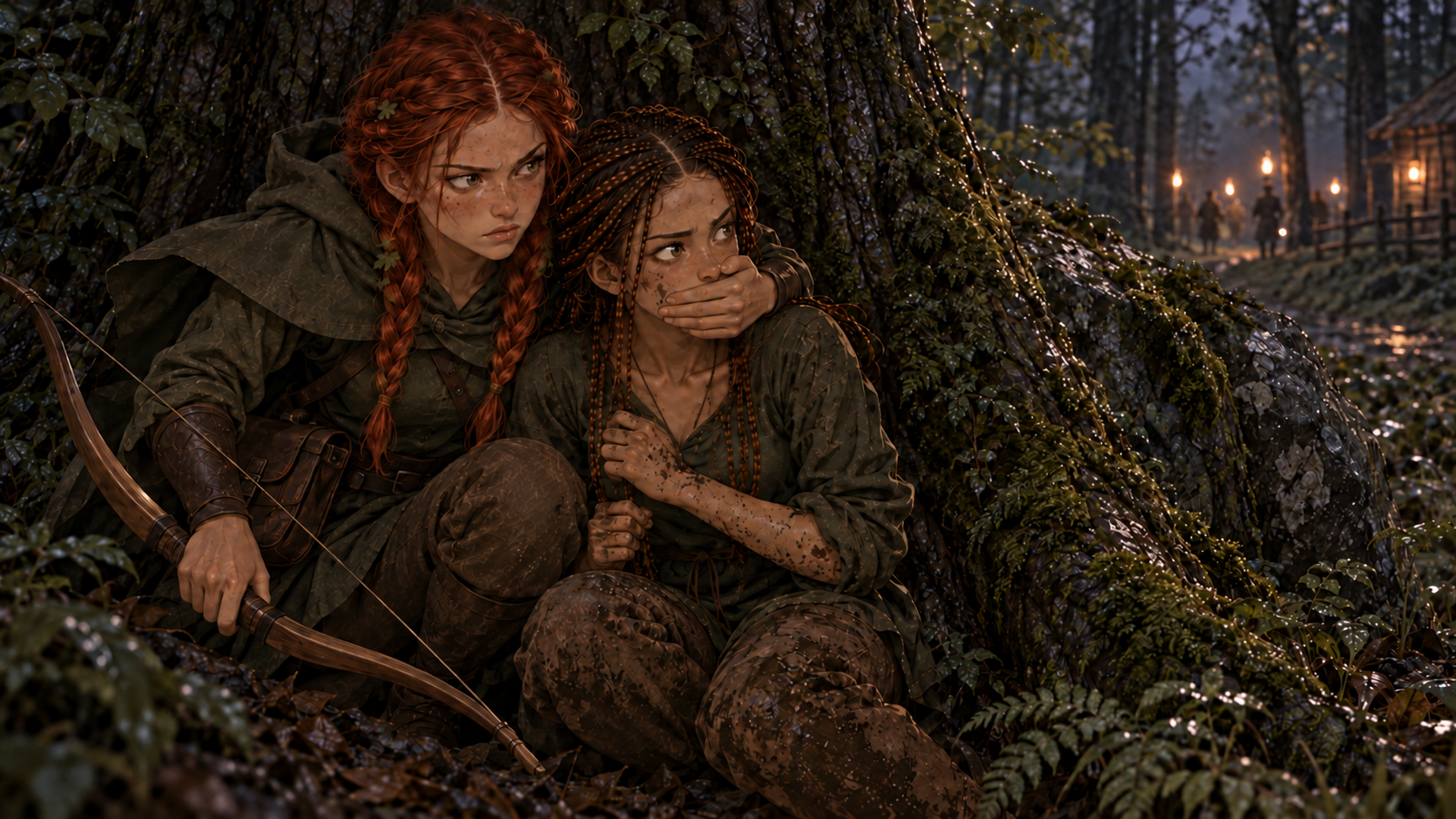
Red hair.
Green eyes.
Brows drawn tight.
Not the look of someone concentrating on doing a job properly this time.
The look of someone angry.
There was a bow in Sirel’s other hand.
Outside, along the edge of the forest, torches were gathering.
None came in.
Voices shouted. Cursed.
Then, one by one, they began to retreat.
Sirel took her hand from V’s mouth.
For a long time, she said nothing.
She looked at V. At the stream water on her clothes. At her shaking hands. At the red mark the cord had left around her neck.
And at the stone.
Still there.
Still cold.
Still hanging from her neck.
“You’re not human,” Sirel said.
It wasn’t an accusation.
It wasn’t anger either.
A category was being corrected. One label peeled off, another stuck in its place.
V knew the process.
“I…” V’s voice broke. “I didn’t mean to kill him. The water… it did it by itself. I didn’t mean to…”
“I know.”
The most human comfort Sirel had offered her yet.
Then she stood, looked deeper into the forest, directly away from the torches, slung the bow across her back…
and this time, it wasn’t a question.
“Come.”